








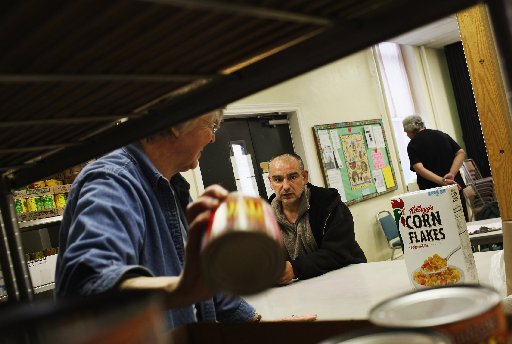
A few mornings each week the Rev. Earl Kooperkamp stands watch over the doors of the Church of The Good Shepherd as dozens of down-on-their-luck Vermonters gather outside the little church. Most come looking for a hot breakfast of egg casserole or a steaming bowl of oatmeal or shelter from the cold, bitter morning air. Some are homeless or disabled. Others are unemployed or seniors on limited incomes.
“I’m grateful to God that we have so many good people in the congregation to help out and volunteer, but I’m angry we can’t as a nation work out a better way to make sure the most vulnerable in society aren’t forgotten,” Kooperkamp said on Tuesday afternoon, not long after the church served its last breakfast of the day.
“They are almost literally pushed to the side. People are getting sicker, people are getting poorer, and ultimately it really becomes a matter of life and death.”
Like countless thousands of churches, synagogues, mosques and other faith communities across the country, Kooperkamp’s church operates as a safety net for the least of us, filling the gaps where public assistance ends and good will begins.
But with budget talks in Washington dragging slowly, dangerously close to the so-called Fiscal Cliff—the drop-dead deadline for a deal that would trigger just over a trillion dollars in automatic funding cuts to programs that would include those that feed and house the poor—religious organizations and clergy are praying for a resolution that spares the huddled masses they collectively serve.
Leaders in the religious community say that behind the cold, hard numbers and the ubiquity of the catchy phrase coined for the country’s looming fiscal Armageddon are real people with real needs.
“It’s really extraordinary that the two political parties don’t talk much about poor people,” said the Rev. David Beckmann, president of Bread for the World, a collective of mostly Christian organizations that have lobbied Congress and the White House for policies that lessen hunger and poverty. “The Republican Party generally doesn’t. They have other priorities, certainly other than protecting programs for poor people.”
And President Obama, Beckmann said, has done a good job protecting certain programs, “but he doesn’t like to use the word poverty, so he calls them, ‘people who want to be middle-class.”
But the Good Book, Beckmann noted, is clear: “God does talk about poor people… The New Testament says a nation will be judged by whether or not we take care of poor people and how we treat people in prison.”
If no deal is reached by Dec. 31, analysts expect as much as $54.7 billion in cuts to programs like the Supplemental Nutrition Assistance Program, known as SNAP, which gives millions of poor families access to food stamps.
Democrats and Republicans have offered deep cuts to SNAP, the former offering up $4 billion in cuts, the latter a whopping $16 billion. There would be cuts to Homeless Assistance Grants, the Low Income Home Energy Assistance Program and educational programs for poor children and poor children with special needs.
Also on the table is Medicaid; the mammoth federal health insurance program for the poor could be cut by $11 billion under sequestration.
“A lot of people are unemployed and hungry. This is a terrible time to cut things like healthcare for people who can’t afford to go to the hospital or cut food assistance to people who rely on it,” Beckmann said.
The Rev. Earl D. Trent of the Florida Avenue Baptist Church in Washington, D.C., said churches do as much as they can with the limited resources they have, but helping society’s most vulnerable needs to be a joint effort between the government and the governed.
“We know that if you’re looking at the faith community as a safety net, we really don’t have the capacity,” Trent said Tuesday afternoon. “We’re looking at what we can do but we’re stretched. The poor and the working poor people who have jobs but who are struggling to make ends meet are barely making it. I’m concerned that they will be pushed off the cliff.”
Trent said his church like many others in his community have been hard pressed for resources to help the needy. The weekly feeding program that regularly served dozens of poor families has had to shutter its doors. Resources were slim and they simply didn’t have the manpower to maintain it. “I’ve always said to my congregation and to others, policy determines who eats, who gets a slice of the pie, who gets the crumbs and who gets nothing,” Trent said. “Policy has a direct impact on the wellbeing of people. It goes hand in hand.” A number of large religious organizations, including the U.S. Conference of Catholic Bishops, the Christian Methodist Episcopal Church, American Jewish World Service and the Islamic Society of North America, joined Bread of the World recently to form a so-called “Circle of Protection” campaign to urge Congress to protect programs that help the poor. The groups encourage church members to write and call their local member of Congress, to educate friends and congregants on current budget issues and to raise their voices in defense of the hungry. “The church loves to preach about Jesus, but do we have the courage to preach what Jesus preached?” the Rev. Otis Moss III, Sr. Pastor of Trinity United Church of Christ in Chicago, wrote in a letter endorsing the campaign. “Bread for the World has courageously called upon people of faith to ‘comfort the afflicted and afflict the comfortable’ with the 2012 legislative campaign.” The mandate, wrote Moss, who happens to be the minister at President Obama’s former church, “as people of faith is to create a circle of protection’ for the poor through advocacy rooted in love and justice.” On Tuesday morning as the crowd at the Church of the Good Shepherd died dow sain, Rev. Kooperkamp stood a moment and thought about all of the good that needs to be done, and how the pain, hurt and work will likely be amplified if Congress cuts funding to programs so many rely on. Koopekamp spent more than a decade working in hard-scrabble Harlem communities. But even in the mountains of Vermont, where fresh air and maple syrup flow freely, there are hard times. “There is a fair amount of anxiety and outright fear,” Kooperkamp said. “For many, everyday looks like a cliff. They’re already at the bottom, saying, I’ve already crashed and burned, now how much more crashing and burning can I do.”
Trymaine Lee
Trymaine Lee is an NBC News correspondent. Recommended


