








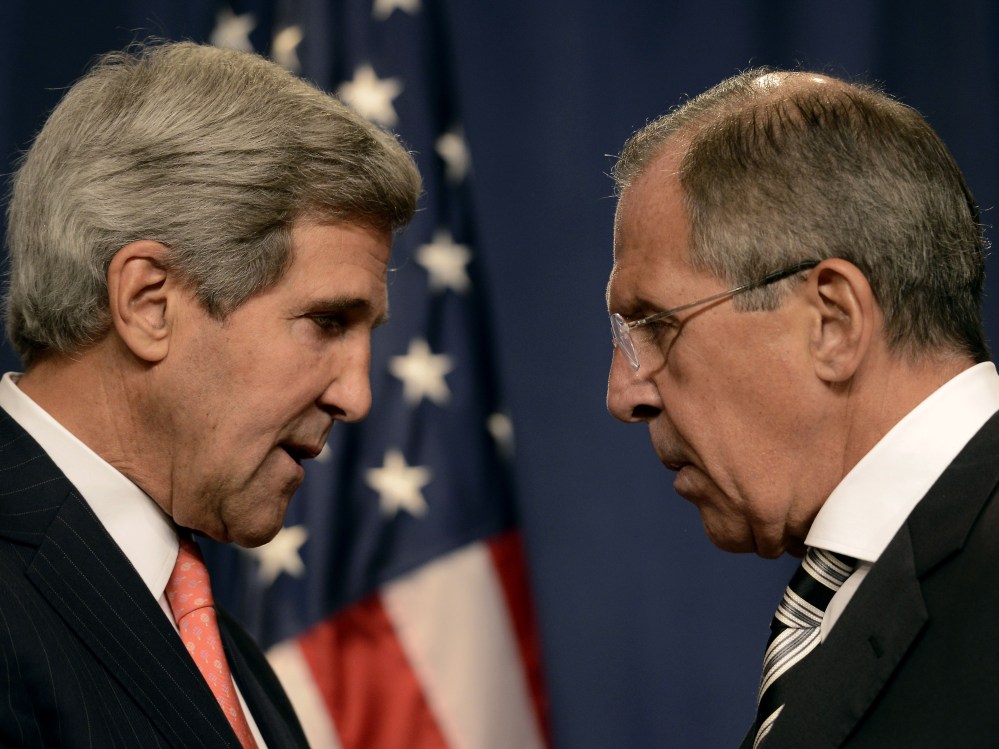
UPDATED AT 11:55 a.m. – Secretary of State John Kerry Saturday said the U.S. and Russia had reached a deal outlining how the international community plans to secure and destroy Syria’s chemical weapons arsenal by mid-2014.
Syria must hand over a “comprehensive listing” of its chemical weapons stockpiles within a week to ensure their elimination in the “soonest and safest manner,” Kerry said during a press conference Saturday. The Assad regime must also allow United Nations inspectors on the ground no later than November.
“There can be no games, no room for avoidance, or anything less than full compliance by the Assad regime,” Kerry said.
If Syria fails to comply, the Assad regime could then face punitive action from the UN Security Council, Kerry added.
The U.S. secretary of state ended three days of talks with his Russian counterpart, Sergei Lavrov, in Geneva Saturday to outline the scope of Syria’s chemical weapon draw down. While pointing out the many differences that separate the U.S. from Russia, an ally to Syria, Kerry said the two countries agreed on the size of Syria’s stockpiles.
“We have no illusions about the challenges ahead,” Kerry said.
The White House released a statement Saturday, calling the talks a “concrete step forward” on both nation’s goals. President Obama said the U.S. will continue to work with Russia, the United Kingdom, France and the United Nations in ensuring that Syria makes good on its promises. “And if diplomacy fails, the United States remains prepared to act,” Obama said in the statement.
Talks of diplomacy broke through in recent days after the Obama administration lobbied Congress, the international community, and the American people for over a week to support a military strike against Syria. However, after what appeared to be off-the-cuff remarks from Kerry suggesting that the Assad regime should simply hand over its chemical arsenal to the international community, Russia agreed to set a political solution into motion.
In his weekly address recorded prior to the deal in Geneva, President Obama argued that the threat of U.S. military action triggered the diplomacy talks.
“Since this plan emerged only with a credible threat of U.S. military action, we will maintain our military posture in the region to keep the pressure on the Assad regime,” Obama said in his weekly address. Pentagon officials on Saturday reiterated that the administration will continue to maintain a readied stance on military force. “We haven’t made any changes to our force posture to this point,” Pentagon Press Secretary George Little told NBC News. “It’s important that the Assad regime lives up to its obligations under the framework agreement.” Tennessee Republican Sen. Bob Corker, ranking member of the Foreign Relations Committee, said he still supported a diplomatic solution to the crisis in Syria, but “absent the threat of force, it’s unclear to me how Syrian compliance will be possible under the terms of any agreement.” U.S. officials accuse the Assad regime of carrying out a chemical weapons attack on its own people Aug. 21, killing over 1,400 people, including more than 400 children. The international community said it would await UN inspectors’ preliminary reports from the region before agreeing to take military action forward. UN Secretary-General Ban Ki-moon was confident Friday that his agency’s report will confirm that chemical weapons were in fact used in the Aug. 21 attack. The report is expected Monday.
Amanda Sakuma Recommended


