








The nation’s new insurance exchange beat all expectations during the enrollment season that ended last month, but some states are still struggling mightily to run their own clearinghouses for health coverage. One of them has now reached the breaking point.
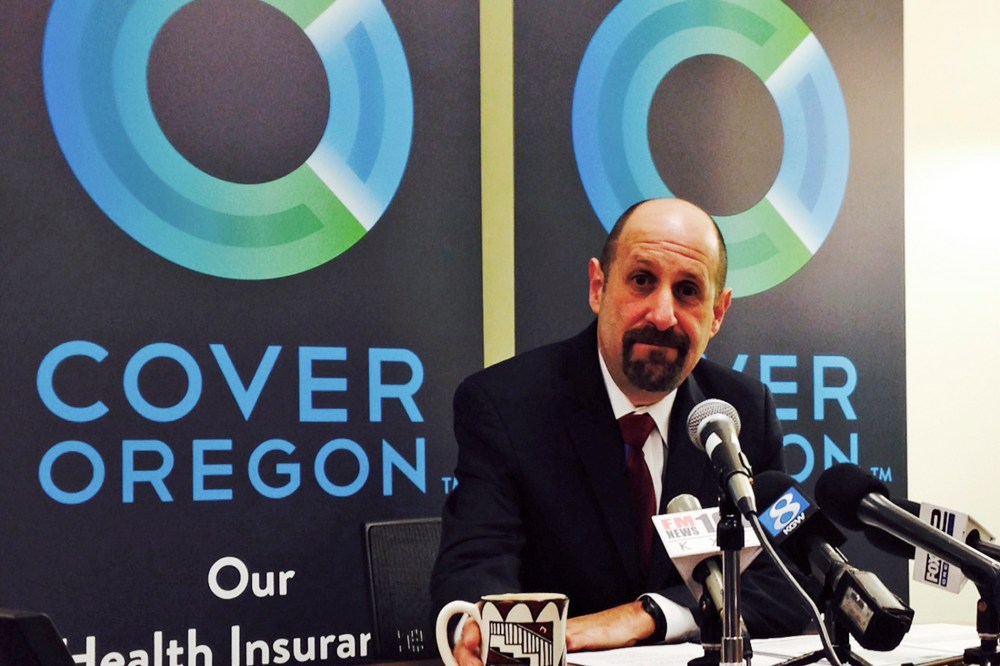
On Friday, the board of Cover Oregon voted to shut down the state’s troubled enrollment site and let the federal government manage Obamacare signups in Oregon, according to the Associated Press.
Despite Gov. John Kitzhaber’s enthusiastic support—and $300 million in federal assistance—Cover Oregon has placed fewer than 64,000 residents in private health plans since last October, and most have had to submit applications on paper.

Friday’s decision comes as no surprise. Independent experts recently advised the state to fold its site. Auditors have publicly lambasted its project managers for ignoring technical problems and the state is feuding with its website developer (Oracle) over payment. The Washington Post reported Thursday that federal and Oregon officials had already agreed privately that “closing down the system is the best path to rescue the state marketplace.”
Aaron Albright, a spokesman for the Center for Medicare & Medicaid Services (CMS), said that the agency is “working with Oregon to ensure that all Oregonians have access to quality, affordable health coverage in 2015.” The federally run marketplace, healthcare.gov, was designed to be “scalable,” meaning it can add additional states as needed.
Consultants estimate that folding Cover Oregon into healthcare.gov will cost only $4 million to $6 million, whereas rebuilding the state-run site could cost 16 times that amount.
Oregon is the first state to ditch a homegrown enrollment site, but it may not be the last. While state-run exchanges have flourished in California, New York, Connecticut, Kentucky and Washington state, helping millions of consumers sign up for private health plans, Nevada, Maryland and Massachusetts have suffered problems similar to Oregon’s.
As signed into law four years ago, the Affordable Care Act encouraged all states to develop their own insurance marketplaces, each one tailored to its local environment. But only 14 states and the District of Columbia have attempted the feat. Most red states refused out of political spite, and many blue states deferred to avoid the vast technical challenges. Now that the federal exchange is functioning smoothly, and half of the self-starters are floundering, a unified national system is starting to look like a better idea. In a late-March analysis, CNBC found that the state-run exchanges varied wildly in cost efficiency. Hawaii Health Connector had enrolled just 5,700 people, at a cost of more than $35,000 per enrollee, while Covered California had signed up more than a million people for about $1,000 each. Those costs will diminish over time, as the newly built systems keep enrolling people, but the wide disparities themselves raise an obvious question. Given the difficulty of building one efficient health insurance exchange, why try to build 50 of them? Several states now face that question. The Post reported that officials from Maryland and Massachusetts will meet with CMS officials next week to discuss their own troubled exchanges. Maryland is seeking another $40 million to $50 million to replace the flawed technology it gambled on. But if Oregon’s cost estimates are any indication, moving Maryland into healthcare.gov may ultimately make more sense. Congressional Republicans have seized on the troubled state exchanges to impugn Obamacare in general, but their attacks have no bearing in most states. The launch of healthcare.gov proved that building an online marketplace is a moonshot. If some of the pioneering states can’t get there on their own, that well-tested site now offers a credible alternative.
Geoffrey Cowley Recommended


