








On this day 50 years ago, George Wallace defined his legacy with his “Stand in the Schoolhouse Door.”
The Alabama governor, who months earlier had famously said “segregation now, segregation tomorrow, segregation forever,” physically blocked African American students Vivian Malone and James Hood as they attempted to attend classes at the University of Alabama in Tuscaloosa.
A strong states’ rights advocate, Wallace stood in front of the door (surrounded by national news media) and announced his resolute opposition to the integration of the school. “I stand here today, as governor of this sovereign State, and refuse to willingly submit to illegal usurpation of power by the Central Government,” he said.
President John F. Kennedy responded by federalizing the Alabama National Guard and ordering 100 troops to escort the students into the campus. When the troops arrived, Wallace stepped down. Hood and Malone–whose future-brother-in-law Eric Holder became the nation’s first African-American attorney general–enrolled.
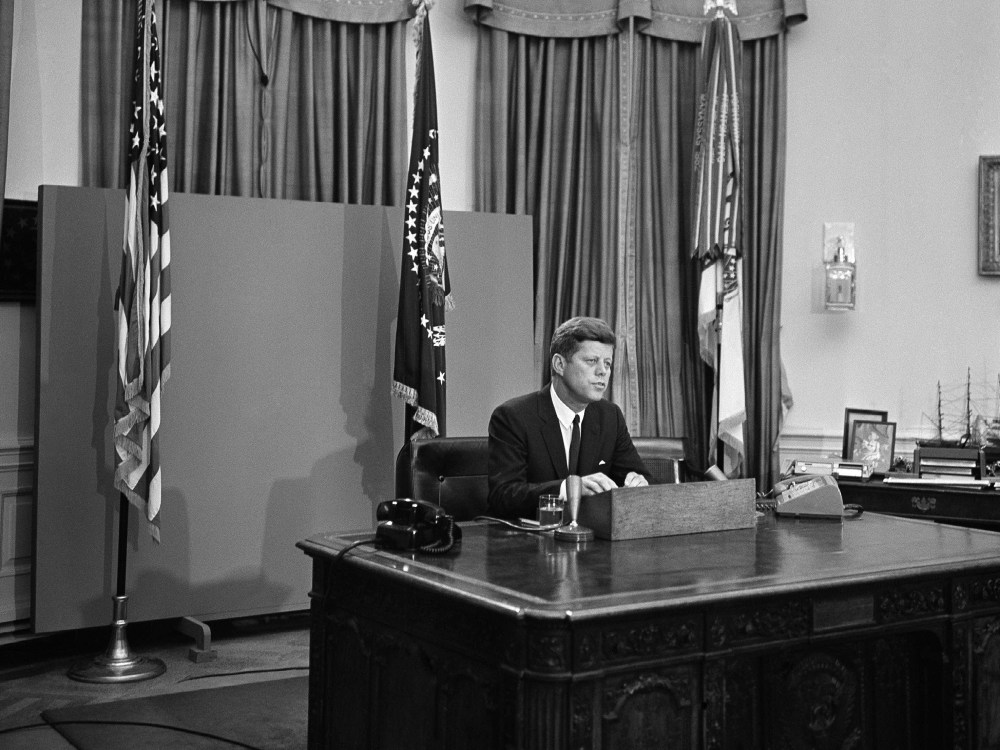
Wallace’s support for segregation inspired President John F. Kennedy to give an historic speech on civil rights, a moment seen by many historians as one of the turning points in the civil rights movement.
In his evening televised address to the nation, Kennedy quickly pivoted from the news of the day and Wallace’s segregationist tactics to make an emotional and reasoned plea for all Americans, regardless of color, to embrace the civil rights movement.
“The heart of the question is whether all Americans are to be afforded equal rights and equal opportunities, whether we are going to treat our fellow Americans as we want to be treated,” he said. “If an American, because his skin is dark, cannot eat lunch in a restaurant open to the public, if he cannot send his children to the best public school available, if he cannot vote for the public officials who will represent him, if, in short, he cannot enjoy the full and free life which all of us want, then who among us would be content to have the color of his skin changed and stand in his place?”
“One hundred years of delay have passed since President Lincoln freed the slaves, yet their heirs, their grandsons, are not fully free,” he continued. “They are not yet freed from the bonds of injustice. They are not yet freed from social and economic oppression. And this Nation, for all its hopes and all its boasts, will not be fully free until all its citizens are free.”
Kennedy outlined plans for federal legislation to help bring an end to segregation. But a few hours after Kennedy’s address, a white supremacist shot Medgar Evers outside his home in Jackson, Mississippi. Despite the opposition, Kennedy moved forward. Within a week of the address, he began working with Congress on civil rights legislation. Months later, after Kennedy’s assassination, then-President Lyndon Johnson picked up the civil rights cause, leading to the signing of the Civil Rights Act of 1964 and Voting Rights Act of 1965. Although Kennedy helped to create momentum for the civil rights movement, Wallace did not disappear from the spotlight. He challenged Johnson for the Democratic nomination and won significant voting blocks in states like Maryland and Wisconsin. Decades later, Wallace’s daughter Peggy Wallace Kennedy is devoted to “racial healing,” marching with Congressman John Lewis across the Edmund Pettus bridge and supporting Barack Obama for president. “There willbe no more schoolhouse door stands. There will be no more Edmund Pettus Bridge violence. There will be no more of that,” she told NPR in a recent interview. “We’ve come too far. We’ve got a long way to go, and I want to be part of that change. I hope and pray that my voice can help, just in some small way, to make that happen.”
Morgan Whitaker Recommended


