








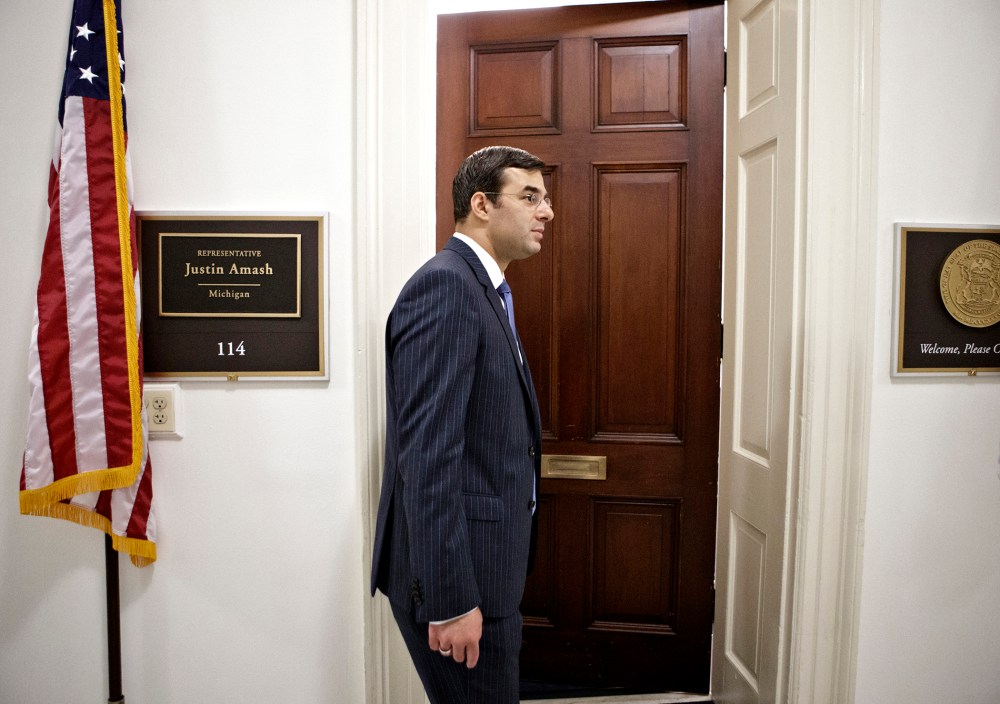
Nearly a month ago, Rep. Justin Amash (R-Mich.) read the Mueller report and came to an important conclusion: Donald Trump “engaged in impeachable conduct.” The Michigan Republican became the first member of his party — in either chamber — to call for the president’s impeachment.
Just two days later, the congressman’s ostensible allies in the House Freedom Caucus formally condemned Amash for reaching such a conclusion. According to Rep. Jim Jordan (R-Ohio), “every single person” in the right-wing group disagreed with Amash’s position.
Three weeks later, the Michigan Republican stepped down from the caucus he helped create.
Rep. Justin Amash quit the conservative House Freedom Caucus on Monday night, weeks after becoming the lone Republican to call for President Donald Trump’s impeachment.
The Michigan lawmaker told a CNN reporter that he has “the highest regard for them, and they’re my close friends,” but he “didn’t want to be a further distraction for the group.” Amash’s decision to step down was confirmed to POLITICO by his office.
All of which brings us back to the question about the purpose of the House Freedom Caucus.
Circling back to our earlier coverage, for decades, the most conservative members of the House Republican conference found a home in a group called the Republican Study Committee. But as GOP politics moved sharply to the right, and the party’s moderate wing effectively disappeared, most of the Republicans elected to the chamber ended up joining the Republican Study Committee, which effectively defeated its purpose.
The RSC was supposed to represent the party’s most rigid ideologues and reactionary voices, but as Republican politics became radicalized, the lines between the Study Committee and the party mainstream blurred.
And so, the House Freedom Caucus took form four years ago, giving far-right lawmakers a new, smaller, more cohesive alternative. The Freedom Caucus, unlike the Republican Study Committee, would represent GOP lawmakers committed to a purer form of conservative thought, without regard for the wishes of party leaders or the Republican establishment. At least, that was the idea. As the break between Amash and his colleagues helped demonstrate, the House Freedom Caucus isn’t principally concerned with the size of government, the size of the deficit, or the reach of the federal government. Rather, it’s focus appears to be the protection and celebration of Donald Trump. Instead of being home to a group of unapologetic, uncompromising ideologues, the group is committed to following their president — who, ironically, has no real ideology of his own and little interest in the governing principles that originally served as the rationale for creating the Freedom Caucus in the first place. In 2015, the House Freedom Caucus was a reactionary thorn in the Republican establishment’s side. In 2019, it’s a fan club.
Steve Benen is a producer for "The Rachel Maddow Show," the editor of MaddowBlog and an MS NOW political contributor. He's also the bestselling author of "Ministry of Truth: Democracy, Reality, and the Republicans' War on the Recent Past." Recommended

