








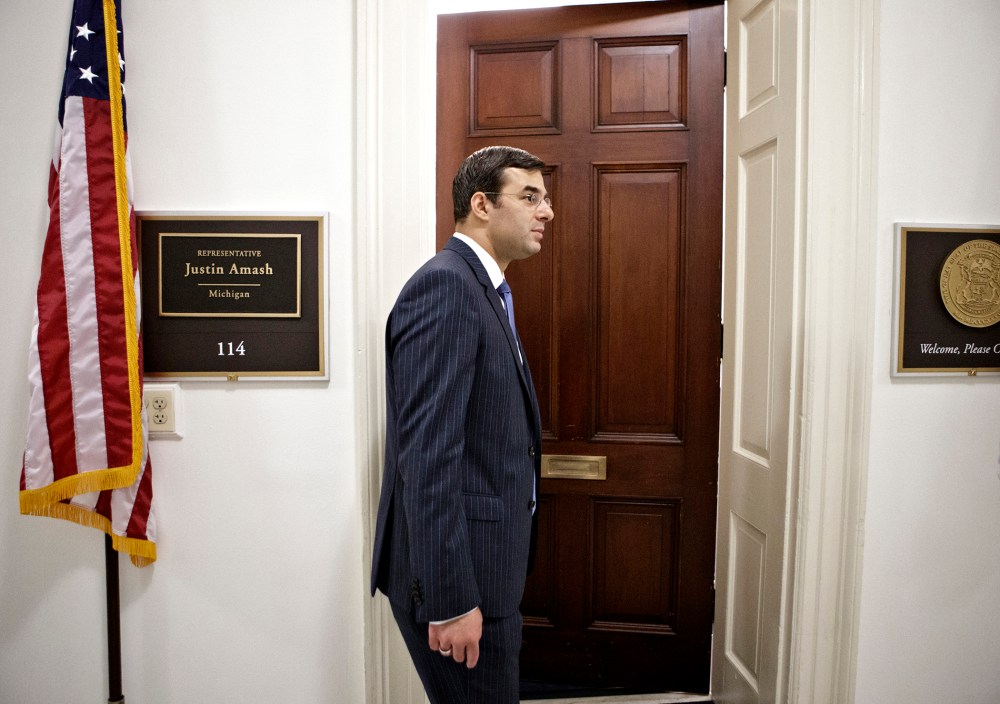
At face value, Rep. Justin Amash, a Republican congressman from Michigan, recently did something that was wholly unremarkable. The five-term GOP lawmaker read Special Counsel Robert Mueller’s report “carefully and completely,” and soon after came to some important conclusions. First, the lawmaker determined that Attorney General Barr has “deliberately misrepresented” Mueller’s findings.
And second, Amash concluded that Donald Trump “engaged in impeachable conduct.”
For his trouble, the Michigan Republican faced some predictably unkind words from the president, but as Politico reported, the response from Amash’s ostensible allies on Capitol Hill was more striking.
The House Freedom Caucus on Monday night formally condemned one of its founding members for declaring that President Trump committed impeachable offenses, but stopped short of kicking Rep. Justin Amash (R-Mich.) out of the hard-line conservative group.
Rep. Jim Jordan of Ohio, the top Republican on the House Oversight Committee and a former chairman of the Freedom Caucus, said that every single member in attendance during a weekly caucus meeting was unified in their opposition toward Amash’s comments. The group, which took a show of hands, needs the support of 80 percent of its members to take a formal position on an issue.
“It was every single person who totally disagrees with what he says,” Jordan said after the meeting.
Amash was not in attendance — by some accounts, he hasn’t participated in a Freedom Caucus gathering in nearly a year — and his colleagues did not vote on whether to expel him from the far-right group.
All of which raises a related question about the purpose of the House Freedom Caucus.
For decades, the most conservative members of the House Republican conference found a home in a group called the Republican Study Committee. But as GOP politics moved sharply to the right, and the party’s moderate wing effectively disappeared, most of the Republicans elected to the chamber ended up joining the Republican Study Committee, which effectively defeated its purpose.
The RSC was supposed to represent the party’s most rigid ideologues and reactionary voices, but as Republican politics became radicalized, the lines between the Study Committee and the party mainstream blurred.
And so, the House Freedom Caucus took form four years ago, giving far-right lawmakers a new, smaller, more cohesive alternative. The Freedom Caucus, unlike the Republican Study Committee, would represent GOP lawmakers committed to a purer form of conservative thought, without regard for the wishes of party leaders or the Republican establishment. At least, that was the idea. As we were reminded last night, the House Freedom Caucus isn’t principally concerned with the size of government, the size of the deficit, or the reach of the federal government. Rather, it’s focus appears to be the protection and celebration of Donald Trump. Instead of being home to a group of unapologetic, uncompromising ideologues, the group is committed to following their president — who, ironically, has no real ideology of his own and little interest in the governing principles that originally served as the rationale for creating the Freedom Caucus in the first place. In 2015, the House Freedom Caucus was a reactionary thorn in the Republican establishment’s side. In 2019, it’s a fan club.
Steve Benen is a producer for "The Rachel Maddow Show," the editor of MaddowBlog and an MS NOW political contributor. He's also the bestselling author of "Ministry of Truth: Democracy, Reality, and the Republicans' War on the Recent Past." Recommended


