








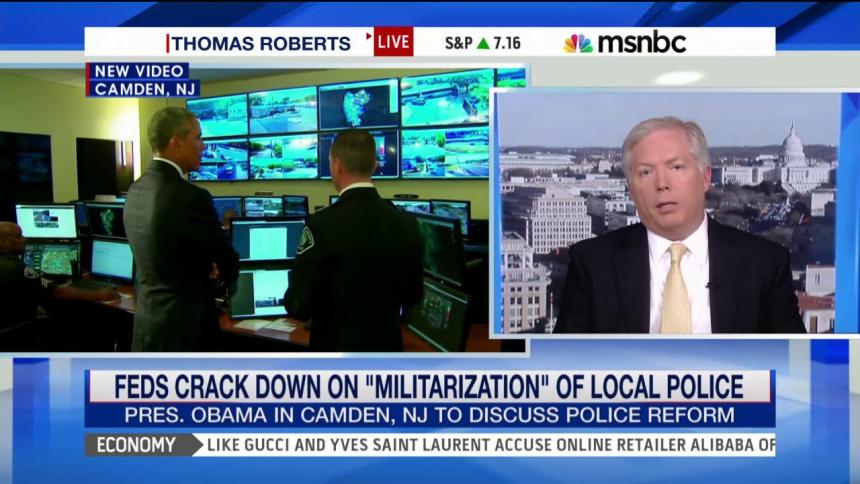
President Barack Obama announced new efforts to demilitarize America’s police departments on Monday, telling an audience in Camden, New Jersey that heavily-armed police forces have left many local residents feeling alienated and intimidated.
“We’ve seen how militarized gear can sometimes give people a feeling like there’s an occupying force,” Obama said. “We’re going to prohibit some equipment made for the battlefield that is not appropriate for those police departments.”
Obama’s announcement on the ban on the transfer of some types of military weapons to local police departments signals a continued draw down sparked by the militarized show of force in Ferguson, Missouri last summer that exacerbated withered trust between police and communities.
RELATED: Obama pays tribute to fallen police officers
The ban is part of a broader effort by the Obama administration to ease tensions between police and communities of color across the country, including Ferguson and Baltimore, theaters of unrest following the deaths of unarmed black men killed by police.
It includes the transfer of military weapons and gear, including armored vehicles, bayonets, grenade launchers and .50-caliber ammunition, the kind ubiquitous on foreign battlefields and increasingly in recent years, have landed in the hands of local police officers.
The new restrictions are being rolled out as a policing task force. A 116-page report will urge the country’s police agencies to “embrace a guardian – rather than a warrior— mindset to build trust and legitimacy both within agencies and with the public.”
%22We%20are%2C%20without%20a%20doubt%2C%20sitting%20at%20a%20defining%20moment%20in%20American%20policing.%22′
The ban is effective immediately.
Obama’s announcement on Monday afternoon in Camden, perennially one of the most dangerous cities in America, was no accident. Obama was in the city to tout it as a success story after wide policing reforms. Policing in the city has been transferred from city police to the Camden County Police Department, which has instituted a number of reform initiatives including strengthened community policing efforts.
“Communities like some poor communities in Camden or my hometown of Chicago, they’re part of America, too,” Obama said. “The kids who grow up here are America’s children. They’ve got hopes, they’ve got dreams, they’ve got potential. We’re not investing in them.”
The president riddled off a number of promising stats since the county’s takeover of the department. Violent crime in Camden is down 24%, murder is down 47% and open air drug markets have been cut by 65%, Obama said. The response time for 911 calls plummeted from an hour to five minutes. But perhaps the most significant gain has been growing trust between the police and local residents.
“I’ve come here today to do something that would have been unthinkable a few years ago, that is to hold you up as a symbol of promise to the nation,” Obama told an audience of local residents, officials and law enforcement. “This city is onto something … I want to focus on the fact that other cities across America can make similar progress.”
Obama twice referenced the recent unrest in Baltimore, Ferguson and New York City following the deaths of unarmed black men either in police shootings or in police custody, and said the social problems that fuel unrest shouldn’t be left solely to police officers to solve.
“We cannot ask the police to contain and control problems that the rest of us are unwilling to face,” Obama said.
City leaders in Camden last month accepted the My Brother’s Keeper Community Challenge, an effort aimed at getting cities to adopt plans specifically to help bolster the outcomes of young men and boys of color, part of the broader My Brother’s Keeper initiative, President Obama’s signature effort to help at-risk youth. Camden was also among the latest round of cities designated by the White House as Promise Zones, cities that have shown innovative collaborations with various stakeholders to improve the conditions of its poor residents. As a Promise Zone city Camden will benefit from an enhanced relationship with federal partners, help with accessing federal resources and grants and get tax breaks and tax credits for businesses.
On Monday, Obama highlighted recommendations made by the Task Force on 21st Century Policing, including a blueprint for improved community policing, updated technology that allows for greater transparency of police data, the expansion of police body cameras, among other recommendations.
“We are, without a doubt, sitting at a defining moment in American policing,” Ronald L. Davis, the director of the Department of Justice’s Office of Community Oriented Policing Services, told reporters in a conference call to discuss the White House’s latest efforts. “We have a unique opportunity to redefine policing in our democracy, to ensure that public safety becomes more than the absence of crime, but it must also include a presence for justice.”
RELATED: Obama announces new phase of ‘My Brother’s Keeper’ Dante Barry, executive director of Million Hoodies Movement for Justice, said the president’s militarization ban is a good first step, but arriving at this moment has been long a coming. “If not for all the pressure that groups like ours and all the folks that were on the ground in Ferguson we would not have gotten to this point,” Barry told msnbc. “This is just a stepping stone. I think we want to get away from this idea that the military equipment is the only form of police militarization, it’s not.” Barry said there needs to be more oversight and accountability of local police SWAT teams that routinely raid black and brown communities and more transparency when it comes to surveillance technology used to spy on Americans. “Being able to really scrutinize and reflect on how our local communities are being turned into war zones and it’s not just about military equipment,” Barry said. “That’s just the mobilizing point for folks. For some people that’s new to see tanks in local communities, but in reality that’s happening in cities all across the country.” The federal government’s practice of offering military-grade weapons and gear through grants and sale to local law enforcement agencies was ramped up following the 9/11 terrorist attacks, when Congress made the funnel from weapons depots to various cities in the name of fighting terror much wider. Through the Defense Department’s excess property program, also known as the 1033 Program, local police landed grenade launchers and high-caliber guns and ammunition. Since its inception in 1997, the 1033 Program transferred more than $4.3 billion in equipment to police forces, including nearly a half billion dollars in 2013 alone, according to reports. RELATED: Obama on poverty: Racial segregation became income segregation But in the wake of the killing of unarmed black teen Michael Brown Jr. in Ferguson by a white police officer last August, the optics, let alone the actual use of bomb-resistant tanks, heavily-armed officers in fatigues and some peering at peaceful protesters through sniper scopes affixed to rifles, was unnerving. The outsized show of force seemed to provoke angry, but mostly peaceful crowds who’d taken to the streets to protest Brown’s killing. The unrest that followed Brown’s killing continued after a grand jury decided not to indict former police officer Darren Wilson in his death, and spread to other cities as the list of unarmed black men killed by police continued to grow. There have been calls for greater bias training and accountability, including the wider use of body cameras by law enforcement. Last December, President Obama announced $75 million in federal funds for 50,000 body cameras for police across the country. “The idea is to make sure we strike the right balance of providing equipment that is appropriate and important, while at the same time put standards in place that give a clear reason for the transfer of that equipment, with clear training and safety provisions in place,” Cecilia Muñoz, the White House director of domestic policy, told reporters on the conference call.
Trymaine Lee
Trymaine Lee is an NBC News correspondent. Recommended


