








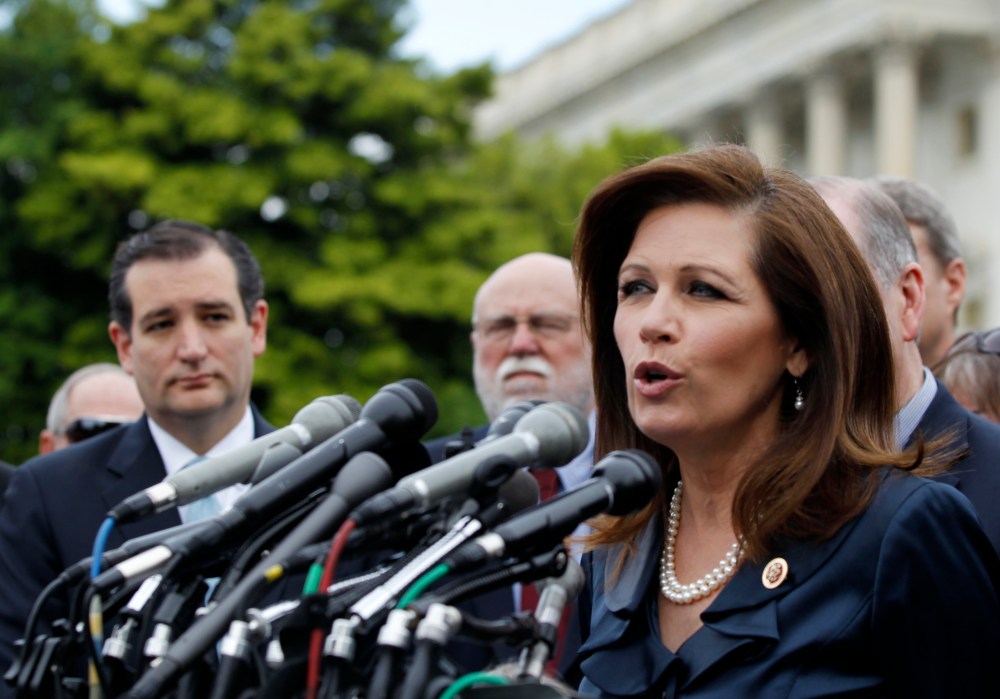
Minnesota Rep. Michele Bachmann said Wednesday morning in a video that she won’t seek re-election in 2014.
The outspoken Republican and onetime presidential candidate was a perpetual Democratic target, but without Bachmann on the ballot, the GOP-leaning seat becomes much easier for Republicans to hold next year.
“After a great deal of thought and deliberation, I have decided next year I will not seek a fifth congressional term to represent the wonderful people of the Sixth District of Minnesota,” Bachmann said in an eight-minute video posted on her campaign website. “After serious consideration, I am confident that this is the right decision.”
But Bachmann has other concerns even without re-election: Bachmann is still facing scrutiny from her presidential run, with the Federal Election Commission, the Office of Congressional Ethics, and the FBI looking into allegations she paid an Iowa state senator to work on her presidential campaign.
Bachmann, however, denied those investigations were the reason behind her decision not to seek another term.
“Be assured, my decision was not in any way influenced about my concerns about being reelected to Congress,” said Bachman . “And rest assured, this decision was not impacted in any way by the recent inquiries into the activities of my former presidential campaign or my former presidential staff.”
The Republican said her future was “limitless and my passion for America will remain….There is no future option or opportunity … that I wouldn’t be giving serious consideration if it can help save and protect our great nation.”
An often controversial politician who was a champion of Tea Party causes in the House, Bachmann herself was the only reason her seat was ever a concern for 2014, and without the one-time presidential candidate on the ballot, Republicans’ chances of holding the seat skyrocket.
The founder of the House Tea Party caucus first elected in 2006, Bachmann quickly became a prominent voice against Democrats in the House and the Obama administration, particularly against the president’s health care plan. She entered the 2012 GOP presidential race as the lone woman, and while she had a brief wave of success in the fall of 2011 and won the Ames, Iowa, straw poll in August, by the time actual votes were cast, her support had dissipated. She finished a disappointing sixth in the caucuses in her native state, and dropped out soon after.
Her foray into national politics didn’t help her own reelection chances back home, with wealthy hotel magnate Jim Graves giving her the toughest challenge of her career. Hitting her for not being in the district enough and missing votes in the House, Bachmann narrowly won reelection in 2012 by just 4,296 votes even as Mitt Romney won this suburban Twin Cities seat by 15 points. Her district was drawn to be the most Republican district in the state: in 2008, McCain got 55% while in 2004 Bush took 58%. But Bachmann consistently underperformed the top of the ticket, though Democrats were never able to topple the congresswoman.
Democrats were optimistic about their 2014 chances. Graves had already announced he was running again, and this time the four-term incumbent showed signs she was taking him seriously. While she said in her retirement announcement her decision wasn’t motivated by reelection concerns or the looming investigations into her presidential run, Bachmann was doing her due diligence, and then some, for her reelection campaign. Bachmann had already begun running campaign ads nearly a year and a half before the election, touting her work to repeal the health care law. Just last week, Graves touted a robopoll conducted for his campaign that showed the two in a statistical tie and Bachmann with a 51% unfavorable rating. While national Democrats didn’t invest in Graves’ challenge last time, he’d already been named to their “Jumpstart” program for promising recruits, and the House Majority PAC had named Bachmann as a top target. When Republicans thought Bachmann wasn’t running again in 2012 as she prepped her presidential bid, several local politicians showed interest and there’s sure to be a crowded GOP primary to replace her. Names mentioned last time include former Rep. Mark Kennedy; former state Rep. Phil Krinkie, former state Rep. Jim Knoblach and businessman Jay Emsay, who all lost to Bachmann in the 2006 primary; former state House Majority Leader Matt Dean; Anoka County Board Chair Rhonda Sivarajah; former state Rep. Chris DeLaForest, state Senate Majority Leader Amy Koch and state Senate President Michelle Fischbach. While several House members are running for higher office in 2014, Bachmann is the first outright House retirement. Rep. Jo Bonner (R-Ala.) announced last week he will resign in August to take a position with the University of Alabama.
Jessica Taylor Recommended


