








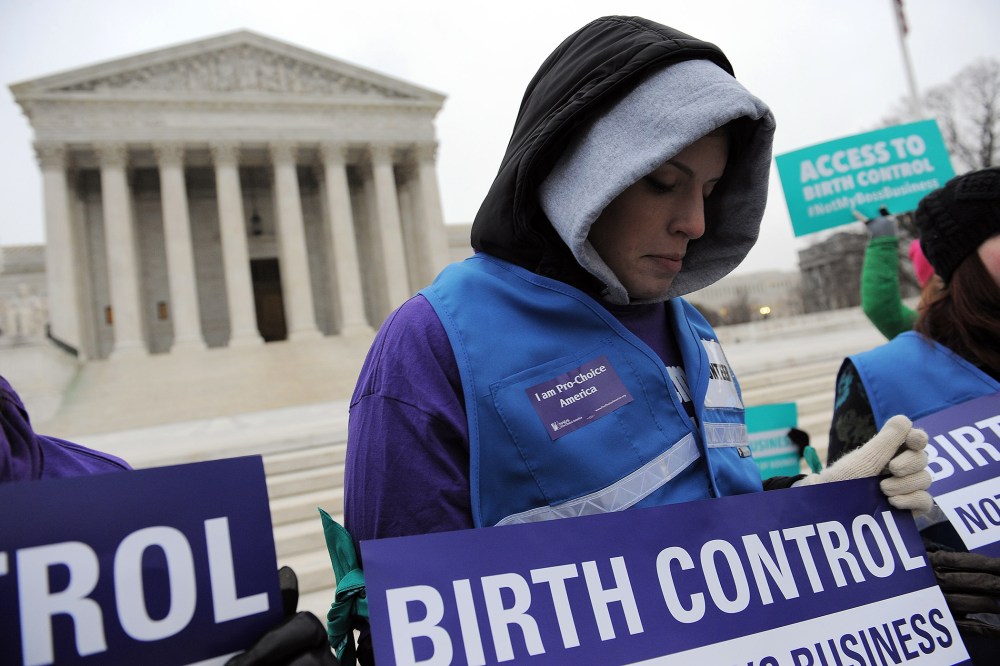
It’s already a great time to be a corporation in America, but it may be about to get even better.
That was my reaction after listening to the oral arguments in the Supreme Court over whether for-profit corporations can ignore a federal law requiring health insurance plans to cover certain forms of contraception. Two companies – Hobby Lobby, a chain of more than 600 craft stories, and Conestoga Wood Specialties, a cabinet-maker – are owned by families who believe these forms of contraception cause abortions. That medical opinion is not shared by mainstream medical science or agencies like the Food and Drug Administration.
The families are claiming that because the Affordable Care Act requires health insurers to cover four particular forms of contraception, they now bear a “substantial [religious] burden,” since they are indirectly paying for an employee group health plan that covers prescriptions and procedures they consider immoral. If one of their employees takes a birth control pill or uses an IUD covered by the company-provided health insurance plan, the families say they are being forced to “participate” – even at a distance – in what they see as an evil act.
For a moment let’s assume that the families who own Hobby Lobby and Conestoga are as sincere in their “deeply held” beliefs as their lawyer so eloquently argued. Legally, that sincerity can’t be tested by a court, but it has been a rhetorical rallying point for cultural conservatives hoping to water down mandates for women’s health insurance coverage in general and contraception coverage in particular in employer-provided health insurance plans.
The issue here isn’t the families or their personal beliefs – it’s about whether those beliefs should entitle them to have their for-profit corporations treated like a nonprofit religious organization or a house of worship.
Hobby Lobby is a corporation. Churches are often incorporated, too. But by any reasonable standard they are very different kinds of corporations, echoing long-recognized distinctions between economic and civic institutions and religious institutions. These differences predate the founding of the United States and have been maintained over and over again during more than two centuries of American litigation.
Since just after the nation’s founding, corporations have been legally considered “persons” for the purpose of being a legal entity that can sue and be sued in court, exist beyond the natural lifespan of individual owners and or directors, and – most importantly – shield those owners and shareholders from being held personally liable for the corporation’s actions.
That liability protection is what made corporations such an attractive way to organize business enterprises, yet the benefit exists only because there is a wall of separation – the legal term is ‘veil’ – between a corporation’s owners and directors and the corporation itself.
But Hobby Lobby and Conestoga – and their supporters – want to wipe out the distinction between religious and business corporations to give themselves the power to police the morals of their employees by denying them access to certain health care prescriptions and treatments. For-profit business corporations would then become a highly capitalized, legally privileged state-sanctioned vehicle for establishing employers’ religious beliefs in the lives of their employees, negating the abilities of employees to act according to their own consciences and judgments.
And in this case, Hobby Lobby’s owners want to “pierce” that veil while continuing to reap the economic and legal benefits of running an incorporated business. One minute they get to impose their personal religious views as company policy, but in the next minute they want to hide behind liability protections afforded by incorporation.
The companies also want to have it both ways when it comes to taxes. Under federal law, the companies already have the right not to provide healthcare coverage to their employees. All they have to do is pay a tax of $2000 per employee (some call it a penalty; Chief Justice Roberts famously called it a tax.) This would mean that employees would either rely on family members’ plans or go buy insurance on one of the Obamacare state health insurance exchanges.
But the companies don’t want to do that. Hobby Lobby’s lawyer claimed that the company owners consider providing health insurance to be a moral obligation, so paying the tax would “violate their own interest.” As the attorney argued, “We believe it’s important to provide our employees with qualified health care.”
Yet the company wants to re-define “qualified” in a way that excludes the things they want to exclude. And they want to be able to do this while continuing to get the tax benefits that come with providing employees health care coverage. Hobby Lobby’s owners want to continue to collect those benefits even if their plans don’t meet the same bar as other for-profit employer-provided plans at similar-sized companies.
Without rehashing all of the details of the argument and the case (check out Irin Carmon’s story here) let’s look at the big picture.
At the heart of the Hobby Lobby and Conestoga argument is the claim that federal law should treat a for-profit corporation engaged in commerce no differently than a nonprofit religious organization, church, or house of worship. Business corporations would therefore become no different from ‘natural’ living, breathing people when it comes to having religious and speech protections under the First Amendment, even though such claims – contrary to what Justice Scalia claimed – have never been recognized in the past (just for fun check out the Lee, Braunfield, and Gallagher cases)
But based on the direction of questioning from Chief Justice Roberts, there may now be five votes on the Court to change that.
Roberts was sympathetic to the description of Hobby Lobby and Conestoga as “small closely-held corporations that have firmly held religious beliefs,” as if a ruling in their favor could be crafted to have only a narrow impact on the nation’s employers and employees. So instead of asking what would happen if 51% of a company’s shareholders decided that blood transfusions or vaccines were against their religious beliefs, Roberts preferred to stick to a polite discussion about one subset of “closely held” corporations. Roberts dismissed the idea that larger corporations would even venture into cases like these. It’s “the sort of situation I don’t think is going to happen,” he said.
But wait. Let’s think back four years ago to another case that expanded the rights and privileges of corporations as “persons.”
In 2010 the Roberts Court, by a 5-4 margin, ruled in Citizens United v. Federal Election Commission that business corporations were entitled to the same First Amendment speech protections as private citizens and other associations when they spend money (called “independent expenditures”) to influence elections. Previously, the McCain-Feingold campaign finance law barred business corporations and labor unions from engaging in that kind of spending during the last weeks before an election. The court tossed out those restrictions by dismissing the notion that lawmakers who wrote campaign finance legislation – not only Sens. John McCain and Russ Feingold, but a century of their predecessors – had any compelling interest in combatting corruption in American government. Writing for the majority, Justice Anthony Kennedy wrote, “independent expenditures, including those made by corporations, do not give rise to corruption or the appearance of corruption.” The reaction from critics was: “Seriously?” Justice John Paul Stevens was so outraged by the decision that he read his 90-page dissent from the bench in the Supreme Court chamber, an almost unheard-of act of protest. “At bottom,” Stevens said, “the court’s opinion is thus a rejection of the common sense of the American people, who have recognized a need to prevent corporations from undermining self-government since the founding, and who have fought against the distinctive corrupting potential of corporate electioneering since the days of Theodore Roosevelt.” “While American democracy is imperfect,” Stevens continued, “few outside the majority of this Court would have thought its flaws included a dearth of corporate money in politics.” One of the most defining features of early American politics was a skepticism about corporate power. The idea of handing a bundle of privileges over to a narrow subset of wealthy individuals and then giving them a blank check to distort the religious and political lives of their fellow citizens was not something that could have been supported in the country’s first decades. If corporations in 1789 looked like corporations do in 2014, it is very possible that no corporation would have ever been chartered in the new nation – it would have looked too much like monarchy. And yet the Roberts court seems poised – once again – to vest ever more power and privilege in this odd legal creature, all while ignoring the political and economic implications for the nation’s employees and citizens. In 2010 the court predicted that dark money spending would not lead to an “appearance of corruption.” Now they’re pondering whether to demolish ancient and sensible distinctions between businesses and churches, and promising the damage will be contained. Given the court’s track record we can be forgiven for being skeptical. If you toss out the free speech claims in Citizens United and the religious claims made by the Hobby Lobby owners, both cases are similar in that they’re about power. Specifically, they’re about corporate power – the power that comes from amassing human, financial, and political capital in order to bend (and often distort) policies and laws in ways that favor wealthy people at the expense of the public good. Some might call this complaint “socialism,” but if that’s true it would make Alexander Hamilton and his cohort some of the biggest socialists in American history. It is quaint to refer to Hobby Lobby as a “small” and “closely held” family business, but it’s a company that took in more than $3 billion last year and has 14,000 full time employees working in more than 600 stores. And now, because it enjoys corporate privileges, it is poised to gain even more special privileges. Instead of scrutinizing the power that comes with bigness, the Roberts court rewards it with even more power, all the while telling us not to worry about the risks.
Brian Murphy Recommended


