








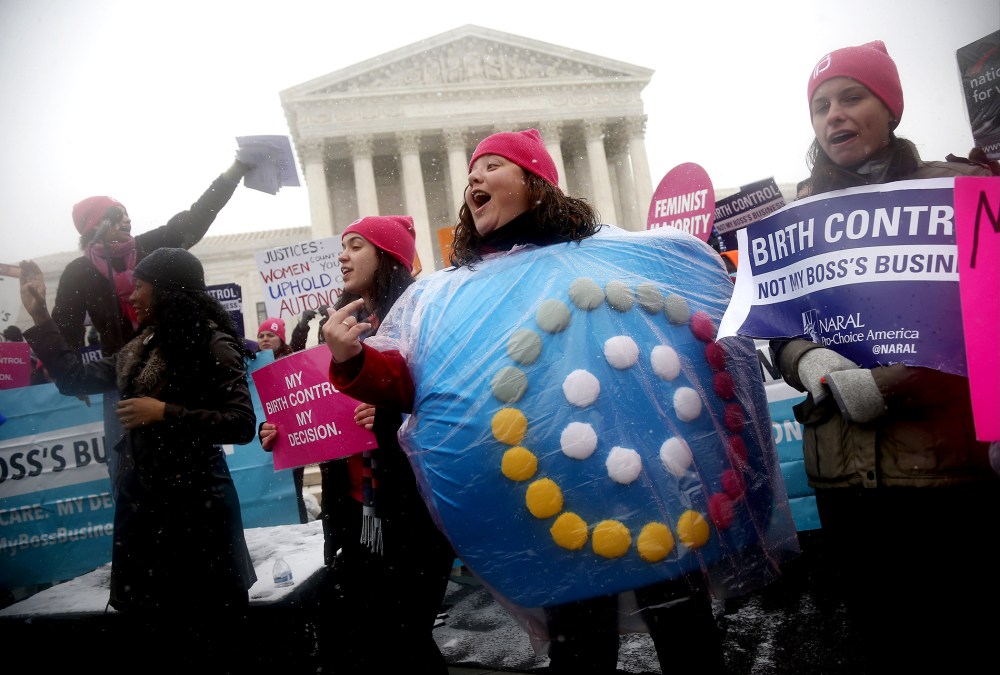
Judging by the direction of questions at oral argument at the Supreme Court today, the closely watched contraceptive cases — Hobby Lobby and Conestoga Wood, who are suing the government over regulations in the Affordable Care Act — are likely to divide along traditional partisan lines, with Justice Anthony Kennedy providing the tie-breaking vote.
The Court is considering a challenge from for-profit corporations who want a religious exemption from the Affordable Care Act’s minimum requirement provisions, which say that contraception is preventive care that should be fully covered, without a co-pay. The companies say that since the owners are religious, so are the companies, and so the company plans should be allowed to refuse to cover whatever the owners object to.
On the baseline question of whether a for-profit corporation can even have religious exercise — something the Court has never held — Hobby Lobby may be in luck. The women on the court, Justices Ruth Bader Ginsburg, Elena Kagan, and Sonia Sotomayor expressed deep skepticism that it was workable to allow corporations religious exemptions, citing religious objections to everything from vaccinations to family leave. “So one religious group could opt out of this and another religious group could opt out of that, and everything would be piecemeal, and nothing would be uniform,” Kagan said.
Sotomayor asked flat out, “How does a corporation exercise religion?”

But Chief Justice John Roberts and Justice Samuel Alito seemed perfectly comfortable with corporate religiosity as a concept — and Kennedy seemed to agree with the conservative Justices. Or, at the very least, he seemed to think that the line — in which religious nonprofits were given an accommodation — should have been drawn by Congress, and not the Department of Health and Human Services, for a “First Amendment issue of this consequence.” He also wondered whether such a distinction could mean a corporation could be forced to pay for abortions.
(Justice Stephen Breyer, who was relatively quiet on Tuesday, said little on whether corporations have religious freedom. Justice Clarence Thomas, as usual, said nothing.)
If a corporation does have religious freedom, the next questions are whether covering contraception on an employee plan is a substantial burden on it, whether the government has a compelling interest in that coverage, and whether it is fulfilling it through the least restrictive means. Most of the conversation on Tuesday morning focused on the second and third points, and whether third party interests — the ones of the employees — should be considered.
Paul Clement, arguing for the plaintiffs, said the government couldn’t find its interest that compelling if some organizations were exempted one way or another. Solicitor general Donald Verrilli said those exemptions are relatively narrow, and some are time-limited. And anyway, he said, one “less restrictive means” — the insurer providing contraception directly — had already been deemed unacceptable by religious nonprofits, who are suing over them.
Both Kagan and Sotomayor also said that it wasn’t such a substantial burden on the plaintiffs for employer plans to cover contraception, because the employers could just opt out of offering insurance at all and send their employees to the exchanges, thus diluting their involvement in paying for it. But Clement insisted that would also hurt Hobby Lobby by making it pay a fee, and that providing insurance coverage was also part of their religious belief. (Ginsburg was incredulous on that point.) If the Court determines that the corporation can have religious exercise, the question is still where third parties fall into the analysis. “How should we think of the rights of the employee?” asked Kennedy, wondering whether an exemption would “allow the employer to put the employee at a disadvantageus position. The employee may not agree with these religious beliefs of the employer. [Do] the religious beliefs just trump?” (Scalia’s answer: If it wasn’t written into the Religious Freedom Restoration Act, it doesn’t exist.) Clement replied, “This is not about access to the contraception, it’s who’s going to pay for the government’s preferred subsidy.” But Kagan, for her part, had a different answer: “Congress has made a judgment and Congress has given a statutory entitlement and that entitlement is to women and includes contraceptive coverage, and when an employer says, no, I don’t want to give that, that woman is quite directly, quite tangibly harmed.” A ruling is expected by June.
Irin Carmon Recommended


