









If you’ve seen more Democratic senators across your social media feeds this past year, there’s a good chance it’s because of Sen. Cory Booker.
The 56-year-old New Jersey lawmaker — himself one of the most-followed politicians online — took over the messaging shop for Senate Democrats in 2025. And he’s been focused on expanding the reach of his colleagues by encouraging them to compete across new digital platforms — a tricky task for a group of lawmakers with an average age of 60.
“There were so many stories kind of punishing Democrats after the last election that the Republicans were doing a much better job messaging in places where people are,” Booker told MS NOW in a phone interview.
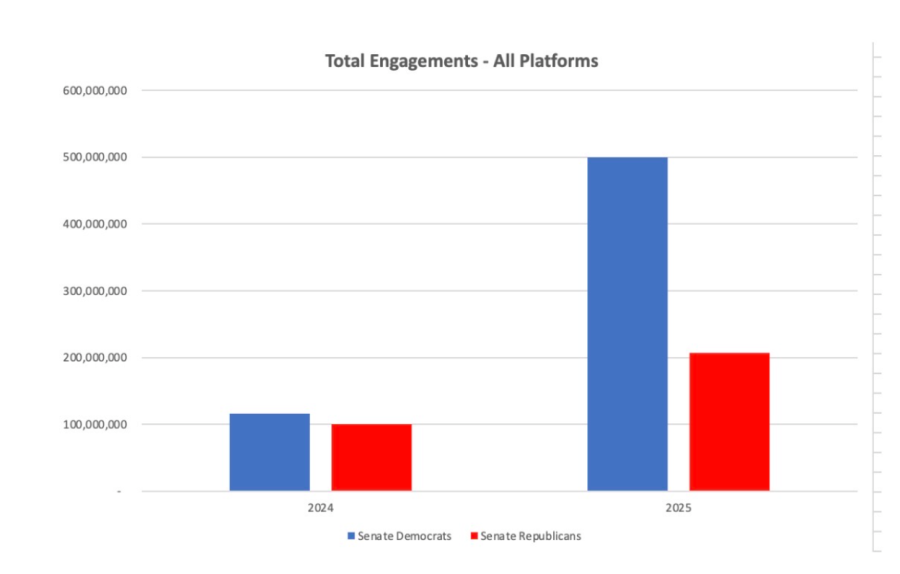
But a year into the endeavor, Senate Democrats have notched over half a billion engagements and more than 20 million followers across their social media accounts, according to the Senate Democratic Strategic Communications Committee’s internal tracking, shared first with MS NOW.
Their social media accounts on X, Facebook, Instagram, YouTube, TikTok, Threads, and Bluesky generated 430% more engagement than the year before. Now, according to charts like this one that Booker has shown his colleagues privately, Democrats dwarf Republicans.
“This is not just views,” Booker said. “This is a human being pushing a button to ‘like’ something or forwarding it to their friends or putting comments on it. So it’s a substantive metric, more than just scrolling and seeing something online.”
Engagement leads to followers. The 20 million new followers mark for Senate Democrats, an 80% increase over the last year.
“My colleagues, in this last year, found ways to center the issues and fight in ways that we just weren’t using before,” Booker said. He pointed to New Hampshire Sen. Maggie Hassan emotionally speaking about her son’s cerebral palsy during a hearing with Health and Human Services Sec. Robert F. Kennedy Jr., as well as Sen. Mark Kelly, D-Ariz., selling his Tesla in response to Elon Musk and DOGE.
Asked about a criticism that often booms around political circles — that “the internet is not real life” — Booker agreed. “But neither is TV and radio,” he said.
And increasingly, social media is a vehicle for setting the agenda in Washington. President Donald Trump, perhaps more than any other politician, has set that bar with his continuous use of Truth Social as a personal presidential megaphone. His administration has followed suit in 2025 with videos strategically meant to inflame internet circles, translating into coverage on “traditional media” platforms. Pew Research Center data from November 2025 shows large swaths of Americans on social media platforms. Eighty-four percent of U.S. adults reported using YouTube in 2025, 71% were on Facebook, and 50% use Instagram. Trump’s preferred corner of the internet, Truth Social, polled the lowest percent of users: 3%, just under the left-leaning Bluesky platform. But even in an increasingly digital age, Booker recognizes what’s always worked. Leaving his own town hall-style event, Booker told MS NOW: “Nothing is as good as ‘in real life,’” before adding the internet-friendly way of making that same point. “I-R-L,” he said.
Ali Vitali is MS NOW's senior congressional correspondent and the host of "Way Too Early." She is the author of "Electable: Why America Hasn’t Put a Woman in the White House … Yet." Recommended


