








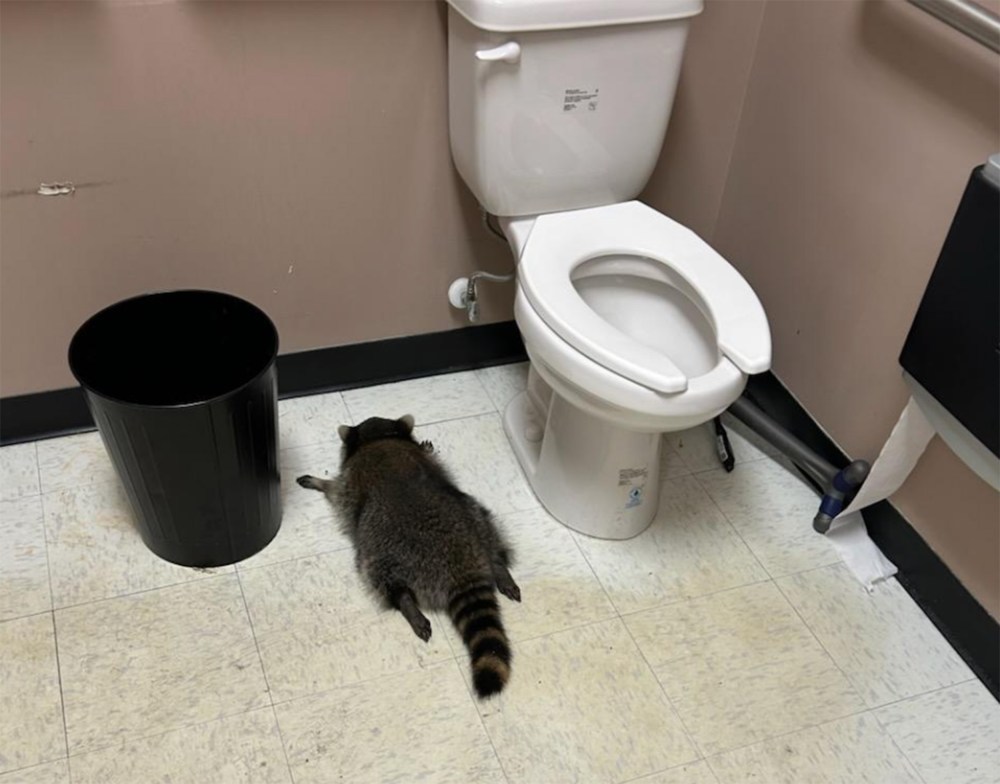
Over the past week, stories about a raccoon who passed out in the bathroom of a Virginia liquor store have gone viral. The headlines really write themselves, with major news outlets from the Associated Press to The New York Times to the BBC describing how a “trashed panda” went on a “liquor-fueled rampage.”
But whenever a wild animal shows up in popular culture, whether through a TV series or a viral photo, there’s almost always a more nuanced story — usually about our relationships with animals more broadly. Indeed, I couldn’t help but feel for the little guy, who was likely terrified, and think about the countless other animals that end up in similar situations every year.
Here’s what happened: The weekend after Thanksgiving, employees arrived at their shop in Ashland, Virginia, to discover a raccoon that had apparently gained entry at the roof level, fallen through a tile in the ceiling and found himself trapped inside the building. Likely seeking a way out, he climbed back up the shelves to reach his original entry point, knocking down glass bottles from the lower shelves. Judging from the photos, he ingested a potentially dangerous amount of alcohol.
I couldn’t help but feel for the little guy, who was likely terrified, and think about the countless other animals that end up in similar situations every year.
Thankfully, animal control officers eventually arrived to help, gave him a place to sober up and safely released him outside.
“I thought we ought to put that on social media media,” Chief Jeff Parker of Hanover County Animal Protection and Shelter told The New York Times. “I had no idea it would go national or even worldwide.”
This raccoon was one of the lucky ones. But we can’t say the same for hundreds of thousands of animals who find themselves in similar situations every year.
A big piece of the problem involves poor planning, design and construction of our developed landscapes: our homes, commercial districts and communities. When wild animals have easy access to the spaces in our buildings, whether through an unprotected vent, a roofline with gaps, an open crawl space access or, yes, a ceiling tile, the consequences can be dire. And while this raccoon survived his ordeal, countless others who wander or find themselves unexpectedly in human spaces are injured, displaced or killed.
The natural psychology and behavior of animals come into play as well. While wild animals generally want to avoid humans, many will tolerate and use the available sheltering sites our constructed landscapes provide.
Such was the case for a bear in a neighborhood in Altadena, California; a video of the massive fellow squeezing through an open crawl space went viral earlier this week. He had been using this space for a while, not only because it was available but likely because he had drastically reduced options for a natural den site because the Eaton Fire had devastated his natural habitat. The vast majority of conflicts that people experience with wildlife occur in our cities and towns, and as our world continues to urbanize, wild animals will continue to adapt and thrive in these spaces. Raccoons are among the most adaptable animals in North America. They are intelligent and curious, and those traits can also get them into serious trouble in a world so overwhelmed by human development. They thrive in cities, suburbs and rural areas, and they readily use what we unintentionally provide: unsecured garbage, vegetable gardens, bird feeders, and shelters like crawl spaces, uncapped chimneys and attics. Even the tongue-in-cheek “trash panda” nickname defines raccoons by the garbage that people have created — receptacles bursting with human food castoffs left unsecured and tempting. As wild species continue to adapt to our world, humans need to adapt their own behaviors to implement kinder tactics that allow animals to safely coexist with us. For example, our Wild Neighbors program at Humane World for Animals, formerly called the Humane Society of the United States, trains animal control and sheltering professionals in communities across the country in effective, humane strategies that prevent wildlife conflicts before they happen. In 2025 alone, we have trained more than 1,500 professionals from 612 agencies across the U.S. We promote practical methods of humane exclusion, designed to keep wildlife safely out of homes and businesses — rather than turning to outdated methods like trap-and-relocate or lethal control, which are not only inhumane but also ineffective. We can’t kill our way out of this issue. As winter approaches, encounters like the ones recently in the news tend to spike. Hungry raccoons, squirrels and other animals follow smells, warmth and opportunity. But these incidents are not inevitable. They’re preventable. Sealing entry points — which seems to have been the issue for this curious raccoon — repairing eaves and ceilings, securing vents and windows, storing trash and food waste responsibly and removing easy enticements can reduce the risk of wildlife finding their way indoors. These are inexpensive, proven steps that protect animals and people alike. People design the modern world, and that makes us responsible for designing it with wildlife in mind, through better, safer and more careful construction. Humane exclusion works: Patch the roof, secure the trash bin, seal the vent and prevent the next wild animal encounter before it has a chance to go viral. These simple, kind actions can make a world of difference for animals.
Kitty Block
Kitty Block is the president and CEO of Humane World for Animals, formerly the Humane Society of the United States and Humane Society International. 

