








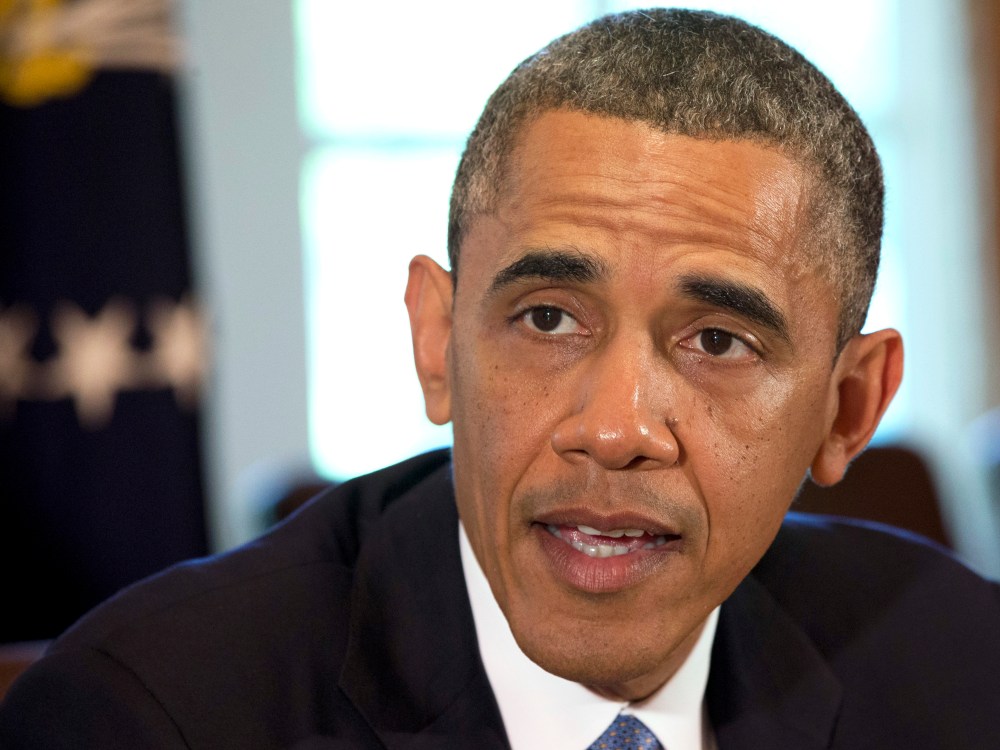
On Thursday President Obama will make the case for his administration’s counter-terrorism policies, including drone attacks. At the State of the Union this year, Obama had promised more transparency about the controversial targeted killing program. His aides say that’s what Obama is offering this week.
“He will discuss the policy and legal framework under which we take action against terrorist threats, including the use of drones,” a White House official told me, adding that the speech will also “review” U.S. detention policy and attempts to close the Guantanamo Bay prison.
Very few people, of course, need a review of the congressional standoff over Gitmo. (Congress has erected financial barriers to transferring detainees, while the White House has spent very little political capital to change that.) For human rights advocates, merely reiterating a desire to close Gitmo is not enough at this point. If the president doesn’t take major action soon, he will likely leave office with Gitmo up and running.
He could start by putting a senior person on the job; the State Department post for transferring detainees has been vacant since January. Attorney General Eric Holder recently discussed filling that post as part of the “renewed effort to close Guantanamo.” While Guantanamo has proved intractable, the most vexing legal dilemmas in U.S. counter-terrorism are far from the coast of Cuba.
From declared battlefields, like Afghanistan, to nontraditional warzones, such as Pakistan and Somalia, this administration has overseen a major expansion of targeted killing. While many security officials insist that such targeting is superior to traditional warfare–proposing that its precision makes it safer for our soldiers and foreign citizens alike–the drone program has suffered a string of setbacks.
In the courts, the D.C. Circuit recently rejected the CIA’s argument that the entire operation is exempt from public oversight. (Apart from speeches, that’s one binding reason the president must grapple with more transparency.) In politics, concern over targeted killings complicated John Brennan’s CIA nomination and sparked a dramatic, some say histrionic, filibuster from Sen. Rand Paul. And in the field, drones are increasingly reviled, as The New York Times reported Wednesday. (“The costs of the drone strikes” are evident, the Times reports, as innocent deaths “have shaken the claims of precise targeting” and “become a staple of Qaeda propaganda.”) The president has a chance to address the backlash with concrete actions. He can shift targeted killings from espionage at CIA, where they are a state secret, to the Pentagon. He can respond to related FOIA lawsuits by actually releasing requested information, instead of stonewalling. (That’s what he did for requests regarding the “torture memos” when he first came into office.) He can tell Congress which countries are currently being hit by drone attacks – a rather basic data point for crafting foreign policy, but one the administration has refused to provide, and he can publish a full accounting of the metrics used to determine who ends up on the “kill list.” Tommy Vietor, Obama’s former National Security Council spokesman, says the address is useful because the president “wants to have a conversation about the way we conduct counter-terrorism operations.” That discussion has sometimes been compromised by politics, Vietor argues, as top Republicans tried to demagogue the issue. Sen. Paul’s filibuster was “deeply misleading” because it posited the execution of “non-combatants on U.S. soil,” Vietor says, and Paul’s criticism was “more rooted in a far-right distrust of government–period–than an actual effort to find a balance between secrecy and transparency.” There’s no question that these policies have prompted selective outrage. But with no elections left in his career, Obama can afford to be less concerned with political opponents on this issue. After all, someday a Republican president will wield the counter-terrorism powers that Obama has expanded.
Ari Melber
Ari Melber, an Emmy Award-winning journalist, writer and attorney, is the host of “The Beat with Ari Melber” airing nightly at 6 p.m. ET on MSNBC. He also serves as MSNBC’s chief legal correspondent and an NBC News legal analyst. Before joining MSNBC, Melber practiced First Amendment law and served as a legislative aide in the U.S. Senate. He received a J.D. from Cornell Law School and is a member of the New York Bar. Recommended


