








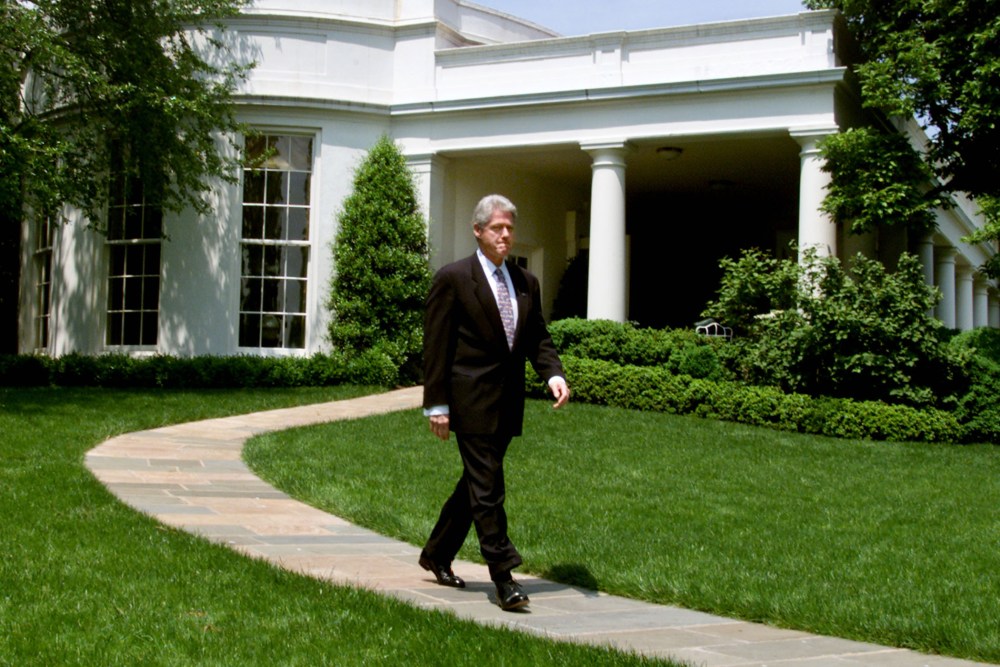

On Friday, two weeks after nearly 4,000 pages of documents from the Clinton White House were made public for the first time, the William J. Clinton Presidential Library posted a trove of additional documents for journalists and presidential history aficionados to scrutinize.
This latest batch of documents provide a glimpse into the latter portion of Bill Clinton’s presidency, offering new insight into how he dealt with his vice president’s campaign for the presidency and foreign policy in the pre-9/11 era, among other issues.
Here are a few highlights from the documents. This post will be updated.
1. Managing the White House’s response to the 2000 recount standoff. In one of his final speeches as the 42nd president, Clinton had to delicately address his vice president’s concession to George W. Bush following the U.S. Supreme Court’s order to halt the Florida recount, effectively handing the presidency to Bush.
In several drafts, the revisions show efforts by speechwriters to tone down the language about damage done to the democratic process. A sentence comparing the nation to “a fabric torn,” is crossed out with a note in the margin that reads: “Too negative–never torn apart by this–remain strong b/c constitution is strong.” Several drafts also call for a comprehensive, nationwide overhaul of the voting process, though notes suggests disagreement on that point. One editor offers the critique: “Tonally – too much about ballot.” It ended up not making it into the final version.
2. The road to the Clinton Global Initiative. A 1997 memorandum ahead of a volunteerism summit lays out a philosophy on service that would eventually become the bedrock of the Clinton Foundation and the Clinton Global Initiative. In it, Clinton adviser Benjamin Barber stresses that the summit offers an opportunity to “gently distinguish [the president’s] view of service as a road to citizenship and government as a partner of service organizations from its conservative rival (service as an entirely private sector and personal form of philanthropy, government as superfluous, as an ‘enemy’ of volunteers that gets in the way of solving social problems.)”
Barber also lists an idea of giving Colin Powell a service award, then recommends he not work so closely with the Republican general, who many suspected would run for president.
“The summit risks becoming a showcase for an ex-President’s private philanthropy (noncivic) approach to service and four year national platform on which a prospective President (General Powell) can run against you and the Vice-President on what should be YOUR issue,” Barber wrote. The Summit could become “a perfect platform for General Powell to spend for (sic) years in the limelight talking about your issues.”
3. Some undue optimism from Al Gore over climate change. In 1998, Vice President Al Gore offered hope that a coordinated international response to rising global temperatures was imminent.
“Against all odds, for the first time, all the industrialized nations of the world now are working together in common cause against the threat of global warming,” he said during public remarks at a State Department breakfast held to honor then-British Prime Minister Tony Blair. “And I would like to personally thank Prime Minister Blair for his leadership in helping to make this happen.”
After his failed bid for the presidency, Gore would go on to become a leading voice in the environmentalist community, which is still fighting to institute a global policy response to global warming.
4. Calibrating the public response to terrorism. As early as 1995, the Clinton administration was thinking of ways to defuse anti-Muslim sentiment when discussing national security and terrorism. When then-Transportation Secretary Federico Peña suggested that the White House “publicly acknowledge” his department’s new security measures were a response to “a general increase in the potential for anti-American terrorism,” an unknown aide wrote that the administration should “send a Muslim” to make the statement.
“This effort will get us to the real issue, ‘terrorism’ [versus] a perceived issue of religion,” wrote the aide. “(Muslims against US and vice versa.)”
5. White House aides considered moving to end the filibuster. In 1994, a group of Clinton advisers drafted a memo to then-White House chief of staff Leon Panetta (who later became President Obama’s CIA director and eventually his Secretary of Defense) suggesting that the Clinton administration “should consider mounting a drive to eliminate dilatory rules like the filibuster, which is now a prime obstacle to getting things done.”
The advisers were frustrated with what they saw as an intransigent Republican Senate caucus, which made enthusiastic use of the filibuster to block President Clinton’s agenda. Yet since the end of the Clinton administration, the filibuster has only grown in popularity: Whereas 80 motions to end a filibuster were filed in the Senate during Clinton’s two terms, the Senate under President Obama has already filed over 300 such motions. As a result, Senate Majority Leader Harry Reid, D-Nev., recently changed Senate rules to limit the power of the filibuster.
6. U.S. didn’t want to push Russia on Lee Harvey Oswald docs. The JFK Assassination Records Review Board had been lobbying the White House to pressure Russia into turning over their records on killer Lee Harvey Oswald. The independent agency, which was created in 1992, examined assassination-relation docs that the feds deemed too sensitive for public consumption. But with the Board shutting down in 1998, the Clinton administration seemed weary at the time to escalate the requests to the international level with Russia. “The Assassination Records Review Board is about to go out of business (end September), and they think that the Russians have further archival data on Oswald in the USSR. The Board wants the VP to raise with Kiriyenko,” wrote Jonathan Elkind, who served as the Director for Russian, Ukrainian, and Eurasian Affairs on the U.S. National Security Council. The July 1998 email to Richard Saunders, adviser to the vice president, explained why he didn’t want Vice President Gore to bring up the issue with his counterpart. Elkind admitted, “I feel somewhat awkward about this given the fact that the Board is about to go out of biz, but I think this should NOT make the cut for the VP’s agenda.” “We simply cannot be all things to all people,” he added. “We already have way to many “little” items to keep on the screen.” 7. Advice to avoid ‘nasty’ politics at Princess Diana’s funeral Aides warned Hillary Clinton to steer clear of answering reporters’ questions at Princess Diana’s funeral in September 1997. White House official Glyn Davies told staffers in a memo the first lady “will be the most prominent guest at the funeral.” Passing along advice from Bob Bradtke at the U.S. embassy in London, it continued, “It is appropriate/expected that she make a brief statement but answer no questions (to avoid entanglement in what he describes as the increasingly “nasty” Palace politics).”
Ned Resnikoff is an urban policy analyst, researcher, writer, and editor. His byline has appeared in a variety of publications, including the New York Times, San Francisco Chronicle, Dissent, and The Nation. He writes the newsletter Public Comment, which can be found at publiccomment.blog.
Sarah Muller
Emma Margolin
Emma Margolin is a reporter at MSNBC.com. Recommended


