








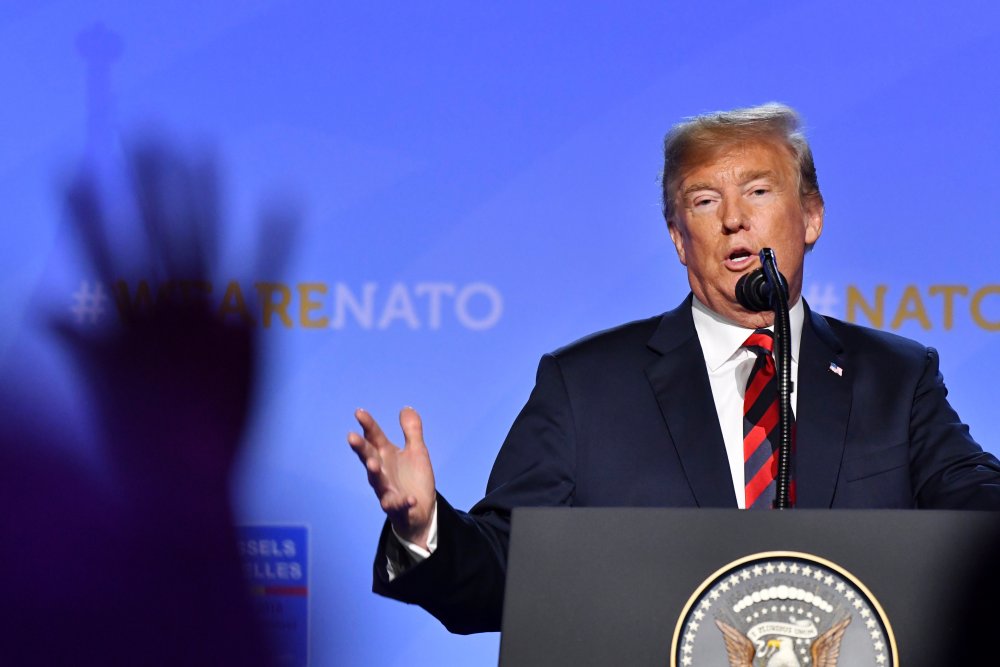
About a year ago, ahead of Donald Trump’s first address to NATO leaders, then-National Security Adviser H.R. McMaster, then-Secretary of State Rex Tillerson, and Defense Secretary James Mattis spent weeks lobbying behind the scenes, fighting to ensure that the president would explicitly endorse the core principle at the heart of the alliance: the Article 5 guarantee that an attack on one NATO country would represent an attack on every member.
As regular readers may recall, the three were pleased when they thought they’d improved the written remarks — and they were then blindsided when they heard Trump’s remarks and the language they included wasn’t there. According to Politico‘s reporting at the time, it was the president himself who “deleted” the language Mattis, McMaster, and Tillerson wanted.
Thirteen months later, Trump has repeatedly raised doubts about his commitment to NATO, though he was even less subtle than usual during an interview with Fox News’ Tucker Carlson, which aired last night after being recorded on Monday, immediately after the president’s press conference with Russian President Vladimir Putin.
“Membership in NATO obligates the members to defend any other member that’s attacked,” Carlson said. “So let’s say Montenegro, which joined last year, is attacked. Why should my son go to Montenegro to defend it from attack?”
Trump answered: “I understand what you’re saying. I’ve asked the same question. Montenegro is a tiny country with very strong people … They’re very aggressive people. They may get aggressive, and congratulations, you’re in World War III.”
In the next breath, the president added, “I understand that, but that’s the way [NATO] was set up. Don’t forget, I just got here a little more than a year and a half ago.”
In other words, Trump doesn’t much like the structure of the NATO alliance, and he doesn’t want to be blamed for the most successful security alliance in the history of the world.
And that’s something that sets Trump apart from his modern predecessors. Other American presidents have quarreled at times with their allied foreign counterparts and lobbied them to change course on various issues, but for over six decades decades, American presidents from both parties recognized and appreciated the inherent value of NATO as an enduring institution. Trump doesn’t. He doesn’t even bother to pretend. Indeed, the quoted excerpt doesn’t fully do it justice. Take a minute to watch the clip and note the tone the president uses when responding to Carlson’s question. When Trump said, “I understand what you’re saying; I’ve asked the same question,” he made it sound as if NATO’s structure was so obviously flawed that he finds the whole thing baffling. The destabilizing effect of presidential rhetoric like this is real and consequential.
Steve Benen is a producer for "The Rachel Maddow Show," the editor of MaddowBlog and an MS NOW political contributor. He's also the bestselling author of "Ministry of Truth: Democracy, Reality, and the Republicans' War on the Recent Past." Recommended


