








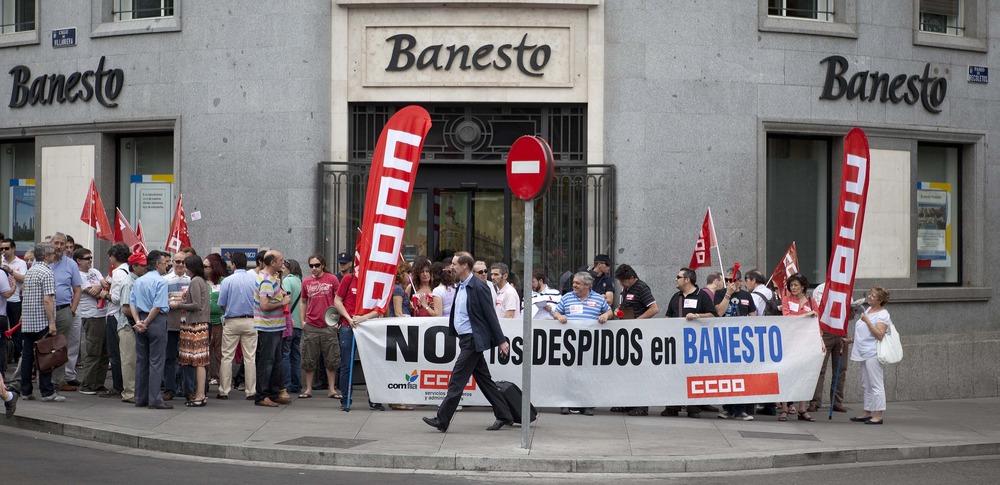
Spain will seek financial help from its Eurozone partners but exactly how much won’t be known until private audits are undertaken, the country’s economy minister announced Saturday.
Earlier, European finance ministers discussed plans to offer Spain up to $125 billion (100 billion euros) in a bid to stabilize its banks — and ease concerns over the even bigger European debt crisis. That amount was described as an upper limit, not an indication of what Spain would ask for.
After Spain’s announcement, the Eurozone ministers issued a statement that they expected a formal request “shortly” and are “willing to respond favorably.”
Spain earlier said it wanted to wait for two independent audits — due by June 21 — before deciding on whether to seek aid, and it was not clear if those audits were being stepped up.
Christian Science Monitor: As Europe peers into economic chasm, Africa is rising
Spain had resisted asking for a bailout since previous ones for Greece, Ireland and Portugal came with demands for tax increases and spending cuts.
Economy Minister Luis de Guindos emphasized the aid would not come with “micro-economic conditions”.
U.S. Treasury Secretary Tim Geithner issued a statement praising the “concrete steps on the path to financial union” for the Eurozone.
Investors and politicians have been increasingly concerned that Spain might not be able to find the money to prop its ailing banks by itself.
Spain warns time is short as G7 discusses eurozone crisis
A report from the International Monetary Fund estimated Spanish banks need a recapitalization injection of at least $50 billion following a stress test it performed on the country’s financial sector. That report came out early Saturday, three days ahead of schedule, underscoring the urgency of the situation.
Officials said there had been a heated debate over the IMF’s role in Spain’s bank rescue, which Madrid wanted kept to a minimum. It will not provide any of the money.
In the end it was agreed that the IMF would help monitor reforms in Spain’s banking sector, while EU institutions would ensure Spain stuck to its broader economic commitments.
Eurozone policymakers were eager to shore up Spain’s position before June 17 elections that could push Greece closer to a Eurozone exit and unleash a wave of contagion.
Nonetheless, some analysts said financial markets might be calmed by the announcement when they reopen on Monday.
“The figure of up to 100 billion (euros) is more encouraging and pretty realistic; it’s an attempt to cap the problem,” said Edmund Shing, European head of equity strategy at Barclays.
“The issue, however, is there is still a lack of detail about where the money’s coming from, which is crucial. The market will treat it with some caution until they see how it will be funded.”
World Bank on Greece crisis: Spain and Italy could be next
The Eurogroup said the funds could come from either from a temporary rescue fund, the EFSF, or the permanent mechanism, the ESM, which is due to start next month. Finland said that if money came from the EFSF, it would want collateral.
EU sources said there was a preference to channel money to Spain through the ESM, rather than the EFSF. Under the ESM, an approval rate of 90 percent or less is needed to trigger aid, and the fund also has more flexibility in how it operates.
“That’s why it’s so important that the ESM … be ratified quickly,” German Finance Minister Wolfgang Schaeuble said.
Spain has already spent $20 billion bailing out small regional savings banks that lent recklessly to property developers. Spain’s biggest failed bank, Bankia, will cost $25 billion to rescue and its shareholders have been wiped out. The race to resolve the banks’ troubles comes after Fitch Ratings cut Spain’s sovereign credit rating by three notches to BBB, highlighting the Spanish banking sector’s exposure to bad property loans and to contagion from Greece’s debt crisis. It said the cost to the Spanish state of recapitalizing banks stricken by the bursting of a real estate bubble, recession and mass unemployment could be between $75-$125 billion. The higher figure would be in a stress scenario equivalent to Ireland’s bank crash. Greeks withdraw $894 million in one day Italy could yet get dragged in too. Its industry minister, Corrado Passera, said the economic situation in Italy had improved since the end of 2011, but remained critical. “Europe was more disappointing than we had expected, it was less capable of tackling a relatively minor problem such as Greece,” Passera told a conference. While Spain would join Greece, Ireland and Portugal in receiving a European financial rescue, officials said the aid would be focused only on its banking sector, without taking the Spanish state out of credit markets. That would be crucial to avoid overstraining the Eurozone’s rescue funds, which would struggle to cover Spanish government borrowing needs for the next three years plus possible additional assistance for Portugal and Ireland. Conditions in the plan would be related to the banks and would probably not add to the austerity measures and structural economic reforms that Spain’s government has already put in place, EU and German sources said. A “bailout lite” would help salvage Spanish pride. Spain is the world’s 12th largest economy and No. 4 in the Eurozone. EU and German officials have cited national pride as a barrier to requesting a full assistance program. The Associated Press and Reuters contributed to this report. More world news from msnbc.com and NBC News: Follow us on Twitter: @msnbc_world
The place for in-depth analysis, commentary and informed perspectives. Recommended


