








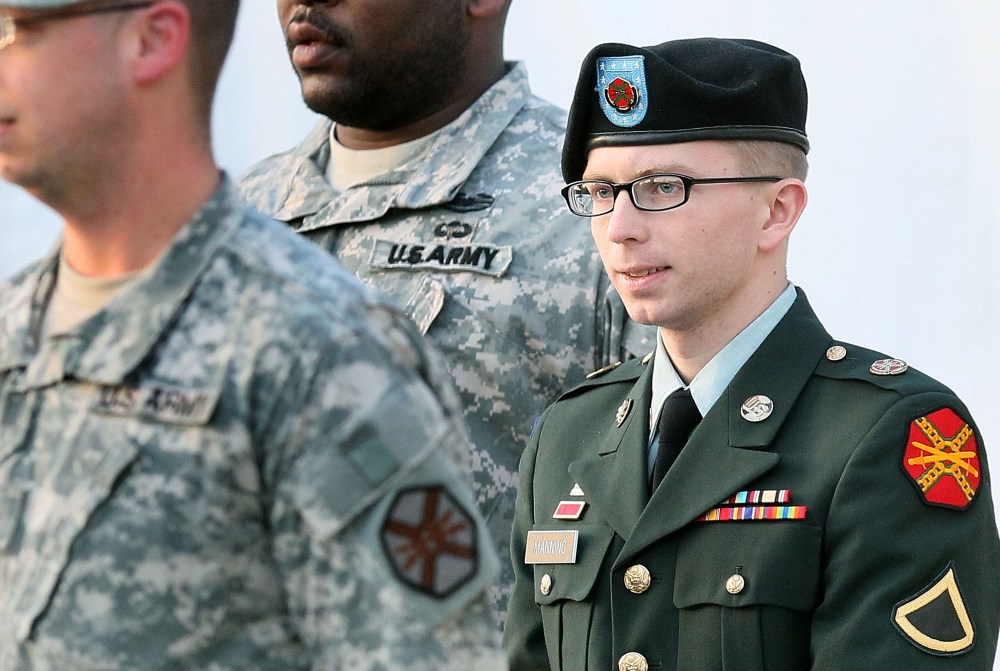
It’s unclear how many Americans are paying attention to the trial of Private First Class Bradley Manning, which got underway this week after three years of preparation. But it is far more than just a domestic legal matter: it is a global event that continues to shape international perceptions of the United States, its policies and values.
The compromise of hundreds of thousands of internal U.S. documents through WikiLeaks was unprecedented in its size and scope. In ways large and small, it touched virtually every country in the world. Since the United States remains the world’s predominant power (notwithstanding a domestic political debate to the contrary), there is something in this now omniscient archive for everyone: lots to admire about America if so inclined or grist to criticize, which more people around the world have been inclined to do in recent years.
Bradley Manning says he distributed the vast array of documents, including diplomatic cables and raw military intelligence reports, to start a debate. In this, he succeeded. Because these detailed accounts of American policies, actions and analysis are online, it is the gift that will keep on giving indefinitely.
Given its unique nature, the Manning case is viewed through several different lenses.
It is seen as a test of the U.S. commitment to freedom of the press. Julian Assange is not a journalist, but he formed a successful partnership with many leading global media outlets–The Guardian, Le Monde, El Pais, Der Spiegel, The New York Times, Al Jazeera and Asahi Shimbun–to report on the material. That makes it difficult to separate Assange’s actions from those of real journalists.
The United States has investigated Assange as a potential co-conspirator and that makes some leap to the conclusion that journalists could be investigated that way too. The unfortunate convergence of the Manning case with other aggressive leak investigations adds force to this argument.
If the United States is perceived as at war with the Fourth Estate, whether true or not, it becomes more challenging for Washington to credibly point fingers at media censorship in Beijing, Moscow and the Middle East. By no coincidence, Russian, Chinese and Arabic broadcast networks were avid reporters on the Manning case this week with hourly updates and lengthy panel discussions on its implications.
Perhaps the most troublesome of Manning’s leaked material was the so-called Collateral Murder video that depicts a trigger-happy Apache gunship crew attacking civilians (including children) and journalists they mistook as insurgents. The U.S. military viewed the video as the fog of war, but much of the world saw it as evidence of America’s flawed strategy in Iraq. As a result, many see Manning as a whistleblower, not an enemy of the state.
Global perceptions of military justice are already challenged by the existence of the military prison at Guantanamo and military commissions that have yet to meet international standards of justice. Many question whether Manning will receive a fair trial. The answer is yes, but the international skepticism has meaning.
Despite coming into office in 2009 committed to resetting global perceptions of the United States and its foreign policy, the Obama administration has taken an arm’s length approach to the Manning prosecution. The president declined to question the pre-trial treatment of Manning in the brig at Quantico even though a United Nations report termed it “degrading.” Even the trial judge in the Manning case concluded it was excessive.
The Army did make important adjustments in Manning’s pre-trial confinement, but in the courtroom, it is now vigorously pursuing the charge that Manning “aided the enemy” through WikiLeaks. A conviction could result in a life-sentence. In doing so, the military passed up a potential plea-bargain, a step done routinely in the civilian justice system. In February, Manning pled guilty to a number of charges that carry a 20-year jail sentence. This was more than enough to send a stern message to those in government charged with protecting the national interest and safeguarding classified information: fail in your duty and there will be stiff consequences. While Manning clearly harmed U.S. national interests and placed lives in jeopardy, it’s hard to argue that he “aided the enemy” any more than the Apache crew or those responsible for Abu Ghraib. Instead of a plea-bargain that would take Manning off the global stage, his trial will continue for weeks, and with it an unwelcome summer rerun of difficult decisions, questionable policies and flawed perceptions that can only further erode global perceptions of the United States. None of this is necessarily true or fair, but in our globalized and interconnected world, perception easily passes for reality and can have lingering and important long-term consequences.
P.J. Crowley Recommended


