








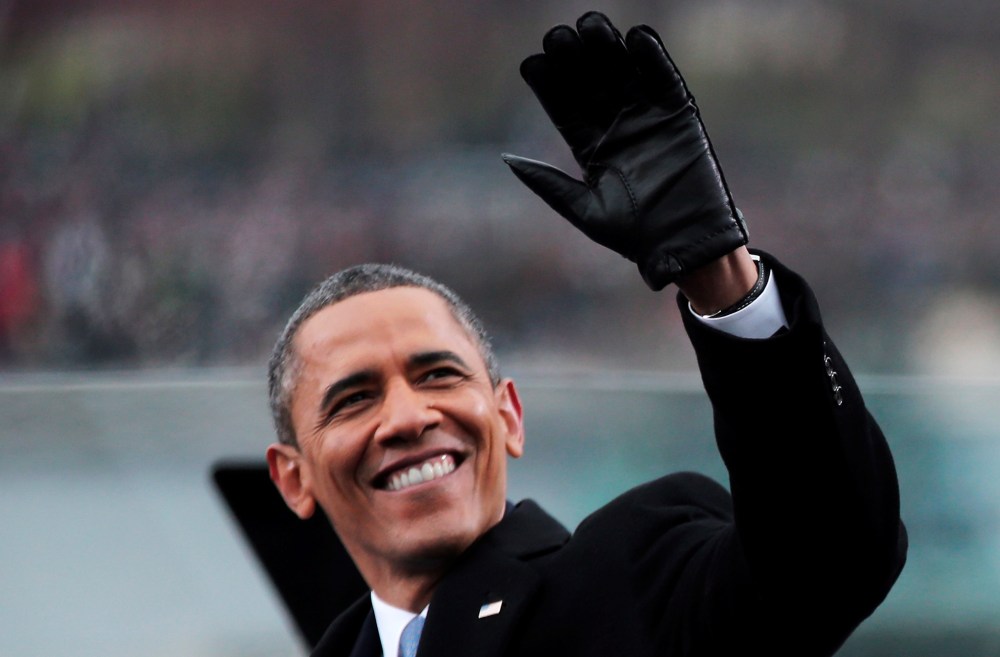
I will admit, as I watched the president’s inaugural address on Monday morning, I was definitely not expecting this:
Obama: “We will respond to the threat of climate change, knowing that the failure to do so would betray our children and future generations…Some may still deny the overwhelming judgment of science, but none can avoid the devastating impact of raging fires, and crippling drought, and more powerful storms. The path towards sustainable energy sources will be long and sometimes difficult. But America cannot resist this transition; we must lead it.”
You’ll recall that with the exception of a single line in his DNC speech, our current state of climate peril was barely mentioned in the campaign, in fact it was the first time in 24 years that it was never raised at any of the debates. So I was not the only commentator who was surprised to find such a passionate, lengthy passage in his speech.
A speech, of course is just that, and often we have a tendency to over-estimate just how much presidential rhetoric can accomplish. But right after the speech, The New York Times ran an article with the headline “Speech Gives Climate Goals Center Stage.” “President Obama made addressing climate change the most prominent policy vow of his second Inaugural Address,” reported the Times, “setting in motion what Democrats say will be a deliberately paced but aggressive campaign built around the use of his executive powers to sidestep Congressional opposition.”
Libertarian author Gene Healy has coined the term the “cult of the presidency” to refer to our cultural investment in the idea of the president as a kind of quasi-monarchical, near omnipotent colossus who doth bestride our system of government, directing the nation’s attention and resources at a whim. And in the sphere of national security that is increasingly what we actually have. But when it comes to domestic and economic policy the president isn’t really the most pressing issue. If you were to start listing the obstacles to climate progress in order you’d start with the major fossil fuel companies themselves, you’d then go to the conservative noise machine that has converted climate change into a culture war issue, another example of out of touch elites trying to tell you what to do, and then the House Republican caucus, which almost unanimously committed to the most depraved kind of denialism, then Senate Republicans who managed to kill the last big climate bill and then Democrats from coal country and other regions that depend on fossil fuel extraction, then Democrats who say they care about climate change but wouldn’t go along with the kind of reform of the filibuster that would make a Senate climate bill a reality and only after that would you get to President Barack Obama.
For this reason, it’s somewhat perverse to focus discussions of climate policy exclusively on Barack Obama. But Barack Obama is also the most powerful person in the world who says he’s committed to averting climate disaster, and with acknowledging that comes some responsibilities. It turns out that even short of congressional action there are a number of extremely significant things the executive branch could do to reduce emissions, develop alternatives and move us closer to the radical, generative transformation of our industrial life we must have very soon. The environmental protection agency actually has the legal authority to begin regulating carbon under the Clean Air Act–no need for congressional approval. The executive branch is such a massive purchaser of energy, vehicles and equipment, it could use that purchasing power to create new, vibrant markets for clean energy. And the White House currently has the authority to block the Keystone XL pipeline, which would pipe extremely carbon intensive tar sands oil from Canada to refineries in Texas. If that pipeline is built, it means a huge new source of emissions into the foreseeable future. The cliche about second presidential terms, one with, I think, a good deal of truth to it, is that in a second term, a president’s attention turns to leaving a legacy. I am almost certain that 50 or 100 years from now, the only issue that will really matter to people is what we did about the climate.
Chris Hayes hosts “All In with Chris Hayes” at 8 p.m. ET Tuesday through Friday on MS NOW. He is the editor-at-large at The Nation. A former fellow at Harvard University’s Edmond J. Safra Foundation Center for Ethics, Hayes was a Bernard Schwartz Fellow at the New America Foundation. His latest book is “The Sirens’ Call: How Attention Became the World’s Most Endangered Resource” (Penguin Press). Recommended


