








Something pretty remarkable has happened in the last month, and I don’t think many people have noticed. After several years in which climate policy was sidelined from beltway political discussion, after a presidential campaign in which the issue was almost entirely ignored, it’s clawing its way back into the conversation. You can feel the terrain shifting beneath our feet subtly but unmistakably.
First there was Sandy, a devastating, 100-year storm that hit the nation’s media capital, highlighted just how much damage higher sea levels can do, and caused an estimated $50 billion in damages. The elephant in the room–the fact that storm intensity will likely grow in the future, and combine with higher sea levels to do even more damage–did not go unnoticed by politicians.
Then came news that 2012 was the warmest year in the United States ever recorded, and not by a little bit. By a full degree Fahrenheit. And then, suddenly, after saying hardly a word about the climate for much of the last year, the president himself, to his great credit, has pushed it back onto the agenda. In his inaugural address he surprised observers by saying this early in the speech, as the first domestic policy issue he mentioned after dealing with the economy:
“We will respond to the threat of climate change, knowing that the failure to do so would betray our children and future generations. Some may still deny the overwhelming judgment of science, but none can avoid the devastating impact of raging fires, and crippling drought, and more powerful storms.”
During Tuesday night’s State of the Union speech, the president once again foregrounded climate, putting it as the first domestic policy issue after the economy and was even more emphatic in his promises to act, saying, “I urge this Congress to pursue a bipartisan, market-based solution to climate change, like the one John McCain and Joe Lieberman worked on together a few years ago. But if Congress won’t act soon to protect future generations, I will.”
Then on Thursday, the independent congressional watchdog the Government Accountability Office came out with a new report identifying risks to the government and at the top of the list was the the fiscal exposure the federal government faces due to Climate Change. Remarkably, Darrell Issa, the Republican Chairman of the House Oversight and Government Reform Committee–he of the Fast and Furious scandalmongering, bete noir of liberals–had this to say about the GAO report:
“I don’t want to walk away from anything in this report…when you look climate change and Hurricane Sandy, and others, it points out that we have under-prepared through FEMA, and through our emergency funds including flood control for a generation.”
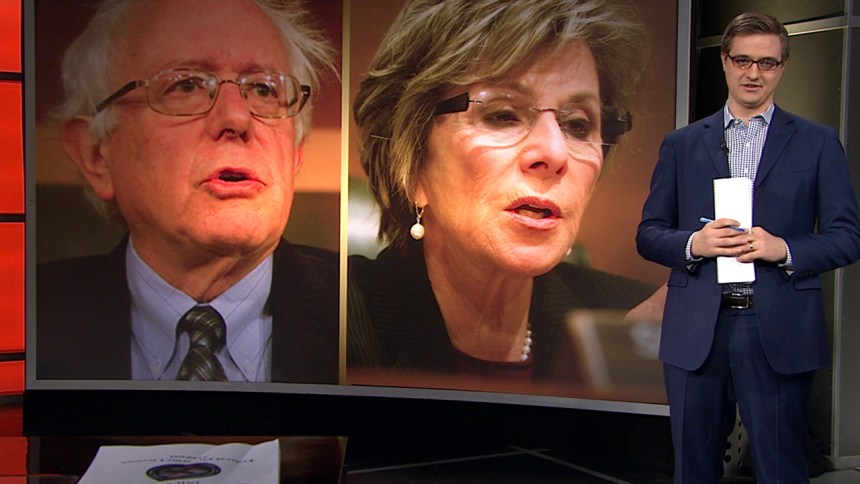
Finally this week, Sens. Bernie Sanders and Barbara Boxer introduced a new, ambitious climate bill that, in the admittedly unlikely event it is passed, would represent a major victory for climate activists with its $20 tax on each ton of carbon pollution as well as its enabling the Environmental Protection Agency to regulate fracking.
After several years of painful, bewildering, infuriating exile, climate policy is back on the agenda. Thank god.
Now, I don’t want to minimize just how far things still have to go and how many challenges there are to overcome to make the kinds of changes required to reduce the risk of total disaster. We were reminded once again this week of the lengths the wealthiest industry in the country, the fossil fuel companies who have trillions of dollars on the line, will go to preserve their right to dump their pollution cost free.
This week the Guardian newspaper reported the conservative dark money group Donors Trust funneled almost $120 million between 2002 to 2010 to groups denying the science on climate change. And that’s on top of the sizable funding from Koch Industries, Exxon and others towards denialist groups. That funding and the pro-pollution lobbying infrastructure aren’t going anywhere.
There’s also the president himself who, while admirably talking about the issue, has yet to indicate whether or not he will use his authority to block the wildly destructive Keystone Pipeline, and who after his strong words in the State of Union, didn’t indicate in his follow-up Google Plus Fireside Hangout that the administration would break any new ground in executive action: “The same steps that we took with respect to energy efficiency on cars, we can take on buildings, we can take on appliances, we can make sure that new power plants that are being built are more efficient than old ones, and we can continue to put research and our support behind clean energy that is going to continue to help us transition away from dirtier fuels.” And then, perhaps most pernicious at this moment, is the strange culture of Washington that views climate as a niche, special interest issue relevant only to environmental groups and not every living human on the planet. While pundits, strategists, columnists and politicians absolutely obsess over budget projections for the year 2040, those same strategists, columnists and politicians seem remarkably sanguine about the fact that Arctic ice volume has shrunk by more than a third in the last decade and more and more recent data that indicate our previous climate models have underestimated the terrifying rate of change to our climate and overestimated just how much time we have left to get our collective asses in gear. No one will care in 30 years what the deficit was in 2013. I guarantee you. Quick pop quiz: what was the deficit in 1953? or 1923? or, heck 1883? The right answer is: you don’t know because it doesn’t matter. What does matter are the molecules in the air, much much more than numbers on a balance sheet. And I’m sorry to say the strange apathy about the climate extends past the usual suspects of deficit-obsessives to people that broadly constitute the president’s base. It’s a standard liberal trope of activists to whine that fellow liberals aren’t paying enough attention to the issue they care most about, but at the risk of falling into it, I can’t help but notice that even when the president tries to insert climate into the conversation it tends to fall with a dull thud among the bulk of progressive politicians, activists, and media outlets. Washington will never make climate a priority until the left makes it a priority.
Chris Hayes hosts “All In with Chris Hayes” at 8 p.m. ET Tuesday through Friday on MS NOW. He is the editor-at-large at The Nation. A former fellow at Harvard University’s Edmond J. Safra Foundation Center for Ethics, Hayes was a Bernard Schwartz Fellow at the New America Foundation. His latest book is “The Sirens’ Call: How Attention Became the World’s Most Endangered Resource” (Penguin Press). Recommended


