








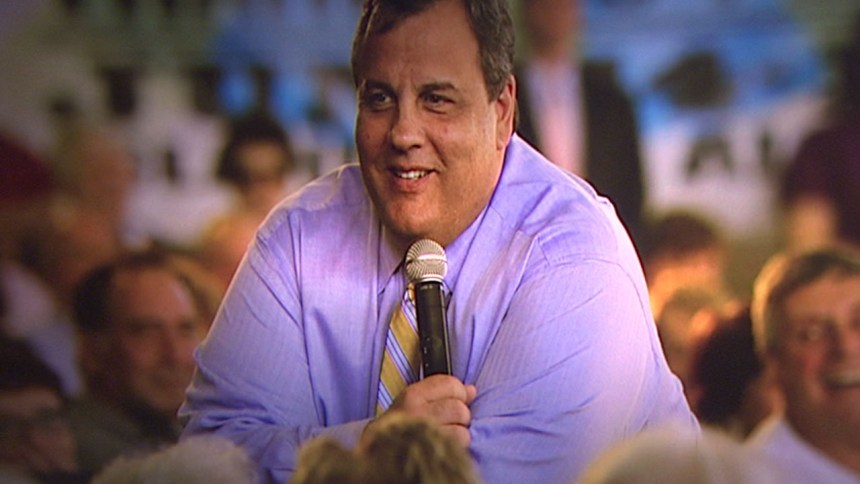
New Jersey Governor Chris Christie looks like he will coast to re-election. A recent Quinnipac poll showed he is currently up 32 points over his Democratic challenger, State Senator Barbara Buono.
But while Christie fans around the country are cheering for a victory across party lines, that could propel his national ambitions, what many observers don’t realize is that being chief executive of New Jersey could actually make it harder for the governor to launch a bid for the White House in 2016.
Many of Christie’s potential liabilities for a national run have been widely discussed—from his temper, to his weight, to his record in New Jersey—but there’s another critical obstacle that he faces: a set of campaign finance laws that limit the ability of a sitting governor, particularly the governor of New Jersey, to raise millions in campaign cash from Wall Street.
To understand the challenge Governor Christie faces, we have to go back 20 years to when state and local candidates and officials around the country were being flooded with campaign donations by bond dealers eager to win millions of dollars in government business. Companies like Goldman Sachs and Morgan Stanley were throwing money at candidates to finance big-ticket projects like new bridges and roads.
These pay-to-play scandals around the country caught the eye of the Securities and Exchange Commission. One of those cases involved the then-Democratic Governor of New Jersey, Jim Florio, whose chief of staff also ran a bond business.
So in 1994, the SEC issued tough new rules to clamp down on corruption. Bond dealers and their employees involved in securing government bond business were prohibited from giving donations of more than a couple hundred dollars dollars to state and local elected officials with the power to steer hundreds of billions of dollars to financial companies. If bond dealers were caught breaking the rules, they’d have to forfeit business with the state for two years—a stiff penalty that would cost them millions.
In 1996, a Morgan Stanley executive donated $1,000 to his old college buddy’s run for U.S. Senate. But that friend was Massachusetts Governor William Weld, who had authority over issuing state bonds. As a result of that donation, Morgan Stanley was barred for two years from millions of dollars in state business.
In 1998, a $200 donation to then- Texas Governor George W. Bush’s re-election by the CEO of A.G. Edwards & Sons dealt the firm a stiff blow. A.G Edwards lost two years of business with the state—business which had brought in $375 million over the three previous years.
Ken Gross, who leads the political law practice at the law firm Skadden Arps, said in an interview that in 2000 then-Governor George W. Bush and in 2008 then-Governor Sarah Palin received donations for their national races from bond dealers that subsequently were put out of business because of the crippling penalties.
This tough campaign finance law has taken a big bite out of campaign cash for state office holders running for national office over the past 20 years. According to Gross, who represents corporate clients and political candidates including Mayor Michael Bloomberg, tens millions of dollars in campaign cash has been frozen out of races.
But the restrictions on campaign cash expanded exponentially three years ago, when the Dodd-Frank financial reforms extended the campaign finance laws to even more financial professionals doing business with the state, including pension fund advisers. Now thousands more companies—including almost every hedge fund, private equity firm, and investment house—are subject to a new set of campaign restrictions.There’s even a first-time ever limit that applies to the big banks for swap deals, as well as an additional rule that will soon be implemented that bars donations from employees advising state projects.
The impact of these laws grew in last year’s presidential election, the first in which no one took federal funds for the primaries or the general election.
In his new book, Collision 2012, Washington Post Chief Correspondent Dan Balz reports on how the rule affected Governor Rick Perry’s failed bid for the Republican nomination.
“According to William Canfield, Perry’s campaign counsel, when Perry began trying to raise money in New York, lawyers for Goldman Sachs told the firm that none of its employees could donate to his campaign,” writes Balz. “Perry’s campaign hired former SEC chairman Harvey Pitt to examine the issue. Pitt said there was no way around it, and Perry’s campaign essentially wrote off any efforts to raise money from the financial community in New York…”
All this adds up to a major headache for any state official running for federal office, as Gov. Perry found out. It spells particular trouble for Governor Christie if he wins re-election and decides to make a bid for the White House. Christie’s donor base draws heavily on finance professionals a stone’s throw away on Wall Street. The FIRE sector—Finance, Insurance and Real Estate—was the single largest source of Christie’s donations in his 2009 campaign, according to The National Institute on Money in State Politics.
Nicholas Confessore reported in September of 2011 that a group of wealthy New York Republican donors, drawing heavily from the finance community, were pushing for a Christie presidential bid. “Meet the Draft Christie committee,” wrote Confessore. “A small but influential group of Republican-leaning donors and activists, many based in New York, united by a shared desire to see Gov. Chris Christe of New Jersey run for president.” But many of these excited would-be donors could not donate to Christie if he were to run, and nor could they bundle funds for him, ask others to contribute to him, give in-kind donations, host an event, or even give to the party.
Another challenge for Christie is that New Jersey has the strongest governorship in the nation, giving Christie the most authority over his state’s financial deals, and the most vulnerability to these campaign finance laws. For example, Christie picks nine out of the 16 members of the state investment council, giving him appointment authority over bond deals. New Jersey also has the strictest state pay-to-play laws in the country, inflicting double the penalties of federal law and affecting even more companies. Christie has the bad behavior of Jim Florio, as well as Gov. Jim McGreevey and a raft of New Jersey politicians to thank for these tough rules he inherited. The impact of this landmine of laws on Christie was not lost on finance-veteran Mitt Romney when he was selecting a vice presidential running mate in 2012. Last August the New York Post reported that the Romney campaign told Christie that he would have to resign his governorship to join the Romney ticket, so as not to trigger the pay-to-play rules. According to multiple reports, Romney asked Christie whether he would resign as governor in order to join the Romney ticket. “Christie refused to resign under any circumstances,” a Romney source said, according to the Post. “It had nothing to do with Chris’ personality and everything to do with money. The story continues, “Christie’s aides tried to find a way around the rules – like passing off power over state bonds and pensions to another official. But that didn’t satisfy Romney officials. They feared that if Christie ran for veep and didn’t resign, the Obama campaign could challenge any Wall Street donations. According to Balz, Romney personally phoned Christie to discuss the issue on July 15 of last year. Romney “raised the issue of setting up separate committees to wall off Christie from his fund-raising,” writes Balz. “Christie thought that was too cute by half, that it wouldn’t’ pass the smell test. He thought it would cause a serious political problem for the ticket. He was also worried about the potential impact on his state, that it would put New Jersey at risk in future bond underwriting.” Christie clearly understood the strict nature and broad reach of these laws. While these strict laws prohibit donations and bundling for candidates, parties and PACS, we don’t yet know if they will also restrict donations to Super PACS. But even if financial firms can still give to outside groups, it would put the cash outside the reach of the Christie campaign. So it raises the question: if Governor Christie is re-elected governor and wants to run for president, will he decide to leave office early to avoid fundraising restraints that would put him at a greater disadvantage than any other contender? Correction: An earlier version of this article incorrectly named New Jersey Gov. William Weld.
The place for in-depth analysis, commentary and informed perspectives. Recommended


