








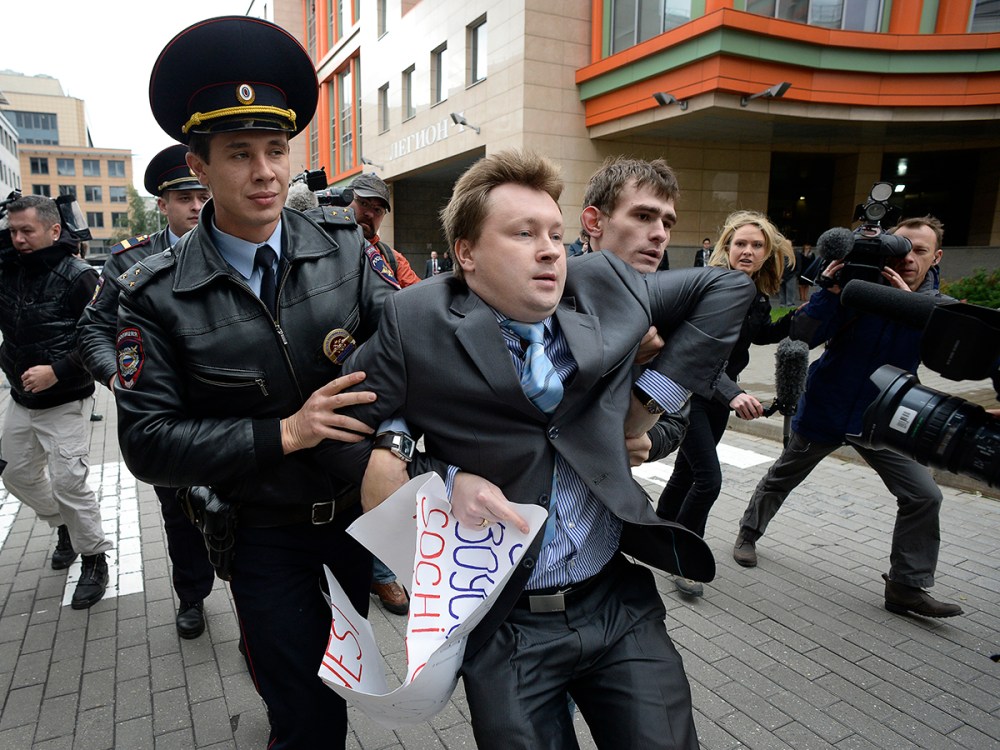
Still under fire for a series of newly enacted anti-gay laws, Russia on Thursday missed what could have been viewed as an opportunity to mend fences with the LGBT community and its international allies.
In an unprecedented ministerial-level meeting at the United Nations, representatives from Argentina, Brazil, Croatia, El Salvador, France, the Netherlands, New Zealand, and Norway, joined Secretary of State John Kerry, the U.N. high commissioner of human rights, gay rights advocates, and other high level representatives of the European Union to discuss violence and discrimination against LGBT individuals.
“Cognizant of the urgent need to take action, we therefore call on all United Nations Member States to repeal discriminatory laws, improve responses to hate-motivated violence, and ensure adequate and appropriate legal protection from discrimination on the basis of sexual orientation and gender identity,” participating members of the group said in its declaration.
Organized by and for this cross regional group–known as the LGBT Core Group at the U.N.–Russia was not explicitly invited. Neither the Russian Embassy, nor the Russian Mission to the U.N. claimed to have known about the meeting.
While it was limited to this core group, however, the meeting “was announced,” said Charles Radcliffe, head of the global issues section at the UN human rights office in New York. “The fact that it was happening was not secret,” he said. “Any country could have requested to join.”
Russia’s absence underscores a wave of criticism engulfing the country for its anti-gay policies, the most contentious of which bans “propaganda of nontraditional sexual relations” among minors. That law, along with two others–one banning the adoption of Russian-born children to gay couples and to individuals in countries that allow gays to marry, and another classifying “homosexual propaganda” as pornography–have sparked worldwide protests, as well as calls to boycott the 2014 Winter Olympics in Sochi.
Over the summer, President Obama criticized Russia’s anti-gay posture, saying such discrimination violated “basic morality.” But on Thursday, the International Olympic Committee declared the “propaganda” law was not in violation of the Olympic charter’s anti-discrimination clause.
Participants at Thursday’s ministerial meeting adopted a declaration stating their countries’ “strong and determined commitment to eliminating violence and discrimination against individuals based on their sexual orientation and gender identity.” “Many countries have embarked on historic reforms–strengthening anti-discrimination laws, combating hate crimes against LGBT people and sensitizing public opinion,” said U.N. High Commissioner for Human Rights Navi Pillay in her remarks Thursday. However, she noted that serious challenges remain, citing as examples recent laws proposed or adopted in several Eastern European and African countries. “They say that same-sex relationships and transgender identities go against their culture, religious belief or traditional values,” said Pillay. “My answer is that human rights are universal.”
Emma Margolin
Emma Margolin is a reporter at MSNBC.com. Recommended


