








Five communities will receive targeted federal assistance and tax credits as part of a new initiative called “promise zones,” the White House’s latest push to combat poverty, President Obama announced on Thursday.
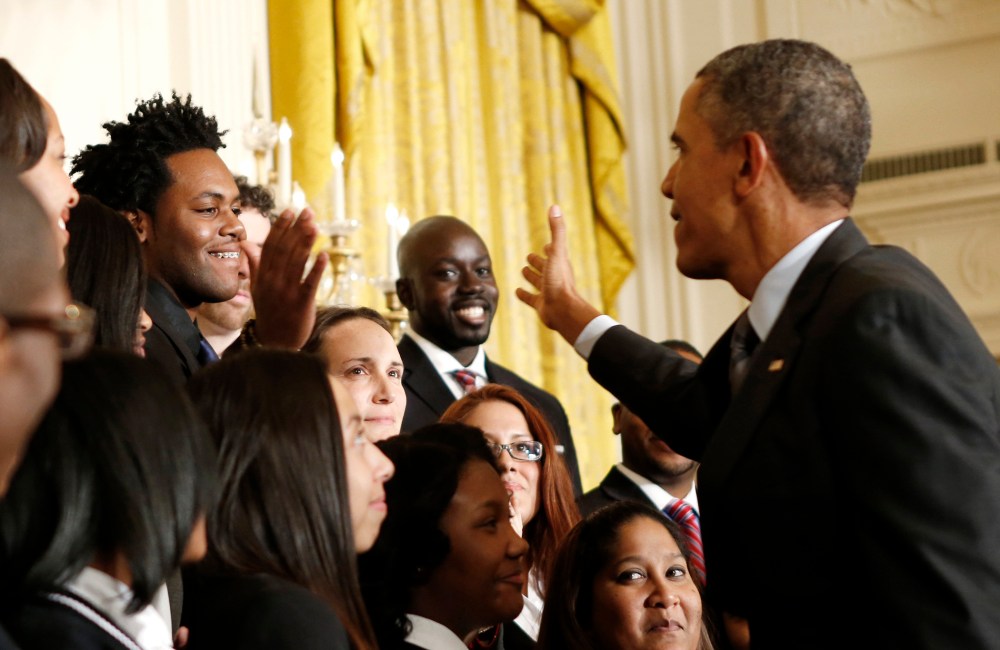
Flanked by students supported through the non-profit Harlem Children’s Zone in the East Room of the White House, Obama affirmed his commitment to “changing the odds of every American child so that no matter who they are, and where they were born, they have a chance to succeed in today’s economy.”
Communities hit hardest by the recession — in San Antonio, Philadelphia, Los Angeles, Southeastern Kentucky, and the Choctaw Nation of Oklahoma — will be the first “zones” to receive federal funding, but the administration hopes to ultimately have 20. Obama first unveiled the idea a year ago in his State of the Union address, and he declared on Thursday that 2014 would be “a year of action.”
The Departments of Education, Housing and Urban Development, Commerce, Health and Human Services, Justice, and Agriculture will all participate in the program, which partners with local officials, businesses, faith institutions, and parents to strategically allocate resources in each community as needed. While the plan is part of the administration’s mission to tackle income inequality, “promise zones” focus on economic mobility and use state and local leaders to combat poverty — ideas embraced by lawmakers on both sides of the aisle.
“I genuinely believe that this is not a partisan issue,” Obama said. “I don’t care if the idea is Democrat or Republican; I do care that they work.”
To illustrate that point, Kentucky Republican Sen. Rand Paul and Senate Minority Leader Mitch McConnell–both fierce critics of Obama –attended the president’s announcement on Thursday. Paul had recently introduced legislation similar to Obama’s plan, calling for “economic freedom zones” in distressed cities like Detroit. McConnell released a statement on Wednesday praising the president for making Eastern Kentucky a “promise zone,” but he also blamed Obama’s “hostile policies” for the region’s problems.
Though he reached across the aisle, the president did not abandon his Democratic colleagues. He praised the Senate for advancing legislation to extend long-term unemployment insurance and called on the GOP-controlled House to do the same. He also stressed that while “government does not have all the answers,” it still “has a role to play.”
“Communities will design from the bottom-up, not the top-down, what they need,” Obama said. But the federal government “will help them succeed not with a handout, but as partners with them every step of the way.” The president – sometimes criticized as aloof — struck an unusually personal note in his speech, saying that the issue of improving communities from the ground-up is what drove him into politics. At the end of his remarks, Obama shared a story of one of the boys standing behind him, Roger Brown, who went from being the “class clown” to becoming the first person in his family to go to college. “If you want to know why I care about this stuff so much, it’s because I’m not that different than Roger,” Obama said. “There was a period of time in my life where I was goofing off. I was raised by a single mom; I didn’t know my dad.” “They only difference between me and Roger was my environment was more forgiving than his,” Obama continued. “So if Roger can make it, and if I can make it…every kid in this country can make it. But we’ve got to believe in that. We can’t just give lip service to it, and it can’t just get caught up in a bunch of political arguments.”
Emma Margolin
Emma Margolin is a reporter at MSNBC.com. Recommended


