








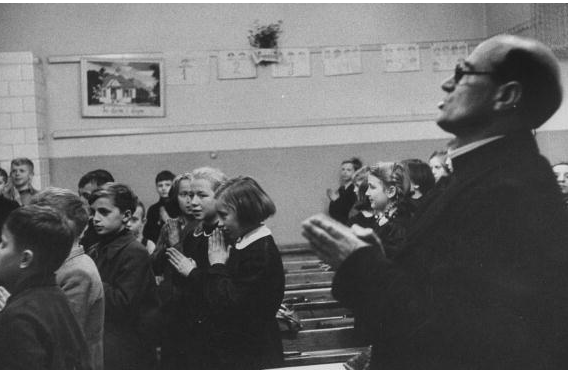
Fifty years after the Supreme Court deemed religious exercises in public schools unconstitutional, the debate over school prayer is alive and well.
On June 17, 1963, the high court issued a landmark 8-1 ruling outlawing Bible readings or the recitation of the Lord’s Prayer as assigned in the public schools of Maryland and Pennsylvania. The case was Abington v. Schempp, and the young man at the center of the controversy was 16-year-old Ellery Schempp, then a junior at a suburban high school outside of Philadelphia.
“I thought the practices in Abington schools and Pennsylvania law were so transparently in violation of the First Amendment and the Establishment clause,” said Schempp, now 72-years-old, in an interview with The Atlantic. “I had the naive notion that if I simply pointed this out, the grown-ups would fix this matter.”
Writing for the majority, Justice Clark found the Bible readings as prescribed to be “religious exercises, required by the States in violation of the command of the First Amendment that the Government maintain strict neutrality, neither aiding nor opposing religion.”
“The place of religion in our society is an exalted one, achieved through a long tradition of reliance on the home, the church and the inviolable citadel of the individual heart and mind,” wrote Justice Clark. “We have come to recognize through bitter experience that it is not within the power of government to invade that citadel, whether its purpose or effect be to aid or oppose, to advance or retard.” Since Abington and a decision the year before in a similar case–Engel v. Vitale–the presence of religion in schools seems to have only expanded. Through student ministries, classes, after-school programs, religious clubs, Bible study, and interfaith groups, God and faith are more present than ever, found the Christian Science Monitor. Last year, when a student sued to have a prayer removed from the wall of her school auditorium, a Rhode Island state representative reacted hotly, calling her an “evil little thing.” And earlier this year, Democratic Rep. Nick Rahall of West Virginia introduced an amendment to the Constitution that would ensure the protection of voluntary school prayer. As the nation awaits landmark decisions on voting rights, affirmative action, and marriage equality cases, it’s important to remember that sometimes the high court’s ruling doesn’t close the book on an issue–it’s only another chapter.
Emma Margolin
Emma Margolin is a reporter at MSNBC.com. Recommended


