








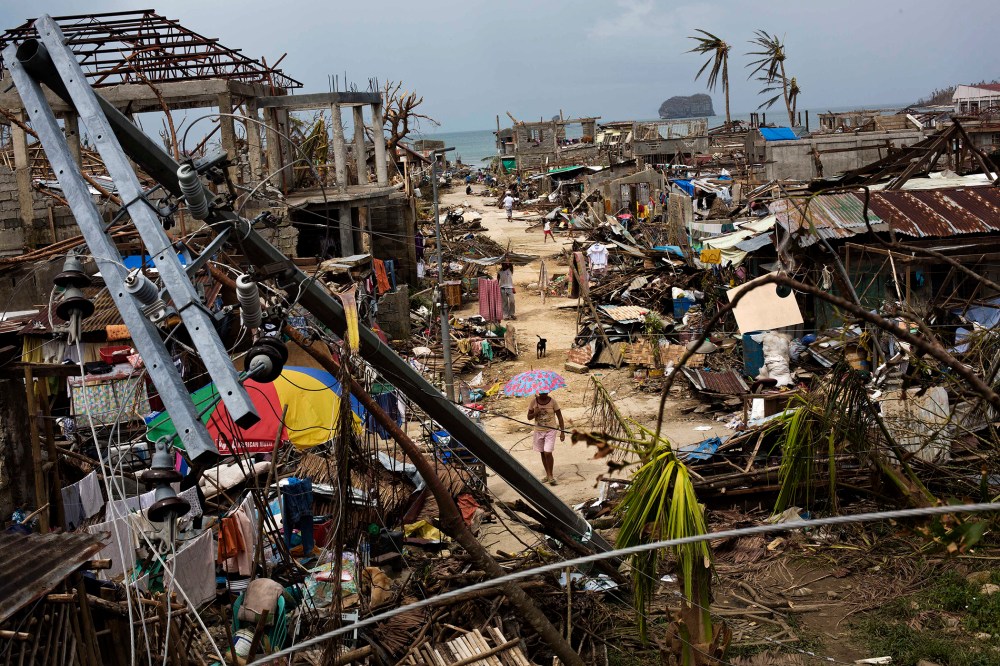
President Obama on Thursday pledged continual assistance to the typhoon-ravaged Philippine islands and urged Americans to help however they can.
“One of our core principles is when our friends are in trouble, America helps,” President Obama said at a news conference. “As I told President Aquino earlier this week, the United States will continue to offer whatever assistance we can. Our military personnel and USAID team do this better than anybody in the world and they’ve already been on the ground working tirelessly to deliver food, water, medicine, shelter and to help with airlift.”
Panic continues to heighten in the devastatation-gripped Philippines where survivors of Typhoon Haiyan are struggling over food shortages, lack of water, and medical aid since the storm made landfall Nov. 8. Relief workers and foreign governments are tirelessly working on the ground to offer relief to the 11.5 million people who have been affected and over 615,000 displaced by the typhoon.
Thursday’s arrival of the aircraft carrier USS George Washington will be a major addition to the international aid already on the ground. The carrier will set up off the coast of Samar Island near the Gulf of Leyte to first assess the overall damage and provide medical supplies and water. The George Washington carrying purifying machines that can purify up to 100,000 gallons of water per day.
The fleet will also bring 21 helicopters to the area, joining six American ships in the area, including a destroyer and two supply vessels.
The airfield in Tacloban is now operating 24 hours a day, as aid is being delivered to the devastated islands of the Philippines.
Access to water has become a high priority for survivors. NBC News chief medical editor Nancy Snyderman spoke to doctors on the ground who have told her that people are boiling their water even though there have been increasing cases of severe dehydration and dysentery.
Six days after the disaster when when the storm’s 195-mph-winds and wall of water slammed into the country, hundreds of unidentified victims were buried in mass graves after workers on Thursday began collecting the bodies of victims of for burial.
With the risk of spreading water-borne diseases such as dysentery, cholera and typhoid fever becoming critical each day, city officials of Tacloban – the capital of Leyte province, the area that was hit the hardest – said they must put public safety ahead of funeral ceremonies.
“It is difficult because there is an urgency for sanitation, and to boost morale and avoid more psychological stress,” said Police Superintendent Pierre Carpio.
“There are still so many cadavers in so many areas. It’s scary,” Tacloban Mayor Alfred Romualdez told AFP.
Official confirmed deaths stood at 2,357, a figure that is expected to rise when further information is collected from other affected areas. Aid workers say the true death toll could be much higher.
After some initial confusion, a spokesperson for the UN’s Office for the Coordination of Humanitarian Affairs said 4,460 people have been confirmed dead. President Aquino said Tuesday estimated there being between 2,000 to 2,500 fatalities, significantly lower than the earlier estimate of 10,000 dead.
“At this time, it is definitely not 10,000,” Cabinet Secretary Rene Almendras said at a news conference. “There has been a body count basd on the dead lying in the streets but we can’t be accurate because there is still, some people say, there are people buried in certain areas.”
The American Red Cross has created a family tracing service in addition to other aid operations. If you are unable to reach a family member in the Philippines, you can contact your local chapter of the American Red Cross to open a tracing case. Representatives added that it has deployed two people to assist with assessments in the Philippines. It asks those who want to support relief efforts to mail a check to their local American Red Cross chapter, with “Philippines Typhoons and Flood” in the memo line. Go to redcross.org for local chapter information.
The Philippine Red Cross said it has mobilized teams on the ground to help with rescue and relief operations. Go to redcross.org.ph to donate directly to the Philippine Red Cross.
We're sending help to @philredcross. More info on that, looking for loved ones or how to help is here: http://t.co/e5XWxHX6mt #Haiyan
— American Red Cross (@RedCross) November 9, 2013
UNICEF is taking donations to help provide children with shelter, clean water, nutrition and vaccines. Representatives said its staff in the Philippines is being repositioned to help in relief efforts and 66 tons of emergency supplies are being sent from Copenhagen. An airlift set to arrive on Tuesday will include water purification systems, storage equipment and sanitation supplies. Donations can be made to UNICEF at unicefusa.org/Philippines.
#Haiyan: Our warehouse in Copenhagen is airlifting US$1.3m worth of additional supplies for another 10,000 families. http://t.co/4eEKNnth8f
— UNICEF (@UNICEF) November 11, 2013
World Food Programme, a United Nations organization, said it will send more than 40 tons of high energy biscuits and work with the Filipino government to help with logistics and emergency communications systems. Representatives said they have allocated $2 million for the disaster response and officials joined an assessment mission to survey damage in Leyte and Samar provinces. Donate by going to www.wfpusa.org or text “AID” to 27722 to instantly donate $10.
Aid workers face huge logistical challenges to reach survivors of Typhoon #Haiyan. Here's how you can help them: http://t.co/cjFEWoyL2Q
— World Food Programme (@WFP) November 11, 2013
Doctors Without Borders has deployed emergency teams in Cebu city, and an additional 50 people including medical personnel, logisticians and psychologists will arrive this week.
Save the Children is also mounting disaster relief efforts to help children and families in the region with emergency assistance.
Catholic Relief Services is accepting donations on its website as it begins moving supplies and staff to respond to the typhoon. Joseph Curry, with Catholic relief services says that victims are in desperate need of help rebuilding their homes. Lutheran World Relief staff are working to provide shelter repair kits, debris removal and household supplies to aid survivors of Typhoon Haiyan. Click the link to donate for LWR’s relief efforts. World Vision said it will provide food and water to those in evacuation shelters. Representative said it is putting together resources to assist 1.2 million people, including food, hygiene kits, emergency shelter and protection. One-time donations can be made at worldvision.org. World Concern, a global relief and development agency, is accepting donations to distribute food, emergency relief supplies, hygiene kits and access to safe drinking water to survivors of this disaster in the Philippines, as well as emotional support for traumatized children. Donate on their website or call 1-800-755-5022. Habitat for Humanity plans to offer shelter repair kits for families who need to re-build damaged homes. Help Filipino families affected by Typhoon #Haiyan #Yolanda. Donate thru #Habitat for cleanup & home repair kits http://t.co/b9Ep8Vezhe Operation USA said it will allocate donations directly to relief and recovery efforts. Oxfam aid teams are on the ground deploying clean water and sanitation materials to affected areas. They’re asking for donations to scale up their efforts. National Alliance for Filipino Concerns (NAFCON) has created a disaster relief fund for victims in the Philippines. The American Jewish Joint Distribution Committee is gathering donations for relief efforts. To contribute, go to www.jdc.org or call 212-687-6200. Mercy Corps is accepting donations on its website as emergency responders move food, water, shelter and other supplies to the region. Americares plans to deploy an emergency response team tio the islands. Go to http://americares.org or call (800) 486-4357. Google has also launched a person finder. Other countries such as Australia, Japan, Taiwan have plans to send out relief teams to assist with medical aid and assessments in the Philippines. Australia announced to dole $9.4 million dollars in addition to sending an emergency medical team. and aid to the U.N. Flash Appeal and other Australian non-governmental organizations for immediate assistance. Japan plans to fly out a 25-member medical team, and Taiwan will send $200,000 in aid. The Associated Press, Reuters, and NBC News contributed to this report.
Clare Kim Recommended


