








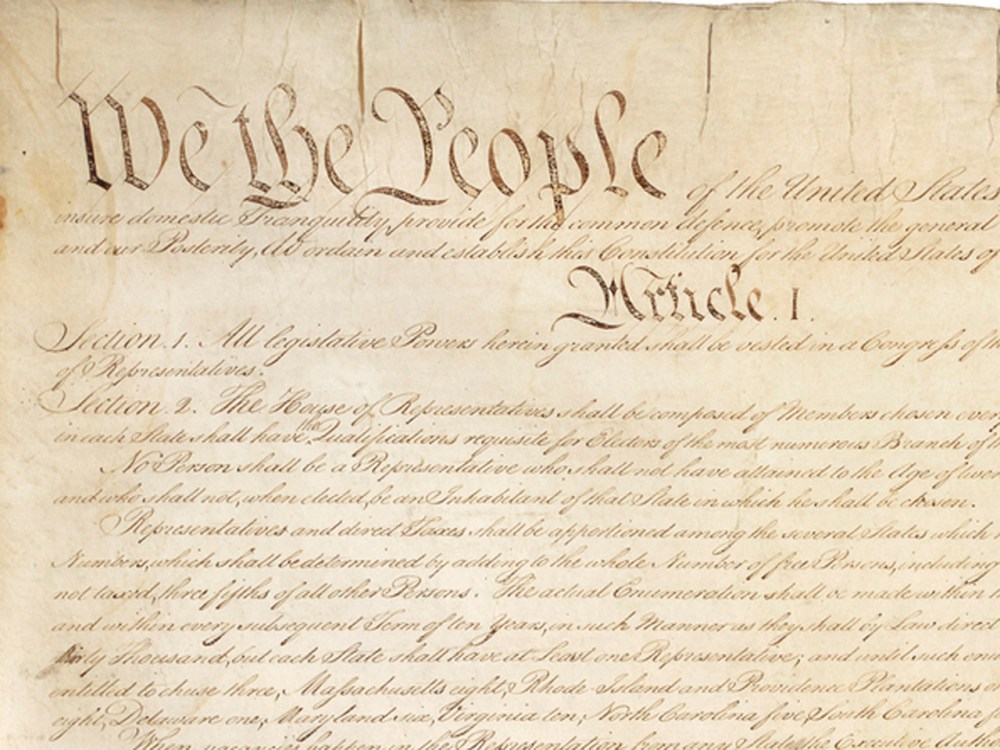
At a press conference Monday, President Obama confirmed that he would not use the 14th Amendment to unilaterally raise the debt ceiling unless both houses of Congress gave him the express authority to do so.
“If [Congress] wants to put the responsibility on me to raise the debt ceiling, I’m happy to take it,” he said. “But if they want to keep this responsibility, then they need to go ahead and get it done.”
While top Democrats have urged him to look more closely at unilateral options, Obama continues to hold Congress responsible for making good on the debts its own appropriations have incurred.
But if Republicans refuse to raise the debt ceiling, as some have suggested doing, Obama may have to act unilaterally if he wants to avoid a government shutdown. In this scenario, would the President have legal authority to raise the federal debt limit via the 14th Amendment?
Here is the section in question, Section 4 of the 14th Amendment:
The validity of the public debt of the United States, authorized by law, including debts incurred for payment of pensions and bounties for services in suppressing insurrection or rebellion, shall not be questioned. But neither the United States nor any State shall assume or pay any debt or obligation incurred in aid of insurrection or rebellion against the United States, or any claim for the loss or emancipation of any slave; but all such debts, obligations and claims shall be held illegal and void.
A Reconstruction-era Amendment, Section 4 was added for two reasons. First, Union lawmakers were eager to affirm that debts incurred by the Confederate South would not be honored by the United States or any other country. This safeguarded Congress from years of disruptive politics. Second, they saw the necessity in guaranteeing the federal debt in case rebel sympathizers returning to Congress threatened to repudiate it for political ends.
Section 4 includes “pensions and bounties for services in suppressing insurrection or rebellion” as an illustrative example of the kind of debt that would be guaranteed. In other words, compensation for soldiers and their widows was safe from the whims of future Congresses.
Though the wording is intentionally broader than its Civil War context, it’s unclear whether Section 4 could apply to the current fight around the debt ceiling. It was former President Bill Clinton who suggested using the provision last year, when Obama and Congress were having the same fight.
“I think the Constitution is clear and I think this idea that the Congress gets to vote twice on whether to pay for [expenditures] it has appropriated is crazy,” Clinton said, adding that he would invoke the 14th amendment “without hesitation, and force the courts to stop me.” Jack M. Balkin, a law professor at Yale, has cited Clinton’s reasoning as strong, but not airtight. “The best version of Clinton’s argument is a little different than the one he is quoted as making,” Balkin wrote on his blog. “It’s an argument for emergency powers: If all else fails, and we are in an emergency situation, the President may act to stabilize the situation. He can then get official authorization later on, or as Clinton says, ‘force the courts to stop me.’ It’s very unlikely that they would.” At the time, Obama was not convinced that invoking the 14th Amendment was a “winning argument.” And, as the New York Times reported last July, it’s “not clear that the nation’s creditors would continue to lend money to the United States were the president to take unilateral action.” Then, as now, Obama balked at the prospect of testing an obscure constitutional provision. The constitutionality of invoking Section 4 to raise the debt ceiling can only be determined after its use. Until then, its power remains vague. Balkin uses testimony from contemporaneous Senator Benjamin Wade of Ohio (1867-1869) to get closer to the law’s original intention. Wade was a key figure in shaping the law; it was his draft which first included the guarantee of Union debts in addition to the repudiation of Confederate ones. In explanation of this addition, Wade makes a point relevant to today: “I have no doubt that every man who has property in the public funds will feel safer when he sees that the national debt is withdrawn from the power of a Congress to repudiate it and placed under the guardianship of the Constitution than he would feel if it were left at loose ends and subject to the varying majorities which may arise in Congress.”
Evan Puschak Recommended


