








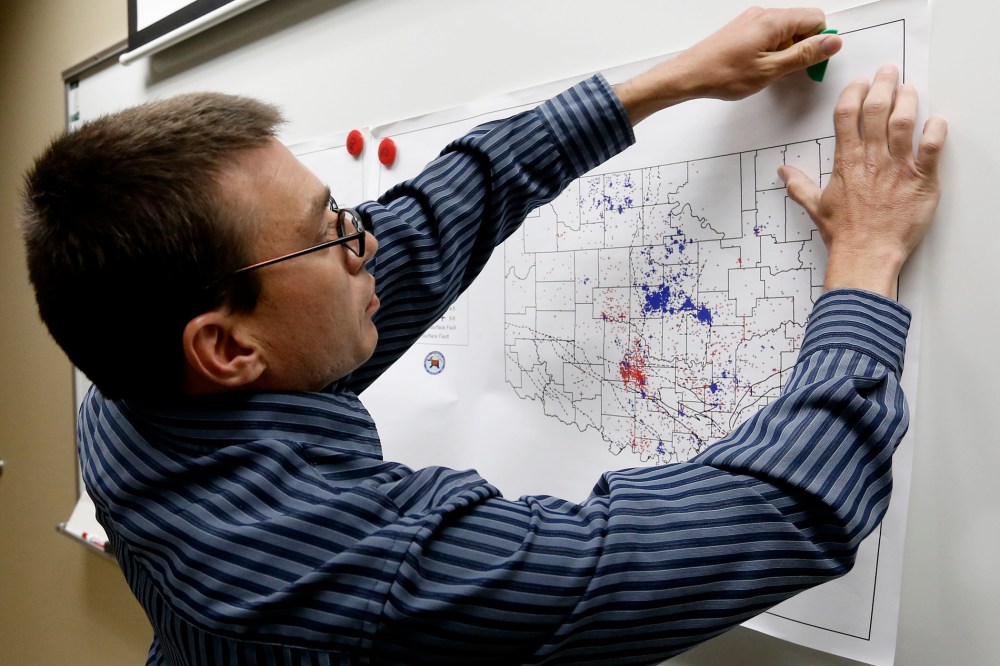
A substantial number of earthquakes in one region of Oklahoma over the past several years can be linked to the process of hydraulic fracturing, i.e., fracking, according to a new study from Science magazine.
Fracking itself — which involves pumping water, sand, and other materials under extremely high pressure into a well in order to fracture underground rock and extract oil and natural gas — has previously been linked to earthquakes. Now, scientists believe that putting fracking wastewater in underground disposal wells — a common post-fracking practice — is more strongly linked to seismic activity than fracking itself.
The study, led by Prof. Katie Keranen of Cornell University, who previously worked at the U.S. Geological Survey as part of its Earthquake Hazards Program, looked at the extremely high number of small quakes in Jones, Oklahoma, over the past five years — 2,547 in total — and found a link between oil and gas extraction near Jones and the town’s seismic activity. Jones is located near four “modern, very high-rate injection wells” that get rid of approximately 4 million barrels of wastewater each month. Those wells, the study finds, can “impact regional seismicity and increase seismic hazard.”
The scientists also found that the Jones, Oklahoma quakes account for 20% of the seismic activity in the entire region.
RELATED: Who should set the rules on fracking?
To bolster its claims, the study also points to the link between fracking and earthquakes in Arkansas, Ohio, Texas, and other parts of Oklahoma. In Oklahoma, the study notes, seismic activity has increased 40-fold between 2008-2013.
%22There%E2%80%99s%20a%20couple%20of%20good%20examples%20where%20I%20think%20it%E2%80%99s%20pretty%20clear%20that%20if%20you%20turn%20off%20the%20well%20the%20earthquakes%20stop.%20It%E2%80%99s%20a%20pretty%20strong%20correlation.%22′
Some experts believe that stopping these types of earthquakes could be as simple as stopping the fracking. Justin Rubinstein, a geophysicist who examines earthquakes potentially caused by human activity for the U.S. Geological Survey, recently told Bloomberg News, “There’s a couple of good examples where I think it’s pretty clear that if you turn off the well the earthquakes stop. It’s a pretty strong correlation.”
But the frequency and severity of quakes linked to the fracking process remains shrouded in mystery. In May, National Geographic reported on a conference at which a group of scientists and seismology researchers said the danger could be greatest across in America’s Southwest and Midwest regions because earthquake fault lines in those areas of the country have not been as extensively mapped as in areas that are prone to naturally-occurring quakes.
In short, the risks are only apparent when the ground starts to shake. “We don’t know how to evaluate the likelihood that a [fracking or wastewater] operation will be a seismic source in advance,” Gail Atkinson who studies Earthquake Hazards and Ground Motions at Western University in Ontario, Canada, told National Geographic. The oil and gas industry, meanwhile, has been reluctant to admit that fracking is linked to earthquakes. Mike Terry of the Oklahoma Independent Petroleum Association told NBC Nightly News in June, “Ultimately it takes time, it takes data, and it takes scientists to figure this out.” Oklahoma averaged two magnitude 3.0 and higher earthquakes per year between 1978-2008 according to seismology Austin Holland with the Oklahoma Geological Survey. But Holland tells msnbc that in the first half of 2014 alone, Oklahoma has experienced more than 253 different magnitude 3.0 and higher quakes. Holland also noted that the number will increase once OGS scientists analyze the backlog of data that accumulated over the July 4th holiday. Keranen’s study counted quakes of all magnitudes, not just those magnitude 3.0 and greater.
Nick Ramsey
Nick Ramsey is a senior producer with MSNBC’s “The Last Word with Lawrence O’Donnell.” Recommended


