








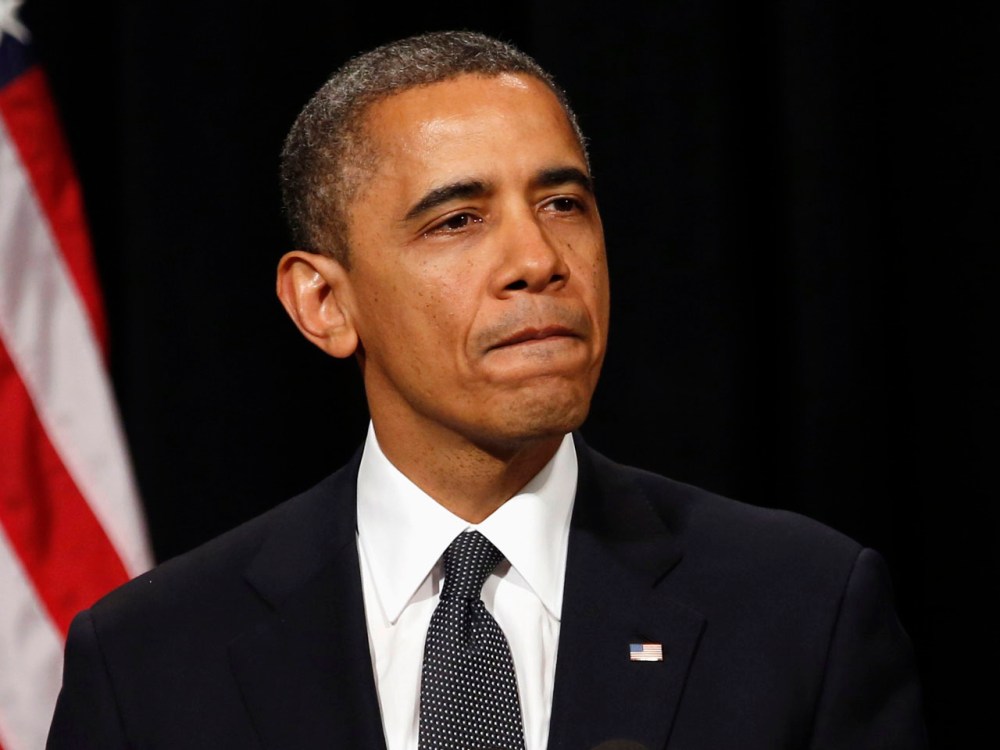
The first time Barack Obama spoke nationally about a mass shooting he was only a candidate for president. Two months after Obama announced his candidacy, on April 16, 2007, Seung-Hui Cho shot and killed 32 people at Virginia Tech University–injuring 17 others–in what remains the deadliest shooting incident by a single gunman in our nation’s history.
“Obviously what happened today was the act of a madman at some level, and there are going to be a whole series of explanations or attempts to explain what happened,” Obama said at a campaign rally in Milwaukee the day of the shooting.
“There is going to be discussion about how did this person get the firearms that he used. And there are already reports that potentially the semi-automatic weapons he used would have been banned under an assault weapons ban that was allowed to lapse. There’ll be discussion about security on college campuses. There will be speculation as to what caused this young man to snap. But I hope that it causes us to reflect a little bit more broadly on the degree to which we do accept violence, in various forms, all the time in our society. We glorify it, we encourage it, we ignore it, and it is heartbreaking and it has to stop.
Obama was only a candidate then, and something of a long-shot at that, but his rhetoric in the wake of Virginia Tech echoes in the speeches he would give after the four mass shootings of his presidency. One thing does change in the later speeches: he ceases to mention the assault weapons ban.
Less than four years later, Obama addressed the nation again–this time as president–to console the community of Tuscon, AZ., after eighteen people were shot in a supermarket parking lot, including U.S. Representative Gabrielle Giffords. Six died in the rampage, and Obama held a nationally televised memorial service in Tuscon shortly thereafter.
[The victims’] actions, their selflessness, also pose a challenge to each of us. It raises the question of what, beyond the prayers and expressions of concern, is required of us going forward. How can we honor the fallen? How can we be true to their memory?…Already we’ve seen a national conversation commence, not only about the motivations behind these killings, but about everything from the merits of gun safety laws to the adequacy of our mental health systems. Much of this process, of debating what might be done to prevent such tragedies in the future, is an essential ingredient in our exercise of self-government.
A year and a half later, on July 22, 2012, Obama spoke from the University of Colorado Hospital in Aurora, CO, after a gunman opened fire in a movie theater two nights before, killing 12 people and injuring 58 others. Obama dispensed with any mention of governmental action in his brief remarks, focusing instead on the victims–until the very last sentence:
“I hope,” he said, “that over the next several days, next several weeks, and next several months, we all reflect on how we can do something about some of the senseless violence that ends up marring this country, but also reflect on all the wonderful people who make this the greatest country on Earth.”
Only sixteen days after Aurora, on August 5th, a gunman entered a Sikh Temple in Oak Creek, WI, killing six and wounding four. Though Obama made no formal speech to the nation, he released a statement the day of the tragedy. “As we mourn this loss which took place at a house of worship,” he said, “we are reminded how much our country has been enriched by Sikhs, who are a part of our broader American family.
The next day, a reporter asked the president if he would push for any further gun control measures. “These kinds of terrible and tragic events are happening with too much regularity for us not do some soul-searching and examine additional ways that we can reduce violence,” Obama responded. “And, as I’ve already said, I think there are a lot of elements involved in it and what I want to do is bring together law enforcement, community leaders, faith leaders, elected officials at every level to see how we can make continued progress.” Finally, on Sunday, Obama spoke at a vigil in Newtown, CT, after Adam Lanza gunned down 26 people at Sandy Hook Elementary school, including 20 children. The excessive brutality brought Obama to tears when making his initial statement Friday, the day of the shooting. The regularity he spoke of in August became more apparent, the calls for action louder and more urgent. President Obama’s remarks at the vigil Sunday are the nearest he’s come to promising action on gun control: Since I’ve been president, this is the fourth time we have come together to comfort a grieving community torn apart by a mass shooting. The fourth time we’ve hugged survivors. The fourth time we’ve consoled the families of victims. And in between, there have been an endless series of deadly shootings across the country, almost daily reports of victims, many of them children, in small towns and big cities all across America — victims whose — much of the time, their only fault was being in the wrong place at the wrong time. We can’t tolerate this anymore. These tragedies must end. And to end them, we must change. We will be told that the causes of such violence are complex, and that is true. No single law–no set of laws–can eliminate evil from the world, or prevent every senseless act of violence in our society. But that can’t be an excuse for inaction. Surely, we can do better than this. If there is even one step we can take to save another child, or another parent, or another town, from the grief that has visited Tucson, and Aurora, and Oak Creek, and Newtown, and communities from Columbine to Blacksburg before that–then surely we have an obligation to try.
Evan Puschak Recommended


