








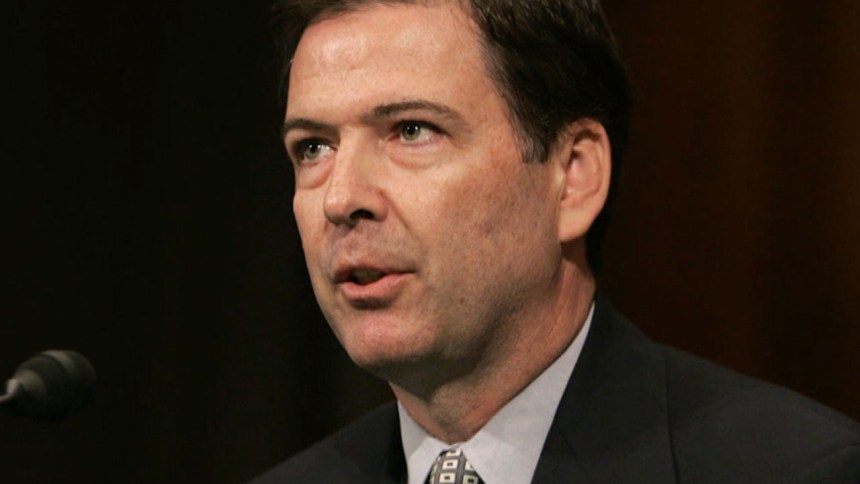
UPDATED June, 21 – President Obama is expected to nominate James Comey on Friday to succeed FBI Director Robert Mueller.
As word first spread last month that Comey was Obama’s pick to lead the bureau into the next decade, the potential nominee was meeting with a group of law professors.
Over lunch, Comey–who served as deputy attorney general under former President George W. Bush–was asked about oversight of government surveillance programs in the wake of a recent Supreme Court ruling related to the issue. Lawyers, Inspectors-General, and Congress all have oversight roles, he said.
No one knows that better than Comey, who nearly resigned after discovering that Bush’s own surveillance program had operated outside the law. Comey stayed after Bush agreed to fix the program.
The 52-year-old registered Republican is expected to replace Robert S. Mueller III, a 12-year veteran who has overseen the FBI’s transformation from chasing bank robbers to overseeing counterterrorism in a post-Sept. 11, 2001 world.
But Comey, who towers over most at 6’7”, is no stranger to conflict: his 2004 clash over the Stellar Wind surveillance program with Vice President Dick Cheney famously came to a head in Attorney General John Ashcroft’s hospital room–and then in the Oval Office.
Comey joined the U.S. Attorney’s Office for the Southern District of New York after graduating from University of Chicago Law in 1987. In Manhattan, he earned a reputation as a tough litigator prosecuting the notorious Gambino crime family. Comey was tapped to take the reins on the investigation into the 1996 Khobar Towers bombing, which killed 19 Americans in Saudi Arabia. He scored a grand jury indictment accusing 13 Hezbollah members in the bombing in June 2001. He also spearheaded an effort to get guns off of Richmond, Virginia’s, streets–a personal issue for Comey–as a federal prosecutor there.
Soon after the 2001 terrorist attacks, Bush sent Comey back to New York as the U.S. Attorney, running an office that produced Rudy Guiliani, Mary Jo White, and Frances Townsend. One of his last high-profile cases was prosecuting Martha Stewart for insider trading.
The race to a hospital bedside
Comey was named deputy attorney general under John Ashcroft in late 2003. Under Comey’s supervision, the Justice Department began re-evaluating a top secret surveillance and wiretapping program, code-named Stellar Wind, which was operated by the National Security Agency and overseen by Cheney. The program, whose existence was known to only a handful of administration officials, required regular renewal, with the Attorney General’s signature.
A week before the March 11, 2004, deadline for the program’s renewal, Ashcroft, Comey and other department lawyers concluded that the domestic surveillance program was illegal.
The next seven days unfolded like a blockbuster movie complete with speeding cars through the Capitol, blocked phone calls, an ailing protagonist, and a determined man in pursuit of justice.
Ashcroft fell extremely ill with acute pancreatitis and was rushed to George Washington Hospital’s intensive care unit. Comey became the Acting Attorney General. Days later, on Tuesday, March 9, Comey communicated his decision regarding the surveillance program to the White House and relevant parties. The news shouldn’t have come as a surprise to Cheney, NSA Director Michael Hayden, White House counsel Alberto Gonzales or Andrew Card, the president’s chief of staff. All had known for months what was brewing in the Justice Department–a potential mass exodus of top officials if Bush continued to authorize the program outside the law. With Comey refusing to reauthorize the program, Gonzales and Card were dispatched to extract a signature from a barely coherent Ashcroft. Alerted by Ashcroft’s chief of staff, Comey raced to the hospital–emergency lights flashing and all–and “literally ran up to the stairs” in an effort to reach the sick AG first. He called Mueller and other senior Justice Department lawyers. The Secret Service was ordered to guard the door. “I was concerned that, given how ill I knew the attorney general was, that there might be an effort to ask him to overrule me when he was in no condition to do that,” Comey testified three years later. Comey was successful in blocking Card and Gonzales but Cheney marched on. The next day, Bush signed the directive to keep the program going. Comey wrote a resignation letter. But he agreed to wait a few days to deliver it so that Ashcroft, when well enough, could quit alongside him. Bush, however, was still in the dark, according to an account of the episode in the Washington Post. After a morning briefing in the Oval Office, Comey finally found his moment alone with the president. Comey told Bush that the program had been deemed illegal and could not continue. Mueller, Comey told the president, was about to resign. But Mueller didn’t–and Comey never handed in his letter. Seven days later, Bush amended his renewal of the Stellar Wind surveillance program and asked the department to make changes so that it could continue within the law. A year later, Comey, who is married and has five children, left the Justice Department for private life. He became general counsel at Lockheed Martin and then joined Bridgewater Associates in 2010. Earlier this year, as the Obama administration launched a search for Mueller’s successor, Comey left the Connecticut-based hedge fund. Since January, he has guest taught at Columbia Law School as a Hertog Fellow on National Security Law. “He knows what it takes to excel,” reads a description of a recent lecture.
Cara Maresca Recommended

