The Rachel Maddow Show WEEKNIGHTS 9PM ETMorning Joe WEEKDAYS 6AM ETDeadline: White House with Nicolle Wallace Weekdays 4PM ETThe Beat with Ari Melber Weeknights 6PM ETThe Weeknight Weeknights 7PM ETAll in with Chris Hayes TUESDAY-FRIDAY 8PM ETThe Briefing with Jen Psaki TUESDAYS – FRIDAYS 9PM ETThe Last Word with Lawrence O’Donnel Weeknights 10PM ETThe 11th Hour with Stephanie Ruhle Weeknights 11PM ET
Desiline Victor to Justice Scalia: ‘Voting Rights Act is not a racial entitlement’
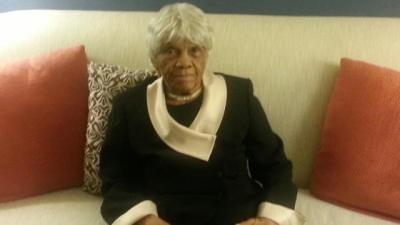
Desiline Victor, the 102-year-old voter who received a standing ovation during President Barack Obama's State of the Union address after he described her waitin
Desiline Victor, 102, awaits President Barack Obama's State of the Union address during a joint session of Congress on Capitol Hill in Washington, Feb. 12,…AP
By
Clare Kim
Desiline Victor, the 102-year-old voter who received a standing ovation during President Barack Obama’s State of the Union address after he described her waiting in line for three hours to cast her election ballot in Florida, sent a letter to Supreme Court Justice Antonin Scalia admonishing his opinion that the Voting Rights Act represents the “perpetuation of racial entitlement.”
Victor wrote that she was “shocked” to hear what the Supreme Court Justice said about the Voting Rights Act during oral arguments last month’s hearing on the constitutionality of the Voting Rights Act. “I thought you must not know what’s happening in this country,” Victor said. “I know that just as there were for me, there are barriers to voting for many people – especially people who are black or brown. I also know that the Voting Rights Act is a way to protect the votes of communities that still face these problems.”
Scalia argued that the act was only renewed in 2006 due to “a phenomenon that is called perpetuation of racial entitlement.” “Whenever a society adopts racial entitlements, it is very difficult to get them out of them through the normal political processes,” Scalia stated. “I don’t think there is anything to be gained by any Senator to vote against continuation of this act. And I am fairly confident it will be reenacted in perpetuity unless a court can say it does not comport with the Constitution.”
The Haitian immigrant waited for over three hours in line at her local library in North Miami, Fl. to cast her early ballot on Oct. 28. As her story resonated with the thousands who endured long lines to vote, Victor became the national face of the Voting Rights Act with the help from the Advancement Project. The First Lady invited Victor to sit in her box during the president’s State of the Union address and President Obama honored her in his speech.
“When she arrived at her polling place, she was told the wait to vote might be six hours,” the president said. “And as time ticked by, her concern was not with her tired body or aching feet, but whether folks like her would get to have their say. Hour after hour, a throng of people stayed in line in support of her. Because Desiline is 102 years old. And they erupted in cheers when she finally put on a sticker that read ‘I Voted.’”
Civil rights organizations including the Advancement Project and Florida New Majority have collaborated with Florida State Senator Oscar Braynon to recently introduce a legislative effort called Desiline’s Free and Fair Democracy Act which aims to protect and improve the right to vote in Florida.
The Supreme Court could potentially strike down section 5 of the Voting Rights Act, which requires nine states to receive “preclearance” from the Justice Department for any changes to districting or voting procedures. The justices weighed an appeal from Shelby County, Al. which asks the Court to determine whether Congress went beyond their power when they voted for the act’s renewal for another 25 years in 2006. Shelby County’s lawyer Bert Rein argued that Section 5 of the Voting Rights Act is unconstitutional because its outdated formula singles out states where racial intimidation and discrimination in voting procedures no longer exist. Solicitor general Donald Verrilli argued that Section 5’s requirement of “those kinds of changes…effectively prevents that kind of mischief” that existed in states like Alabama when the law was introduced in 1965.
Victor wrote of the hardships she, along with many other Americas, faced experience during voting.
“Justice Scalia, the Voting Rights Act is not a racial entitlement. It is an important protection that helps all Americans exercise their right to vote. It was put in place because, sadly, there are people in this country who don’t want everyone to have an equal voice at the ballot box. Equality and the right to vote are the shining lights of American democracy that drew me to these shores, and that right should not be taken away. In fact, it should be made stronger to help more voters who faced obstacles like I did.”
A decision is expected before the court ends its current term in June or July.
My name is Desiline Victor. I was born in Haiti in 1910, and I am 102 years old. After coming to the United States for a better life, today I am an American citizen and live with my family in North Miami. You might remember me from the State of the Union address last month, where President Obama told my story about how hard it was for me to vote.
When I heard what you said about the Voting Rights Act being a “racial entitlement,” I was shocked. I thought you must not know what’s happening in this country. After learning more this year from the civil rights group, Advancement Project, I know that just as there were for me, there are barriers to voting for many people – especially people who are black or brown. I also know that the Voting Rights Act is a way to protect the votes of communities that still face these problems. I would like to tell you about the struggles I faced in the last election.
During the early voting period in Florida last October, I went to my polling place early in the morning. The line was already very long, and wait times were as high as six hours. I stood for three hours before I started to get shaky on my feet, but no one could assist me unless I made it to the front of the line. In addition, there were no poll workers available who could help me in my native Kreyòl language, despite North Miami’s large Haitian community. I was told to come back later. I left. But I was determined to vote, so I tried again. On my second visit that night, I was happy when I finally cast my ballot. But I was also upset. In this great nation why should anybody have to stand in line for hours, and make two trips, to vote?
Not everybody persevered as I did. I learned later that hundreds of thousands of voters in Florida gave up and went home without voting, and that Black and Latino voters were more likely to face those shamefully long lines and wait times. One reason was a new law that cut the early voting period. Around the country, other new laws were passed that made voting harder in 2012 – but Section 5 of the Voting Rights Act blocked many of them before the election. Section 5 also helps voters in other ways. In the five counties in Florida that are covered, voting help in Spanish and Kreyòl is required because of their large Latino and Haitian populations.
I was born at a time when women were not allowed to vote in Haiti, nor the United States. After becoming a U.S. citizen, I was so proud to have a voice in this country. That is what inspired me to fight last year. But voting should never require such a fight. We need more make sure that all Americans can have their voices heard – we need the Voting Rights Act. Justice Scalia, the Voting Rights Act is not a racial entitlement. It is an important protection that helps all Americans exercise their right to vote. It was put in place because, sadly, there are people in this country who don’t want everyone to have an equal voice at the ballot box.
Equality and the right to vote are the shining lights of American democracy that drew me to these shores, and that right should not be taken away. In fact, it should be made stronger to help more voters who faced obstacles like I did.