








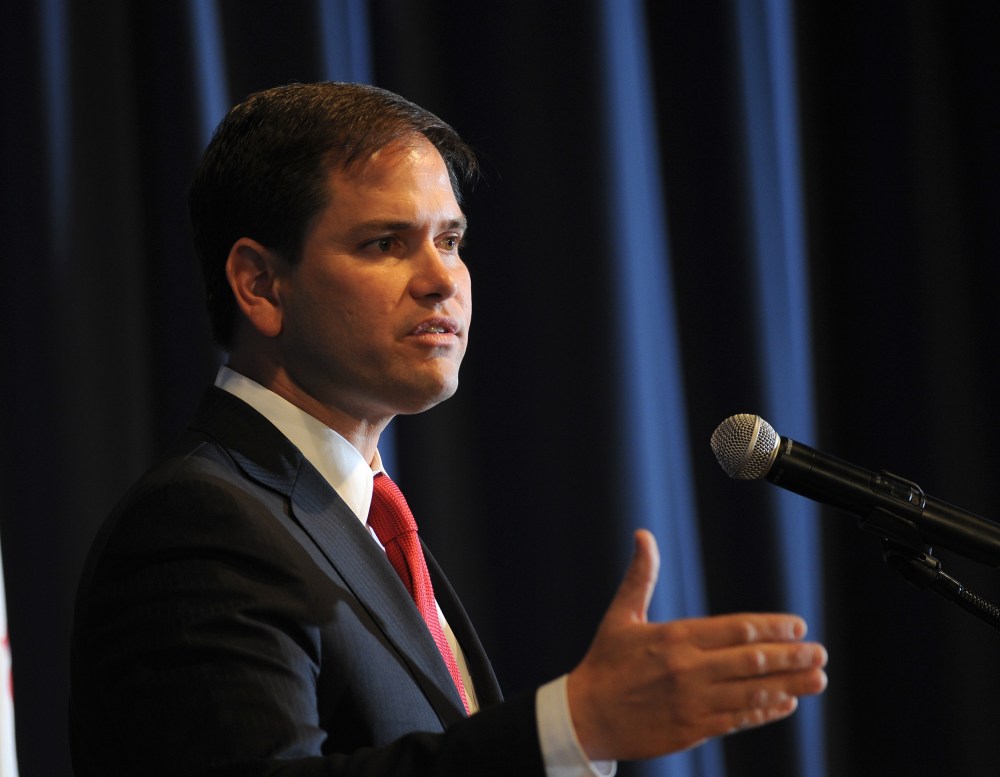
Rep. Paul Ryan (R-Wisc.) and Sen. Marco Rubio (R-Fla.) spoke at the Jack Kemp Foundation Leadership Award Dinner Tuesday night and laid out their respective visions for the future of the GOP. The speeches were carefully optimistic, inclusive–each in their way a response to post-election criticisms that the party is too insular and too white. The tone is familiar: it evokes a former Republican leader’s calls for “compassionate conservatism.”
Compassion was the banner of George W. Bush’s Republicanism, a government small but not ruthless, lean but not emaciated. As Bush said in 2000, at his nominating speech:
Big government is not the answer. But the alternative to bureaucracy is not indifference. It is to put conservative values and conservative ideas into the thick of the fight for justice and opportunity. This is what I mean by compassionate conservatism. And on this ground we will govern our nation. We will give low-income Americans tax credits to buy the private health insurance they need and deserve. We will transform today’s housing rental program to help hundreds of thousands of low-income families find stability and dignity in a home of their own. And, in the next bold step of welfare reform, we will support the heroic work of homeless shelters and hospices, food pantries and crisis pregnancy centers — people reclaiming their communities block-by-block and heart-by-heart.
After an election season that brought us “legitimate rape” and “the 47 percent,” it’s easy to see how a message like Bush’s compassionate conservatism would be welcomed by the GOP. Paul Ryan, whose hopes of being vice president were a victim of the 47% tape, addressed the topic subtly but unmistakably in his remarks:
“You know, both parties tend to divide Americans into our voters and their voters,” he said. “Let’s be really clear: Republicans must steer very clear of that trap. We must speak to the aspirations and the anxieties of every American.”
Rubio struck a similar tone: “Some say that our problem is that the American people have changed, that too many people want things from government. But I am still convinced that the overwhelming majority of our people just want what my parents had: a chance, a real chance to earn a good living, and provide even better opportunities for their children.”
Is this a move forward or backward? All throughout the Republican primaries, candidates derided Bush 43 for outsized spending or didn’t mention him at all. As USA Today’s Amy Sullivan wrote in the thick of it, last January: “There’s no place for compassion in this race, which has featured debate audiences cheering the death penalty and booing the Golden Rule. Candidates have jostled to take the hardest line in opposing government-funded programs to help the poor, with Newt Gingrich calling Barack Obama a “food stamp president” and Rick Perry blasting “this big-government binge (that) began under the administration of George W. Bush.” As Sullivan notes, the housing and food assistance, the grants to charities that help low-income Americans, the job training programs–each mentioned in Bush’s nominating speech above–turned out to be expensive. Not as expensive as two wars, but these programs didn’t escape the blame of GOP deficit hawks. After the reality check that was the last presidential election, rising stars like Rubio are changing their tone. Even Paul Ryan, an Ayn Rand devotee, tried to cast a different light in his speech: “Our party excels at representing that part of the American idea that speaks to the aspirations of our nation’s risk-takers,” he said. “But there’s another part of the American creed: When our neighbors are suffering we look out for them.” It seems that this is the vision for the GOP’s future: “Government cannot do this work. It can feed the body, but it cannot reach the soul. Yet government can take the side of these groups, helping the helper, encouraging the inspired.” Did Rubio say that? Ryan? No: George W. Bush.
Evan Puschak Recommended


