








Is the fiscal cliff/fiscal curb/gently sloping fiscal knoll making your brain hurt? If so, you’re not alone. There are so many elements to the fiscal cliff, and so little time to resolve them, that it can be dizzying to think about. So, to make it easier to wrap your head around, here’s a breakdown of deals that have been proposed, and a couple ideas that have been floated for consideration:
The president’s deal
President Obama campaigned on ending the Bush tax cuts for families making over $250,000 a year, and individuals making over $200,000. Obama wants the top rate to return to the Clinton-era 39.6%, and this is a vital part of his proposed $1.6 trillion in new revenue over the next decade.
Beyond this, Obama’s plan targets deductions and loopholes that help the wealthiest pay less. He’s proposed closing the mortgage interest deduction and the charitable deduction for top earners. And the revenue generated from higher marginal rates and the elimination of such deductions will go toward deficit reduction.
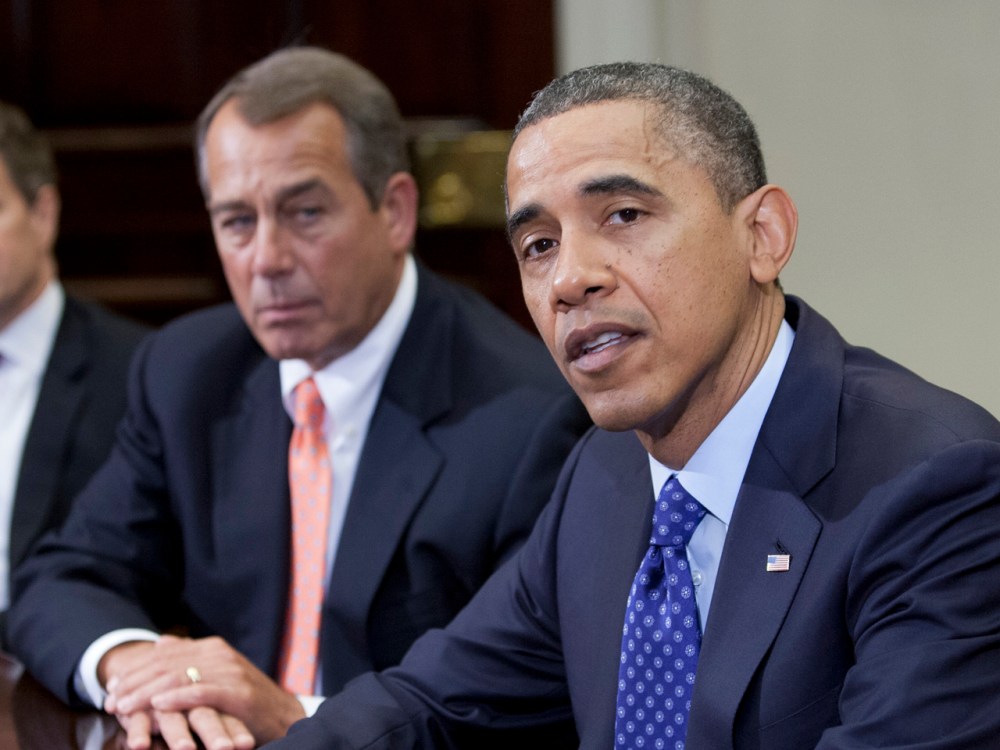
In the deal Obama almost struck with House Speaker John Boehner last year, cuts to Medicare, Medicaid and Social Security were included. This time around, Obama is under pressure from Democrats to avoid cuts to entitlement benefits as much as possible.
Discretionary spending would be cut on a program by program basis. If Obama’s debt plan from last year is any indication, he may be looking for a 10-year discretionary spending cap, balanced between defense and non-defense spending.
Finally, the president’s ideal deal would likely include authorization to raise the debt ceiling by a significant amount, eliminating the need for incremental increases throughout the year.
John Boehner’s deal
John Boehner and most of his Republican colleagues want to extend all of the Bush tax cuts, including those for top income earners. He doesn’t seem to be budging on this point:
“Raising taxes on the so-called top 2% – half of those taxpayers are small-business owners that pay their taxes through their personal income tax filing every year. The goal here is to grow the economy and control spending. You’re not going to grow the economy if you raise tax rates on the top two [percent]. It’ll hurt small businesses; it’ll hurt our economy,” Boehner told reporters Wednesday, after a colleague, Rep. Tom Cole (R-Okla.), suggested that Republicans should take the president’s offer.
In order to generate revenue, Boehner and Republicans are much more willing to look at loopholes and deductions. According to one House aide, the GOP views this as concession enough. Republicans believe that they can generate revenue more effectively by robust economic growth, and to achieve this, they say, the richest can’t be burdened by higher taxes.
Boehner and Republicans haven’t targeted any particular loopholes, nor have they said how much in deficit reduction should come from cutting entitlements, which would no doubt take a more severe hit in their ideal plan. On both of these issues the speaker has signaled the need for more time.
“Since tax and entitlement reform are too complex to complete this year,” Boehner noted, according to one of his aides, “our goal for this year, in the coming weeks, is to settle on long-term revenue targets for tax reform as well as targets for savings from our entitlement programs. Once we settle on those targets, the speaker proposed, we can create simple mechanisms, in statute, that would achieve those revenue and spending goals.”
The Congressional Progressive Caucus’ “Deal For All”
The Congressional Progressive Caucus has produced a deal of their own. The “Deal For All,” which is left of the president’s and somewhat less open to compromise. Here are its four main points: (1) No cuts to Medicare, Medicaid, or Social Security benefits; (2) Must contain serious revenue increases, including closing corporate tax loopholes and increasing individual income tax rates for the highest earners; (3) Significantly reduce defense spending to focus the United States Armed Forces on combating 21st century risks; and (4) Promote economic growth and expand economic opportunity by including strong levels of job-creating Federal investments in areas such as infrastructure and education, and by promoting private investment. Putting a cap on itemized deductions Mitt Romney floated an idea to generate revenue in the second presidential debate which has the potential for bipartisan support. The idea is to put a cap on itemized deductions. If that cap was set at $50,000, the wealthy would bear most of the burden, according to the Tax Policy Center, and it would raise $760 billion in revenue over 10 years. Bringing the cap down to $25,000 would increase the revenue to $1.3 trillion over the same period, but would have a larger negative effect on the middle class. Change the top tax bracket and add a minimum tax Berkshire Hathaway CEO and Chairman Warren Buffett suggested raising the cutoff for the top tax bracket from $250,000, proposed by President Obama, to $500,000 or $1 million. He also proposed a minimum tax so that the very wealthy are guaranteed to pay their fair share. “We need Congress, right now, to enact a minimum tax on high incomes,” Buffett proposed in a New York Times op-ed Monday. “I would suggest 30% of taxable income between $1 million and $10 million, and 35% on amounts above that. A plain and simple rule like that will block the efforts of lobbyists, lawyers and contribution-hungry legislators to keep the ultrarich paying rates well below those incurred by people with income just a tiny fraction of ours. Only a minimum tax on very high incomes will prevent the stated tax rate from being eviscerated by these warriors for the wealthy.”
Evan Puschak Recommended


