








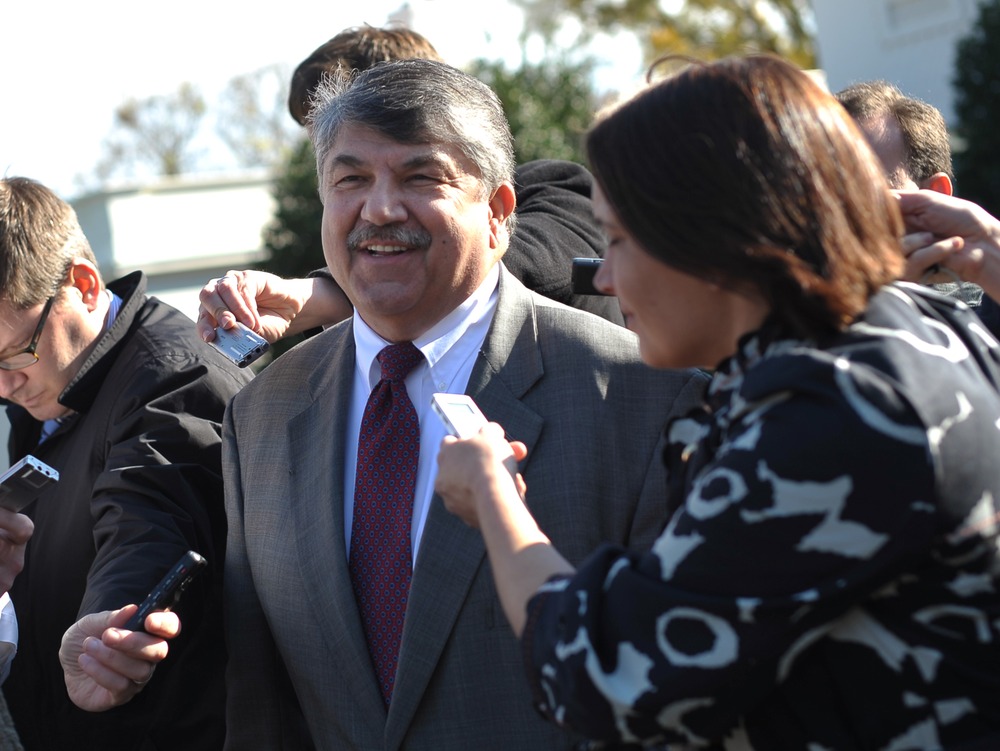
“We need to make sure that thee law provides a road map to citizenship, not just temporary status, for all workers,” said AFL-CIO president Richard Trumka in a video released Thursday on the labor federation’s official YouTube channel.
“We need to fight to protect day laborers, and domestic workers, and taxi cab drivers as much as we fight to protect nurses, and teachers, and fire fighters,” said Trumka. Addressing union leaders within the AFL-CIO—America’s largest labor federation—directly, he said, “I’m counting on you to make history.”
“The topic is coming to Washington in 2013, and we just wanted to make sure everyone is on the same page,” said AFL-CIO media outreach director Jeff Hauser. “And this is a critical fight for the labor movement and working people.”
Organized labor has not always been a steady friend to the immigrant justice movement. “I find that there’s no issue that’s caused the American labor movement more agony than immigration,” said labor economist Vernon Briggs in a 2001 panel sponsored by the conservative Center for Immigration Studies. He noted that unions had “enthusiastically” supported the 1986 Immigration Reform and Control Act, which made it illegal to knowingly employ undocumented workers and increased border security.
However, over at least the past decade, the AFL-CIO has come to take a far more progressive stance on immigration. In 2000, the AFL-CIO formally called for a path to citizenship for undocumented immigrants, and Trumka has emphasized the need for immigration reform since he became president of the federation in 2009.
“This is a top priority from President Trumka on down,” said Hauser. “He’s been speaking about this issue ever since he became president of AFL-CIO. He’s personally passionate about it.”
Immigration is arguably a matter of increasing concern to the American labor movement, as unions attempt to organize the industries where undocumented workers are most heavily concentrated. According to the Center for American progress, some two million undocumented workers are currently employed in the service sector. Prominent and growing unions such as the SEIU and UNITE HERE represent workers in immigrant-heavy industries.
Immigrants have also been central to some of the labor movement’s most prominent organizing drives of the past year. In Arizona, UNITE HERE partnered with immigrant justice groups during the election season to build a progressive Latino power base in Arizona. Wal-Mart, currently the target of a nationwide labor activism campaign, has occasionally been targeted as a major employer of undocumented immigrants. “The top cause of concern for any progressive institution is about the changing face of America, and making sure that all Americans are either citizens or have a pathway to citizenship,” said Hauser. Lynn Tramonte, deputy director for the immigration reform group America’s Voice Education Fund, said the following in a statement: “It’s been nearly 13 years since the AFL-CIO issued this historic statement embracing broad immigration reform that includes a path to citizenship for immigrants without papers. Their reasoning? Giving immigrants full citizenship status and the ability to speak up without fear of being deported takes a tool away from bad employers who want to silence them. “The results of the 2012 elections changed the political dynamics on immigration reform, opening up space for a potential policy breakthrough. The AFL-CIO as well as SEIU and others in the labor movement are playing leadership roles to make sure that happens in 2013.”
Ned Resnikoff is an urban policy analyst, researcher, writer, and editor. His byline has appeared in a variety of publications, including the New York Times, San Francisco Chronicle, Dissent, and The Nation. He writes the newsletter Public Comment, which can be found at publiccomment.blog. Recommended


