








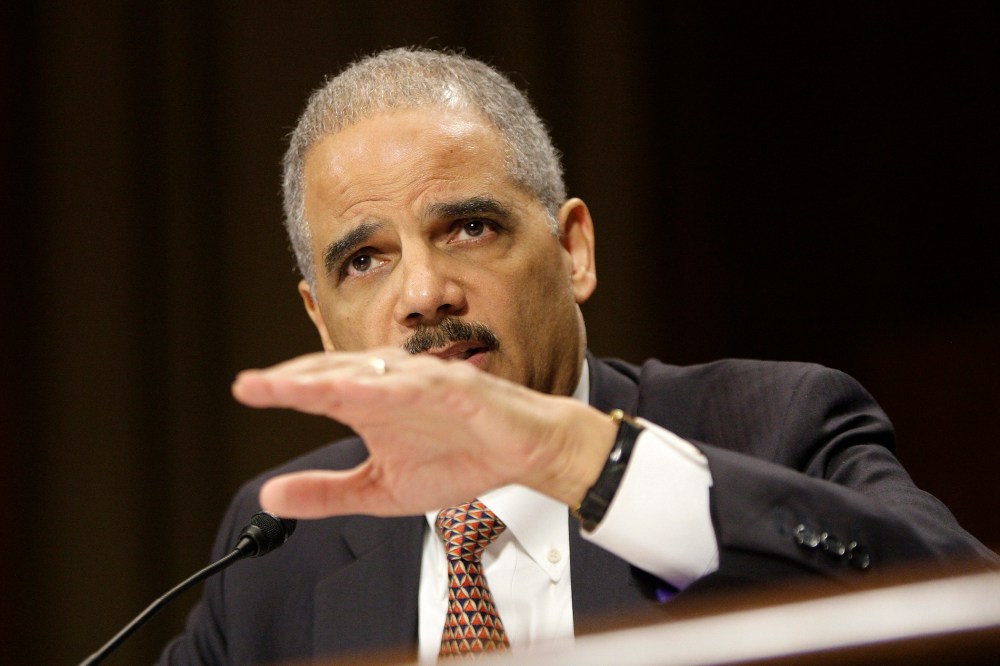
On January 23, Attorney General Eric Holder sat down with msnbc’s Ari Melber for a wide-ranging conversation that covered Edward Snowden, Wall Street crime, voting rights, and the war on drugs. Their talk:
Melber: You heard the president’s remarks on marijuana, not only about how it’s used by individuals and its risk but also seeming to welcome legalization efforts in states like Colorado. You’ve already shifted enforcement policy. Do you have to shift it more to harmonize with his views here? And what did you think of his remarks?
Holder: No, I think the positions that we’re taking in terms of setting out those eight priorities that would warrant federal intervention are, are consistent with what the–what the president said. Small time– small amount– of marijuana cases are not the kinds of things that deserve to be in the federal system.
We have the interstate transportation of it where violence is a part of the– the dissemination of marijuana. Those are the kinds of cases that oughta be in the federal system. And those are the changes that we’ve made. And as I said, I think those are consistent with what the president said.
And the president, of course, was at the Justice Department just last week outlining reforms to the NSA. We have reports of a new government watchdog report that says the bulk collection program was unlawful, it was a subversion of the Patriot Act law, and also not very useful in discovering any terror plots. Is that report, in your view, incorrect? And is there anything more that needs to be done to rein in these programs?
Yeah, I’ve not seen the report. But I will say that– at least 15 judges on about 35 occasions have said that the– the program itself is legal. Now, that answers only one part of the question. It’s legal. It’s something. And I agree with that. I– I think the program is in fact legal.
But the question is– is the program as useful as it can be? And is it something that, that we ultimately need? And those are the questions that the president has put to me, to the director of national intelligence Jim Clapper. And we’re gonna be looking over the next 90 days or so to make determinations about– answer the questions the president said. Just because we can do something–should we–should we do it?
You have mentioned those courts. And there are definitely those decisions. But there’s also a D.C. court that ruled against the NSA and Judge Bates in the spy court in 2011 saying parts of the program at one point were unconstitutional. Your view, though, is– it’s final that is completely legal based on the totality of all those judgments?
Yeah. I think that– those other judges, those 15 judges, I think, got it right. I think the modifications that have been made in the program have made it legal to the extent that there were issues that might have been raised before. But again, that only answers one part of the– of the equation. The other question is– simply because we can do it, should we? And that’s what we’re still working on.
The president’s acknowledged the discussion is partly because of the revelations published and released by Edward Snowden. There have been allegations recently, the suggestion that he may have worked with foreign governments, by the intelligence chairs. Are you aware of any evidence of that? Is that something you’re investigating to add to the criminal complaint against Mr. Snowden?
Well, this is an ongoing investigation. I don’t wanna necessarily get into all of the– all of the details. I will say that– you know, he broke the law, that– he caused harm to our national security. And I think that he has to be held accountable for his actions.
Now, I think the dialogue that we are engaged in, the debate that we are engaged in is in fact– something that is, ultimately, I think, gonna be productive. And I think there is– it’s healthy. But that doesn’t necessarily excuse, I think, that which he did. There are other ways that he might have brought this to the attention of the nation.
Have you seen evidence that he worked with a foreign government? Because those are charges coming from senior congressional officials.
Well, I– as I said, I don’t wanna get into what is an ongoing investigation and say something that might end up in a pre-trial motion when we get to that stage.
Does the fact that the D.C. court did rule against the NSA make him more of whistleblower potentially in the eyes of the law or in your view?
I mean, people have really gotten hung up on whether he’s a whistleblower or something else. From my perspective, he’s– he’s a defendant. He’s a person that we have lodged criminal charges against. And I think that’s the most apt title.
Turning to the indictment of Governor McDonnell and the open inquiry in New Jersey looking into allegations against Governor Christie. First of all– McDonnell’s attorneys have said that this was, quote– routine political conduct– that there was no real exchange of services. Broadly, what is your view of that argument? And how do you approach these federal investigations into state governors?
Well, without talking about the McDonnell case specifically, I– I grew up in the Justice Department in the public integrity section. And we brought cases all the time where public officials received money– exchanged– got gifts in exchange for official action.
That is classic corruption. And that is the– those are the kinds of cases that we traditionally bring. We have brought an indictment against Governor McDonnell. It’s a case that will ultimately be tried in court. I think the indictment lays out in pretty specific detail our theory of the case. And ultimately, a jury will decide whether we are right or wrong.
And then when you look at that idea though, the people say, “This is politics as usual”– broader than that individual case. And you did work for many years in the public integrity section. Is that offensive?
Well– you know, that’s something for the American people, I think, to decide. But from my own perspective, the notion that– you know, public officials trade their office for their own personal gain is something that is inconsistent with the notion of good government.
And again, I’m not talking about the McDonnell case. I’m talking about this just, you know, more–more generally. People who are in these positions have the public trust. They have great benefits that go with them in these positions. And they should be held, I think, to the highest standard.
Looking at voting rights, an area where you have clearly led the Justice Department not only to– patrol and enforce the right to vote but to be somewhat flexible after the Supreme Court decision last year. You shifted resources. You’ve said you’re gonna make sure people have the right to vote.
And now you’re working with members of Congress in both parties. Does that Voting Rights Act amendment do what we need– while also avoiding what used to be your purview, which is Justice Department objections– in the voter ID context, which as you said yourself, is so important?
I think the statute that has been introduced goes as long way to dealing with– that very, I think, wrongly decided– Shelby case. There are some things that I think need to be looked at though in connection with this– recodification of the Voting Rights Act.
Chief among them– I think, is this whole notion of this photo ID requirement. And if we can show that– that photo ID efforts are done inappropriately and for improper reasons, I– I think that oughta be the basis for federal intervention. And so I’m a little concerned that that appears at least for now not to be a part of the scheme.
So you would like this bill that’s being sponsored by Congressmen Sensenbrenner and John Lewis to include Justice Department photo ID objections in its formula for federal supervision?
It is certainly something I think we– we’d like to talk about and have a consideration made as to whether or not that ought to be included and then, you know, come up with language that would be appropriate. People have to understand that we are not opposed to photo identification in a vacuum.
But when it is used in certain ways to disenfranchise particular groups of people, whether by– racial designation, ethnic origin, or for partisan reasons, that, from my perspective, is– is problematic. And so I would like to work with members of Congress to make this bill as strong as we possibly can make it.
And so when some Republicans say that voter identification is for election integrity and thus is different than the history of racial discrimination we have seen in this country– they may be of good faith, but you think they’re wrong.
Yeah. There are some, I think, who are coming that– from a good faith perspective. But I think many are using it for partisan advantage. The reality is that– all the studies show that this whole question of ballot integrity, in-person voter fraud, simply does not exist to the extent that would warrant these kinds of measures.
We had the commission that the president appointed just yesterday. And they indicated this was not– was not a significant problem. And so I think they have come up with a remedy in search of a problem. And I think it is being used in too many instances to depress the vote of particular groups of people who are not supportive of the party that is advancing these photo ID measures.
Now, also in the New Yorker interview, when the president was asked about potential deals or clemency for Edward Snowden which is something some NSA officials have said should be on the table, he said it’s not a yes-no issue. Does that mean that a deal of some kind could still be possible for Mr. Snowden?
Well, he is a person who will– is charged– will be charged with– a variety of crimes. When he has legal representation and if those lawyers wanna talk about a resolution of the case, we would obviously engage in those– in those conversations.
But that means it’s not– you haven’t ruled it out?
The notion of clemency– a simple– you know, no harm, no foul– I think that would be going too far. But in the resolution of this matter– with an acceptance of responsibility– you know, the– we would always, you know, engage in those kinds of conversations.
We have been talking about your approach to incarceration and smart-on-crime initiatives. Another criticism that is made of– not only this Justice Department but your predecessor– is that individual Wall Street executive misconduct doesn’t often lead to jail time outside of the specifics of insider trading.
In addition, as you know, there has been discussion in the economic realm– that some institutions are either too big to indict or too big to really deal with in a criminal context. Now you have been on the job even longer. Those criticisms remain. Your response to them? Are there things that you need from Congress or in our laws so that companies are not too big to indict if they do wrong?
Let me make this very clear. There are no institutions that are too big to indict. There are no individuals who are in such high level positions that they cannot be indicted, criminally investigated. And we have brought charges against thousands of people over the course of these last four-and-a-half, almost five years. We have brought significant cases against some of the largest financial institutions in the country, the last of which was the J.P. Morgan case, which significantly did not include a resolution of the criminal investigation that is ongoing and could result in charges against either the institution or individuals– who are engaged– who were involved in those activities. And we have ongoing investigations that– I’m really not at liberty to talk about but involve significant financial institutions. And the focus of those investigations is not only on the institutions but on individuals as well. So I think, you know, what we are gonna have to do is wait for us to be finished with all of the things that we want to do– and then look and make an assessment of– how well we did and the kinds of charges that we brought. I think it’s a little too early at this point. But the record suggested a great deal of money has been clawed back in some cases– and that working with the Consumer Financial Protection Bureau, sometimes that money goes to victims of financial crimes. But many, as we know, of the completed investigations involved deferred prosecution agreements or deals where people often don’t even have to say that there was official wrongdoing. And many say that is an insufficiently punitive or harsh approach to those actors. Is that fair? Well, you know, people say these things without having the ability to look at the files that we have, the– the cases that we could possibly bring. To the extent that we have the ability to bring cases against individuals or institutions, criminal charges — we will bring them. But we have certain responsibilities to only bring those cases that we think we have an ability to prove beyond a reasonable doubt. It doesn’t mean we only– that we won’t take hard cases and, you know, be prepared to take potentially, you know, losses where we think it is appropriate to bring those charges. But it is not for lack of looking– or lack of aggressiveness– that we have not done all that people think that we should have done. And as I said, I– I think people need to just be a little patient. I know it’s been– it’s been a while. But we have other things that are in the pipeline. One of the other most controversial legal issues has been the boundaries over the targeted killing or drone program. Are you satisfied with where that debate has landed and the transparency that has been provided, which I believe was more than the administration initially planned on? And do you think Americans have a clear understanding of what the line is and how you advise the president to define who can be targeted and whether individuals who haven’t had any due process or any claims proven about their ties to terrorists can still be killed? Well– we– I think we have been pretty transparent. I gave a speech at Northwestern University Law School that laid out some of the legal bases for this kind of action. John Brennan– Brennan gave a speech as well. So I think we have been forthcoming in that regard. And– I think the– the use of those kinds of weapons and– in the numbers of times we’ve done it with regard to American citizens has been justified both by the law and by– by circumstance. And so I’m — I think I’m — I’m comfortable with the way in which we have both conducted ourselves and the way in which we have explained it. The president has wanted to have as much transparency as is possible, understanding that a good portion of these operations must be kept secret if they are to be– if they are to be effective. And as you think on your– legacy, however long you are in office– you are one of the longest– ninth longest-serving attorney general. Is that right? That is right. I didn’t– I did not– okay. [LAUGH] All right. Do you think, when you look at the smart-on-crime initiative and some of the reforms we’ve been talking about, do you– and you presiding over– an actual drop in the total number of the prison population for the first time in a generation, is part of your legacy moving from overincarceration to rehabilitation and other approaches to social problems? Yeah, I would hope that–one of the things that people look back on and say that we got right– was to do things in a different way, not to be stuck in things that are traditional but perhaps ultimately don’t work to break the cycle– not to reflexively say that we were simply tough on crime but as we use the phrase, to be smart on crime. And that necessarily means engaging in prevention activities, rehabilitation activities– re-entry activities that ultimately keep the nation safer at a smaller cost. And it– and it’s also the morally the right thing to do– to have a system [of] criminal justice system that is perceived as being fair and that acts in proportionate ways. We have– you know, we erred, I think, a little in the the war on drugs in going too far with regard to some of the sentences that– that Congress mandated. And I think we have a moment in time now where Congress as well as those of us in the executive branch think that it’s time to pull back just– just a bit. And so I think that– I hope that will be a part of my legacy. Do you feel you are able to do more of that because of the– a change in the politics of fear in this country? Politics of fear? Yeah, the people being afraid of crime so much regardless of the data– that they seek punishment above all other remedy. I think there is a growing recognition in– I think in the American people that different approaches ought to be tried. You know, this mass incarceration happens with a cost. If you look at the way it impacts certain communities and it’s– let’s be honest about this, communities of color– where young men should be the future of these communities are taken out– labeled, then have inabilities to obtain good employment, to be the kinds of productive citizens that they might be. Now, they– people have to be held accountable for individual decisions that they make. But we need to have proportionate penalties. And the ability for– a recognition that you can make a mistake, rehabilitate yourself, and then come back and be a productive citizen. And those are the kinds of policies that I’m trying to advance, that this administration is trying to advance. Mr. Attorney General, I appreciate your time today. Thank you.
Ari Melber
Ari Melber, an Emmy Award-winning journalist, writer and attorney, is the host of “The Beat with Ari Melber” airing nightly at 6 p.m. ET on MSNBC. He also serves as MSNBC’s chief legal correspondent and an NBC News legal analyst. Before joining MSNBC, Melber practiced First Amendment law and served as a legislative aide in the U.S. Senate. He received a J.D. from Cornell Law School and is a member of the New York Bar. Recommended


