








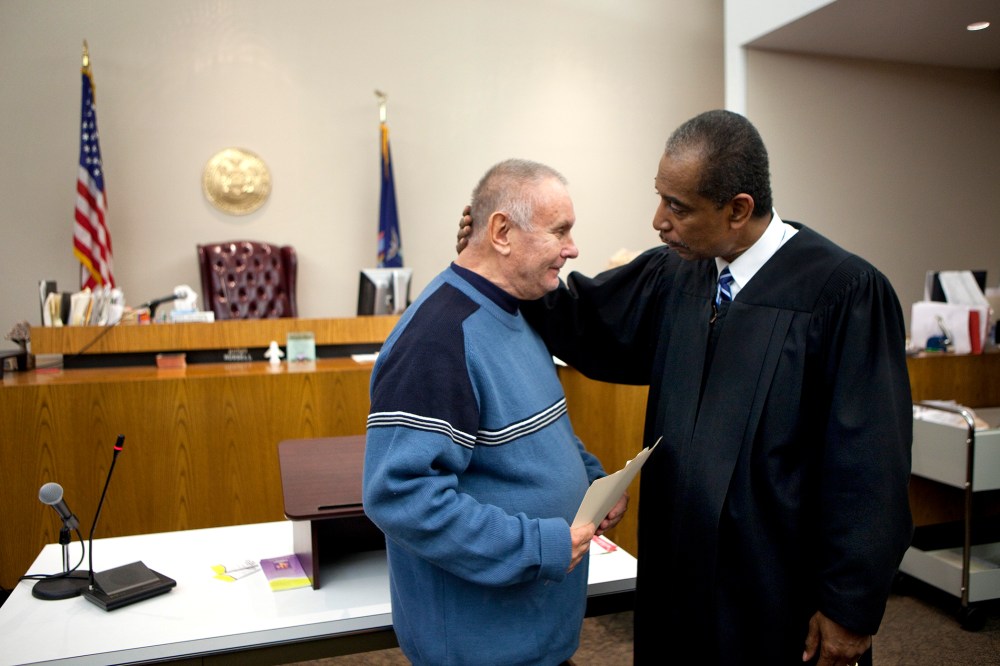

Ronald Taucher, an Air Force veteran, was back in federal court last week. Unlike his past court appearances, however, when Taucher battled alcohol abuse and risked going to jail, now he was celebrating his graduation.
Taucher completed a new program that offers veterans struggling with substance abuse a chance at rehabilitation rather than prison.
Along with four other veterans, Taucher stood before magistrate Judge Michael Urbanksi in a Veterans Court in Roanoke, Virginia. “It is nice to have a happy occasion in federal court,” Judge Urbanksi told the program graduates. “We don’t see many of those.”
It is just the second such federal court in the nation.
In an interview with msnbc, Taucher credited the court for offering him rehab instead of a jail cell. “When you see a judge and he gives you an opportunity,” he said, “you better take it.”
The courtroom was filled with friends, family, veterans’ advocates, and an unusual observer for a local proceeding – Attorney General Eric Holder.
“The program that we’re here to celebrate today provides a lot for preventing recidivism, reducing relapses, and empowering veterans convicted of certain non-violent crimes to join their communities as productive, law abiding members of society,” Holder told the court.
For decades, criminologists have documented how the incarcerated veteran population is largely a result of ex-service members’ substance abuse and mental health issues.
There are about 140,000 veterans in American jails today, according to the Justice Department, and 60% have substance abuse problems. About 25% were inebriated at the time of the violation that landed them in prison. Experts say many are “self-medicating,” countering the strains of their service — PTSD, emotional stress, mental fatigue, family disruption – with drugs or alcohol. (A 2008 Rand study estimated that 18.5% of returning Iraq and Afghanistan vets screened positive for PTSD or depression.)
The incarceration rates also reflect broader trends in criminal justice policy, since the federal government, and most states, typically address substance abuse with jail time, not rehabilitation.
Courts for veterans
For veterans, that approach first began to change a bit in 2006.
Robert Russell, a New York state judge, was overseeing mental health treatment for a Vietnam veteran in his Buffalo courtroom. It was a sad and familiar case. The veteran would attend the required sessions, but failed to participate or engage. Judge Russell recalls how the man, strongly-built and six-feet-four-inches tall, would slump, defeated, in the courtroom. He avoided eye contact. Nothing was getting through.
So Judge Russell asked one of his staff, a Vietnam veteran who served in the 82nd Airborne, to go talk with the man during a recess. ”Is there something we could do,” Judge Russell recalls thinking. “How do we motivate him?”
They returned after twenty minutes, and to Judge Russell, it looked like a different person entered the courtroom.
“There was a remarkable distinguishing difference in this veteran’s disposition,” he recalled in an interview with msnbc this week. “Standing erect — at what they call ‘parade rest,’ which is part of the military culture, your feet slightly apart, hands cupped in the back — and he looked at me, eye to eye, and he said, ‘Judge, I’m gonna try harder.’”
The shift made an immediate impact on Judge Russell.
“I was totally amazed,” he said, noting how a few minutes talking with a fellow veteran apparently awakened the man, enabling him to “tap into part of his military culture” and embrace self-improvement.
Judge Russell recalls asking his staff, “What the heck did y’all do?”
The answer was simple.
“They discussed commonality — where they served in Vietnam — and after they had a discussion about their military service,” he recounted, “they addressed that they wanted him to get better.”
Judge Russell began trying to develop a model, based on rehab success in dedicated drug courts, to address the particular challenges facing veterans. He reached out to the local V.A. hospital, which provided volunteer veteran mentors for the program. As a start, Judge Russell recalls, he set aside aside one day a week for cases of “veterans suffering from mental health disorders or substance abuse.”
It worked. After formally beginning in 2008, states around the country launched their own veterans courts. There are over 130 today. On average, they are far more successful than jailing drug-offenders – 70% of enrolled veterans successfully complete the program, and 75% are not arrested within the following two years. Russell is pleasantly “surprised” that his experiment swiftly become a national model — and he welcomed the interest from the Obama administration. “It’s tremendous for the federal government to have the understanding of the needs of our veterans,” he said, “and the attorney general, and for some of my fed colleagues, having the desire to start up courts like this.” New Department of Justice policy Holder, who talked about his cousin’s Vietnam service when he visited the Virginia court, is advancing more federal veterans courts as part of his “Smart on Crime” reforms. “There’s a crying need for more of these kind of efforts,” he said last week, stressing the special bond with veterans. “It was once said that so many owe so much to so few,” he said, “we owe them in the most profound of ways.” Under Holder, official Department of Justice policy now states that veterans get “involved in the criminal justice system with co-occurring substance abuse and mental health issues” – they risk going to prison because of drugs and strain from their service, basically. The Department encourages Veterans Courts as a rehabilitation model, noting they better serve “veterans struggling with addiction, serious mental illness” and PTSD, problems associated with “higher rates of drug abuse, domestic violence and other criminality.” Since Holder took office in 2009, a dedicated Justice department program has advanced training and a national curriculum for Veterans Courts, in coordination with the Veterans Affairs Department. The attorney general is also calling for more federal Veterans Courts like the one in Virginia. In an interview for msnbc’s “Presumed Guilty” series last week, Holder stressed that even beyond the improved recidivism rates, he views these reforms as a matter of principle. “It’s morally the right thing to do,” he said, contending that these reforms make the criminal justice system more “fair” and better equipped to “act in proportionate ways,” based on the conduct and situation of each defendant. Taucher, the Air Force veteran who graduated from the Veterans Court Holder visited, clearly agreed. “Without a doubt,” he says, “a second chance is what a lot of us need.”
Ari Melber
Ari Melber, an Emmy Award-winning journalist, writer and attorney, is the host of “The Beat with Ari Melber” airing nightly at 6 p.m. ET on MSNBC. He also serves as MSNBC’s chief legal correspondent and an NBC News legal analyst. Before joining MSNBC, Melber practiced First Amendment law and served as a legislative aide in the U.S. Senate. He received a J.D. from Cornell Law School and is a member of the New York Bar. Recommended


