The Rachel Maddow Show WEEKNIGHTS 9PM ETMorning Joe WEEKDAYS 6AM ETDeadline: White House with Nicolle Wallace Weekdays 4PM ETThe Beat with Ari Melber Weeknights 6PM ETThe Weeknight Weeknights 7PM ETAll in with Chris Hayes TUESDAY-FRIDAY 8PM ETThe Briefing with Jen Psaki TUESDAYS – FRIDAYS 9PM ETThe Last Word with Lawrence O’Donnel Weeknights 10PM ETThe 11th Hour with Stephanie Ruhle Weeknights 11PM ET
With tonight marking the third, and final, presidential debate, the income inequality gap question comes into play.
plutocrats
By
Abby Borovitz
With tonight marking the third, and final, presidential debate, the income inequality gap question comes into play. According to the Census Bureau, income rose 4.9% between 2010 and 2011 for the top 5%, while it fell for the middle class and held steady for the poor. Thus, what are the Presidential candidates proposing to address this problem? President Obama wants to extend the Bush tax cuts for all those earning $250,000 and higher, while imposing the Buffett rule, a 30% minimum tax on earning of $1 million and more. While, Governor Romney wants to extend the Bush tax cuts for everyone, along with a 20% across the board income tax cut, which he says will be paid for by closing the tax loopholes.
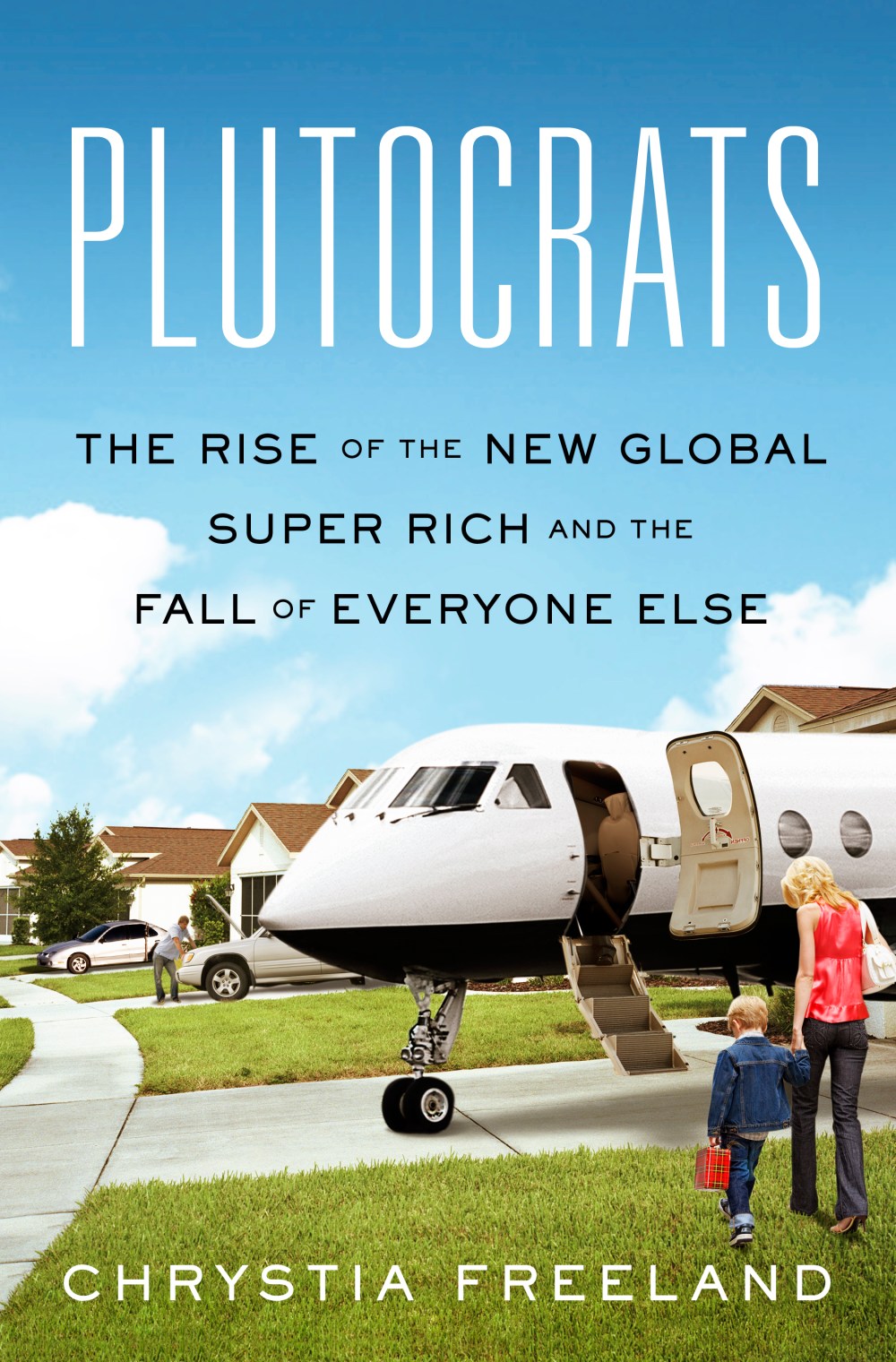
During today’s show Chrystia Freeland, Author of Plutocrats: The Rise of the New Global Super-Rich and the Fall of Everyone Else will be joining The Cycle to discuss her book and how the plutocrats need to be aware that they are threatening the very system that created them.
Be sure to tune in for the full conversation at 3:40pm and check out an excerpt from her book below.
INTRODUCTION
The poor enjoy what the rich could not before afford. What were
the luxuries have become the necessaries of life. The laborer has
now more comforts than the farmer had a few generations ago.
The farmer has more luxuries than the landlord had, and is more
richly clad and better housed. The landlord has books and
pictures rarer and appointments more artistic than the king
could then obtain.
—Andrew Carnegie
Branko Milanovic is an economist at the World Bank. He first became interested in income inequality studying for his PhD in the 1980s in his native Yugoslavia, where he discovered it was officially viewed as a “sensitive” subject—which meant one the ruling regime didn’t want its scholars to look at too closely. That wasn’t a huge surprise; after all, the central ideological promise of socialism was to deliver a classless society.
But when Milanovic moved to Washington, he discovered a curious thing. Americans were happy to celebrate their super-rich and, at least sometimes, worry about their poor. But putting those two conversations together and talking about economic inequality was pretty much taboo.
“I was once told by the head of a prestigious think tank in Washington, D.C., that the think tank’s board was very unlikely to fund any work that had income or wealth inequality in its title,” Milanovic, who wears a beard and has a receding hairline and teddy bear build, explained in a recent book. “Yes, they would finance anything to do with poverty alleviation, but inequality was an altogether different matter.”
“Why?” he asked. “Because ‘my’ concern with the poverty of some people actually projects me in a very nice, warm glow: I am ready to use my money to help them. Charity is a good thing; a lot of egos are boosted by it and many ethical points earned even when only tiny amounts are given to the poor. But inequality is different: Every mention of it raises in fact the issue of the appropriateness or legitimacy of my income.”
The point isn’t that the super-elite are reluctant to display their wealth—that is, after all, at least part of the purpose of yachts, couture, vast homes, and high-profile big-buck philanthropy. But when the discussion shifts from celebratory to analytical, the super-elite get nervous. One Wall Street Democrat, who has held big jobs in Washington and at some of America’s top financial institutions, told me President Barack Obama had alienated the business community by speaking about “the rich.” It would be best not to refer to income differences at all, the banker said, but if the president couldn’t avoid singling out the country’s top earners, he should call them “affluent.” Naming them as “rich,” he told me, sounded divisive—something the rich don’t want to be. Striking a similar tone, Bill Clinton, in his 2011 book, Back to Work, faulted Barack Obama for how he talks about those at the top. “I didn’t attack them for their success,” President Clinton wrote, attributing to that softer touch his greater success in getting those at the top to accept higher taxes.
Robert Kenny, a Boston psychologist who specializes in counseling the super-elite, agrees. He told an interviewer that “often the word ‘rich’ becomes a pejorative. It rhymes with ‘bitch.’ I’ve been in rooms and seen people stand up and say, ‘I’m Bob Kenny and I’m rich.’ And then they burst into tears.”
It is not just the super-rich who don’t like to talk about rising income inequality. It can be an ideologically uncomfortable conversation for many of the rest of us, too. That’s because even—or perhaps particularly—in the view of its most ardent supporters, global capitalism wasn’t supposed to work quite this way.
Until the past few decades, the received wisdom among economists was that income inequality would be fairly low in the preindustrial era—overall wealth and productivity were fairly small, so there wasn’t that much for an elite to capture—then spike during industrialization, as the industrialists and industrial workers outstripped farmers (think of China today). Finally, in fully industrialized or postindustrial societies, income inequality would again decrease as education became more widespread and the state played a bigger, more redistributive role.
This view of the relationship between economic development and income inequality was first and most clearly articulated by Simon Kuznets, a Belarusian-born immigrant to the United States. Kuznets illustrated his theory with one of the most famous graphs in economics—the Kuznets curve, an upside-down U that traces the movement of society as its economy becomes more sophisticated and productive, from low inequality, to high inequality, and back down to low inequality.
Writing in the early years of the industrial revolution, and without the benefit of Kuznets’s data and statistical analysis, Alexis de Tocqueville came up with a similar prediction: “If one looks closely at what has happened to the world since the beginning of society, it is easy to see that equality is prevalent only at the historical poles of civilization. Savages are equal because they are equally weak and ignorant. Very civilized men can all become equal because they all have at their disposal similar means of attaining comfort and happiness. Between these two extremes is found inequality of condition, wealth, knowledge—the power of the few, the poverty, ignorance, and weakness of the rest.”
If you believe in capitalism—and nowadays pretty much the whole world does—the Kuznets curve was a wonderful theory. Economic progress might be brutal and bumpy and create losers along the way. But once we reached that Tocquevillian plateau of all being “very civilized men” (yes, men!), we would all share in the gains. Until the late 1970s, the United States, the world’s poster child of capitalism, was also an embodiment of the Kuznets curve. The great postwar expansion was also the period of what economists have dubbed the Great Compression, when inequality shrank and most Americans came to think of themselves as middle class. This was the era when, in the words of Harvard economist Larry Katz, “Americans grew together.” That seemed to be the natural shape of industrial capitalism.
Even the Reagan Revolution rode on the coattails of this paradigm—trickle-down economics, after all, emphasizes the trickle. But in the late 1970s, things started to change. The income of the middle class started to stagnate and those at the top began to pull away from everyone else. This shift was most pronounced in the United States, but by the twenty-first century, surging income inequality had become a worldwide phenomenon, visible in most of the developed Western economies as well as in the rising emerging markets.
The switch from the America of the Great Compression to the America of the 1 percent is still so recent that our intuitive beliefs about how capitalism works haven’t caught up with the reality. In fact, surging income inequality is such a strong violation of our expectations that most of us don’t realize it is happening.
That is what DukeUniversity behavioral economist Dan Ariely discovered in a 2011 experiment with Michael Norton of HarvardBusinessSchool. Ariely showed people the wealth distribution in the United States, where the top 20 percent own 84 percent of the total wealth, and in Sweden, where the share of the top 20 percent is just 36 percent. Ninety-two percent of respondents said they preferred the wealth distribution of Sweden to that of the United States today. Ariely then asked his subjects to give their ideal distribution of wealth for the United States. Respondents preferred that the top 20 percent own just 32 percent of total wealth, an even more equitable distribution than Sweden’s. When it comes to wealth inequality, Americans would prefer to live in Sweden—or in the late 1950s compared to the United States today. And they would like kibbutz-style egalitarianism best of all.
But the gap between the data and our intuition is not a good reason to ignore what is going on. And to understand how American capitalism—and capitalism around the world—is changing, you have to look at what is happening at the very top. That focus isn’t class war; it’s arithmetic. Larry Summers, the Harvard economist and former secretary of the Treasury, is hardly a radical. Yet he points out that America’s economic growth over the past decade has been so unevenly shared that, for the middle class, “for the first time since the Great Depression, focusing on redistribution makes more sense than focusing on growth.”
The skew toward the very top is so pronounced that you can’t understand overall economic growth figures without taking it into account. As in a school whose improved test scores are due largely to the stellar performance of a few students, the surging fortunes at the very top can mask stagnation lower down the income distribution. Consider America’s economic recovery in 2009–2010. Overall incomes in that period grew by 2.3 percent—tepid growth, to be sure, but a lot stronger than you might have guessed from the general gloom of that period.
Look more closely at the data, though, as economist Emmanuel Saez did, and it turns out that average Americans were right to doubt the economic comeback. That’s because for 99 percent of Americans, incomes increased by a mere 0.2 percent. Meanwhile, the incomes of the top 1 percent jumped by 11.6 percent. It was definitely a recovery—for the 1 percent.
There’s a similar story behind the boom in the emerging markets. The “India Shining” of the urban middle class has left untouched hundreds of millions of peasants living at subsistence levels, as the Bharatiya Janata Party discovered to its dismay when it sought reelection on the strength of that slogan; likewise, China’s booming coastal elite is a world apart from the roughly half of the population who still live in villages in the country’s vast hinterland.
This book is, therefore, an attempt to understand the changing shape of the world economy by looking at those at the very top: who they are, how they made their money, how they think, and how they relate to the rest of us. This isn’t Lifestyles of the Rich and Famous, but it also isn’t a remake of Who Is to Blame?, the influential nineteenth-century novel by Alexander Herzen, the father of Russian socialism.
This book takes as its starting point the conviction that we need capitalists, because we need capitalism—it being, like democracy, the best system we’ve figured out so far. But it also argues that outcomes matter, too, and that the pulling away of the plutocrats from everyone else is both an important consequence of the way that capitalism is working today and a new reality that will shape the future.
Other accounts of the top 1 percent have tended to focus either on politics or on economics. The choice can have ideological implications. If you are a fan of the plutocrats, you tend to prefer economic arguments, because that makes their rise seem inevitable, or at least inevitable in a market economy. Critics of the plutocrats often lean toward political explanations, because those show the dominance of the 1 percent to be the work of the fallible Beltway, rather than of Adam Smith.
This book is about both economics and politics. Political decisions helped to create the super-elite in the first place, and as the economic might of the super-elite class grows, so does its political muscle. The feedback loop between money, politics, and ideas is both cause and consequence of the rise of the super-elite. But economic forces matter, too. Globalization and the technology revolution—and the worldwide economic growth they are creating—are fundamental drivers of the rise of the plutocrats. Even rent-seeking plutocrats—those who owe their fortunes chiefly to favorable government decisions—have also been enriched partly by this growing global economic pie.
America still dominates the world economy, and Americans still dominate the super-elite. But this book also tries to put U.S. plutocrats into a global context. The rise of the 1 percent is a global phenomenon, and in a globalized world economy, the plutocrats are the most international of all, both in how they live their lives and in how they earn their fortunes.
Henry George, the nineteenth-century American economist and politician, was an ardent free trader and such a firm believer in free enterprise that he opposed income tax. For him, the emergence of his era’s plutocrats, the robber barons, was “the Great Sphinx.”
“This association of poverty with progress,” he wrote, “is the great enigma of our times. . . . So long as all the increased wealth which modern progress brings goes but to build up great fortunes, to increase luxury and make sharper the contrast between the
House of Have and the House of Want, progress is not real and cannot be permanent.”
A century and a half later, that Great Sphinx has returned. This book is an attempt to unravel part of that enigma by opening the door to the House of Have and studying its residents.