








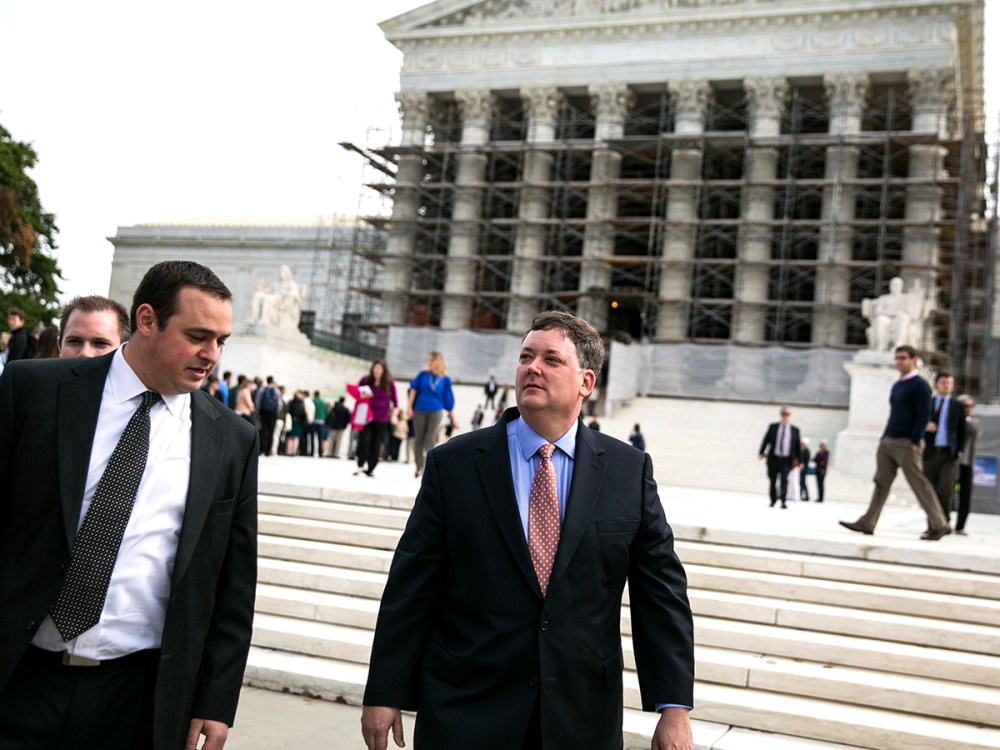
The Supreme Court heard oral arguments on Tuesday in a case being hailed as the next Citizens United, McCutcheon v. Federal Election Commission as the government shutdown stretched into its second week and largely dominated media coverage.
The result of this case could strike down limits on how many different candidates and committees people can donate to. “It’s not really a left or right issue,” Cycle co-host Ari Melber said. “There is a large majority of people who feel money already matters to much in politics.”
OurTime.org founder Matthew Segal believes that money shouldn’t dictate politics. When you have “money as speech there is a clear pattern in who people want to have access and a powerful voice within democracy,” Segal told MSNBC. “What the McCutcheon case is really about is whether particular individuals who are the wealthiest in the country can contribute to an unlimited amount to candidates. It’s essentially a way of hedging their political interest.” Segal, the co-founder of Millennial organization OurTime.Org, is concerned with how this decision could affect Millennials.
“If the limit of contributions are consistently expanded and the caps come higher and higher or eviscerated entirely, without question it will affect the Millennials,” Segal said. “We are the ones who will have to live the longest in a morally deprived political system and we are currently cash strapped.” On average, a Millennial’s political contribution ranges between $10-20, not the hundreds or thousands of dollars someone who is well invested can make. And while Millennials will, later in life, reach a point where they can donate larger sums of money to candidates, Segal argues that by that point their interests and issues of importance to them will change.
As Millennials are choosing colleges, joining the workforce, and attempting to pay off student loans, key issues for their demographic include student loan rates and bringing down the costs of higher education. Should the McCutcheon ruling give more weight to higher-income individuals, Segal feels, Millennial voices will be silenced–and so will their influence and access on issues important to them. Segal’s voice, however, was heard across the crowd at a rally on Tuesday in Washington D.C. to raise awareness about the case. Hundreds of people gathered to hear Segal, and members of other parties and organizations, speak about the high-profile case. But despite strong turnout, the OurTime founder is “not optimistic” about the way the court will rule. Pete Williams reported on Tuesday that a key vote in this case will be that of Chief Justice Roberts, who “said he doesn’t understand why you can say you can give as much as you want to nine candidates but not to ten candidates. He said he didn’t understand the logic of that, that did seem the violation of expression.” The Supreme Court has not yet announced when they will rule on the case.
Abby Borovitz
Ali Vitali is MS NOW's senior congressional correspondent and the host of "Way Too Early." She is the author of "Electable: Why America Hasn’t Put a Woman in the White House … Yet." Recommended



