








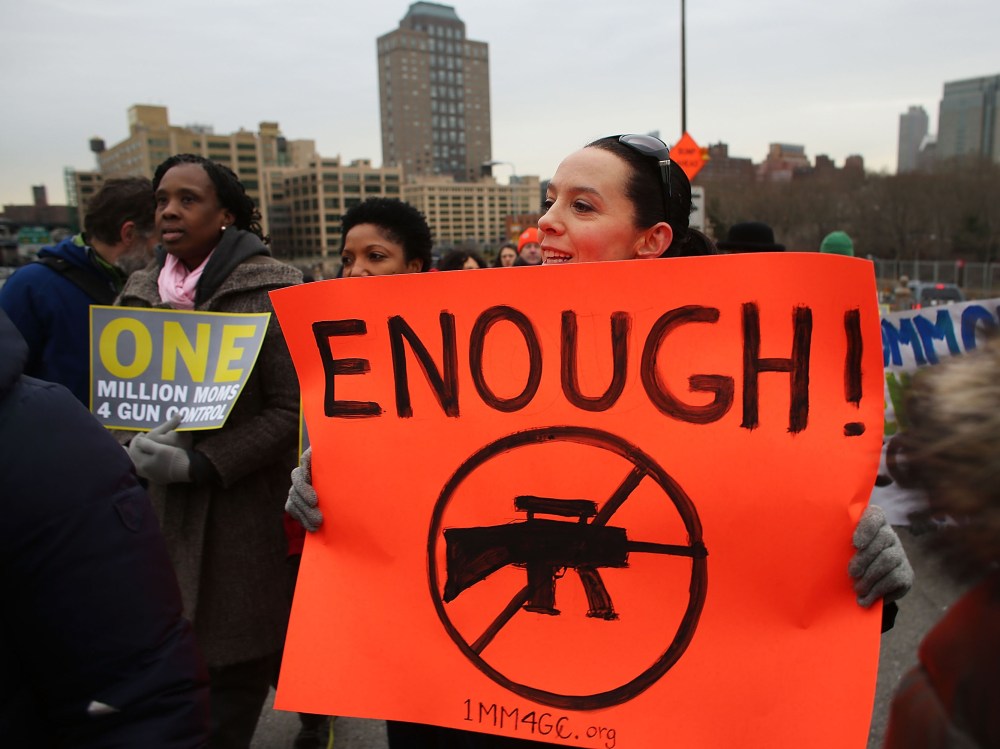
Three months after a gunman took the lives of 20 children and six adults at Sandy Hook Elementary School, public opinion remains strongly in favor of gun control reform to curb gun violence in America. Public support for background checks specifically has polled consistently above 85% in the past decade and a half. A recent Washington Post/ABC News poll released earlier this week found that 91% of Americans support background checks.
Legislation speaks louder than poll data—and tangible legislative results have been watered down at best. Federal lawmakers have taken small steps with many roadblocks along the way in translating public opinion into gun legislation. On Tuesday, the Senate Judiciary Committee approved a Democratic bill that called for background checks on all gun sales; however, the likelihood of it passing the Senate is slim due to objections from Republicans. Sen. Chuck Schumer, D-N.Y., has also been working on legislation to close loopholes in background checks, but the bill recently suffered a setback when it lost its top Republican sponsor, Sen. Tom Coburn, R-Okla., over the requirement to keep a record of gun sales.
As lawmakers battle in Congress, some states are trying to take tighter gun laws into their own hands. In states that have managed to create new laws, or tighten existing ones, the road to action has been blocked. More often than not, the very obstacles standing in the way of public-backed legislation are the legislators themselves.
Florida
Sen. Maria Sachs, D-Delray Beach, introduced the Universal Background Check Act in early March that would require the sale or transfer of guns to be done through a licensed dealer. The bill would close “loopholes” and ensure that gun transactions are not done without a background check—something that polling shows voters want.
But Florida has a gun-friendly history, and a Republican-dominated legislature, which will make passing bills like the Universal Background Check Act difficult. Sachs isn’t calling the legislation gun control, though; instead, she views it as “a gun discussion” that seeks to bring the laws in the state up to date with what Floridians need. Democratic State Rep. Lori Berman, who is co-sponsoring the bill with Sachs, calls sharpening background checks a “no nonsense, non-radical method of trying to rein in terror.” The law does provide exemptions in checks for inheriting and lending guns to family members. Critics reject the idea of public lists of law abiding gun owners—and on a national level, this idea has been likened to lists of registered sex offenders.
But despite predictions of a fight in the Florida legislator, a poll by Mayors Against Illegal Guns found that 92% of Florida’s 13th Congressional District, 88% of Florida’s 9th District, 86% of Florida’s 25th District, and 95% of Florida’s 27th District support requirements for universal background checks. Three out of the four of the above districts are represented by Republicans.
New York
While the New York State Secure Ammunition and Firearms Enforcement Act of 2013 was praised as Gov. Andre Cuomo’s “landmark” legislation on gun control, 52 out of 62 New York counties have already introduced resolutions to repeal it. The NY SAFE Act earned New York the title of the state with the nation’s strictest gun laws. Per Governor Cuomo’s website: “The legislation includes provisions to keep guns out of the hands of convicted felons and potentially dangerous mental health patients, and ban high capacity magazines and assault weapons.” More specifically, NY SAFE bans any magazine holding more than seven rounds (revised down from NY laws previous ten-round limit), allows authorities to track large purchases of ammunition, and closes a private sale loophole to ensure that all purchasers undergo a background check.
During debate of the bill on the New York Assembly floor, opposition came predominantly from Tea Party-favored conservative Republicans, like Assemblyman Steve McLaughlin, R-Melrose. “Moscow would be proud,” read McLaughlin’s statement the day after the bill’s signing. Since then, almost two-thirds of counties have passed resolutions repealing NY SAFE and the movement to oppose it has gained traction on the web and on Facebook among New York gun and Tea Party activists. Yet a survey from Siena Research Institute from late January showed that 65% of New Yorkers polled supported the passage of NY SAFE, and 67% maintaining a favorable opinion of Governor Cuomo.
Oregon
After a gunman opened fire at the Clackamas Town Center in Portland last December, Oregon State Senator Ginny Burdick became inspired to fight for stronger gun reforms. At the start of the 2013 legislative session, Burdick sponsored two bills: one that expands background checks in Oregon to private gun sales, and another that would ban guns on Oregon school property. Oregon Democrats have also introduced a House Bill that would ban many semi-automatic firearms and high-capacity gun magazines—a bill that even chief sponsor Rep. Mitch Greenlick, D-Portland, says is unlikely to pass. A similar bill that would ban the sale of high-capacity gun magazines failed to advance in February as well. Republican legislative leaders in Oregon have said they’re “not interested” in gun restrictions, such as those that have been passed in New York. A poll conducted by The Oregonian earlier this year found the majority of Oregon residents were strong supporters for gun rights, yet 75% were in favor of expanding background checks to cover private gun sales in the state. Colorado A bill that would limit ammunition and expand gun background checks to private and online sales is nearing passage in Colorado, which would make the Centennial State the first on the West Coast to act on gun control since last year’s mass shootings in Aurora, Colo. and in Newtown. The bill has received approval from both chambers of Colorado’s Democratic Legislature, but the state’s Republicans have fought it, arguing that the proposals would restrict their Second Amendment rights. Some parts of the proposals have been successfully removed—banning guns on college campuses, making gun owners and sellers liable for crimes committed with their weapons—but Democrats have otherwise remained firm. Gov. John Hickenlooper has said he will sign the bills if they make it to his desk. The AP notes that passage of these two bills could set a precedent for other politically moderate states when it comes to gun reform. Following the July 20 movie theater shooting in Aurora, Colorado gun sales increased as the nation revived the debate over gun control. Recent polls show that 80% of Colorado residents support universal background checks.
Traci Lee
Ali Vitali is MS NOW's senior congressional correspondent and the host of "Way Too Early." She is the author of "Electable: Why America Hasn’t Put a Woman in the White House … Yet." Recommended



