








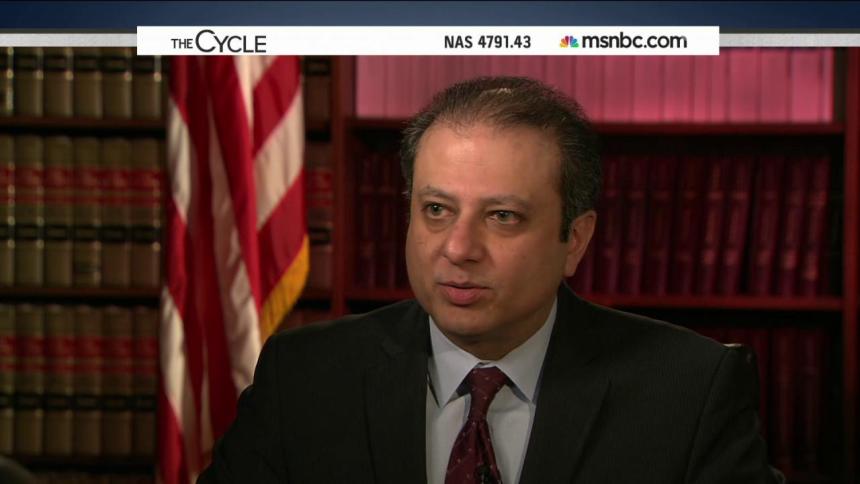
Preet Bharara, New York’s top prosecutor, puts a lot of people behind bars.
According to the Justice Department’s most recent statistics, Bharara sent 1,413 convicts to prison over a year period ending in 2013 – netting the high conviction rate of 96%. He has also targeted some of the city’s most reviled figures, from financier Bernie Madoff to Times Square terrorist Faisal Shahzad. Unlike some prosecutors, however, Bharara is also using his office to reform how convicts are treated once they wind up in prison.
“Our job is to make sure we’re upholding the rule of law,” says Bharara. “Just because you are behind bars doesn’t mean you’re beyond the Constitution,” he said in an MSNBC interview Tuesday.
RELATED: Read the full transcript of the wide-ranging, in-depth conversation
Last summer, in conjunction with Attorney General Eric Holder, Bharara released a multi-year investigation into widespread abuses at Rikers Island, the second largest prison system in the country.
%22Just%20because%20you%20are%20behind%20bars%20doesn%27t%20mean%20you%27re%20beyond%20the%20Constitution.%22′
Investigators found that guards abused inmates with excessive force, solitary confinement and a pattern of facilitating violence by both guards and other inmates. Many of the victims were minors, and the report concluded the abuse violated “the constitutional rights of adolescent inmates.” (The New York Times and the Associated Press have also reported on instances of extreme abuse and brutality at the prison.)
“Some of the most vulnerable people in society,” Bharara said, “are young people — 16, 17, 18 years old — who are thrown into Rikers Island.” And some of them have been “treated very, very, very harshly — and very poorly,” he added.
Bharara recently joined a lawsuit to compel further reforms at Rikers.
“We haven’t come to a complete agreement on the case yet,” he said, noting that New York City has begun limiting the use of solitary confinement on some teenage inmates. “That’s progress right there,” Bharara said, and he believes it stems “in part” from his office’s work.
Related: Bharara’s tells MSNBC about his political corruption investigations
Medical and human rights experts are increasingly skeptical of the use of solitary confinement in the industrial prison complex. In a widely discussed New Yorker article, journalist and doctor Atul Gawande documents how solitary confinement can cause major damage to inmates. Other human rights experts have suggested the practice amounts to torture, especially when used on minors and the mentally disabled.
Some members of Congress from both parties are also seeking to limit the practice, including a proposal from Democrat Cory Booker and Republican Rand Paul.
Yet while Bharara’s report found some conduct at Rikers did violate the Eighth Amendment’s ban on cruel and unusual punishment, he demurred on the question of whether forcing minors into solitary confinement constitutes torture. %22If%20you%20send%20young%20people%20into%20prison%20without%20taking%20care%20that%20they%27re%20being%20treated%20humanely%20–%20as%20opposed%20to%20be%20being%20beaten%20to%20a%20pulp%20–%20you%27re%20causing%20a%20cycle%20of%20violence.%22′ “I’m not going to get into the definition of torture,” he says, “but we very strongly have a view as written out in our report that punitive segregation or solitary confinement for young people is particularly terrible.” Just as many criminal justice reform advocates contend that less punitive policing is both more human and more effective at curbing crime, Bharara argues that humane prisons are more likely to rehabilitate prisoners, rather than “harden” them. “If you send young people into prison without taking care that they’re being treated humanely — as opposed to be being beaten to a pulp, where there are no television cameras who can record it, and where there’s no discipline of the officers who are engaging in that kind of heinous behavior — you’re causing a cycle of violence,” Bharara says. He believes that cycle makes inmates “more likely to be dangerous to the community” later. “What you’ve taught them is that the system is not fair — ‘that no one cares about us,’” he says. Good prosecutors should not fixate on simply “sending a certain number of people to jail — that’s not what the enterprise is about,” he says, and it’s not what justice “should be about.” This article is based on Part 1 of Bharara’s interview on “The Cycle” airing Tuesday. In Part 2 of the interview, airing Thursday at 3pm ET, Bharara discusses his Wall Street prosecutions, insider trading, al Qaeda, ISIS and questions about his future.
Ari Melber
Ari Melber, an Emmy Award-winning journalist, writer and attorney, is the host of “The Beat with Ari Melber” airing nightly at 6 p.m. ET on MSNBC. He also serves as MSNBC’s chief legal correspondent and an NBC News legal analyst. Before joining MSNBC, Melber practiced First Amendment law and served as a legislative aide in the U.S. Senate. He received a J.D. from Cornell Law School and is a member of the New York Bar. Recommended


