The Rachel Maddow Show WEEKNIGHTS 9PM ETMorning Joe WEEKDAYS 6AM ETDeadline: White House with Nicolle Wallace Weekdays 4PM ETThe Beat with Ari Melber Weeknights 6PM ETThe Weeknight Weeknights 7PM ETAll in with Chris Hayes TUESDAY-FRIDAY 8PM ETThe Briefing with Jen Psaki TUESDAYS – FRIDAYS 9PM ETThe Last Word with Lawrence O’Donnel Weeknights 10PM ETThe 11th Hour with Stephanie Ruhle Weeknights 11PM ET
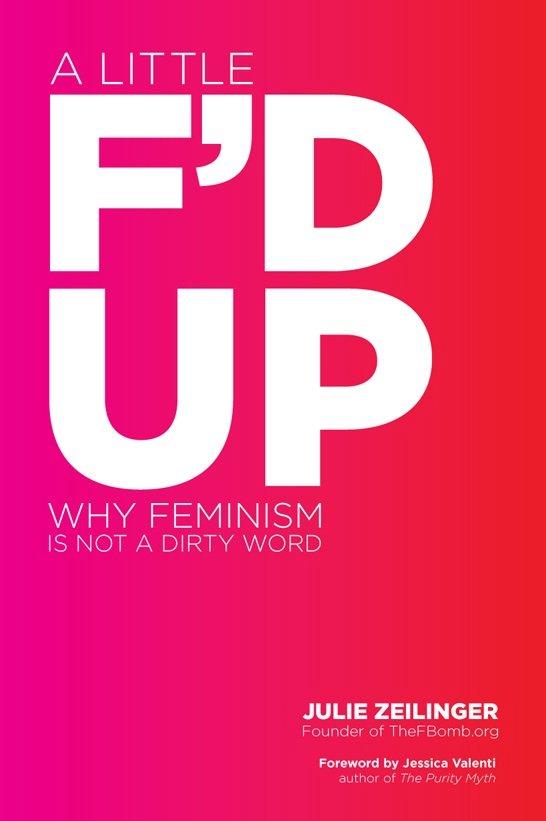
Author, Julie Zeilinger, is joining The Cycle conversation today to discuss her book A Little F'D Up: Why Feminism Is Not A Dirty World.".
Modern Feminism from a teenagers perspective
By
The Cycle Staff
Author, Julie Zeilinger, is joining The Cycle conversation today to discuss her book A Little F’D Up: Why Feminism Is Not A Dirty World.”. In her book, Julie explains why feminism is not a dirty word. Rather, she portrays feminism as a rite of passage that is elss taken in todays world, but an important step in self realization and self-esteem.
Below is an excerpt from her book and be sure to tune in at 3pm for the full conversation!
Reason #4: “I just want to be a normal teenager.”Okay, so maybe this is not an answer you’d actually hear if you surveyed hundreds of girls about why they don’t want to call themselves feminist. In fact, I’ve never heard a teen overdramatically sob about her desire for normality outside of a ’90s-era sitcom. But even if girls wouldn’t actually say this, I can guarantee you that many of them are thinking it.
Somehow, teens have the mistaken idea that if you become a feminist, it takes over your life, your personality, everything. For the record: It really doesn’t.
However, it is true that when you decide to go public with your feminism, some people like to automatically categorize you as, “[Insert Name Here], the Feminist.” For them, it’s your epithet, and it’s all-encompassing. Who cares if you’re awesome at soccer? So what if you make a kick-ass chocolate soufflé? This is the second version of the feminist stereotype—the “if she’s a feminist, then she must live and breathe feminism, and everything out of her mouth must be completely representative of the entire movement” stereotype.
I’ll never forget a conversation I had with a male classmate soon after I went public with my feminist identity. A liberal, open-minded guy who blatantly declared his disgust at racist and sexist jokes, he surprised me by stating—without a hint of humor or ill will—“But you don’t really look or act like a feminist.” When pressed as to what he meant, he elaborated, “You dress like every other girl, and, I don’t know, you seem to talk about a lot of other stuff and have other interests.”
I promptly slapped him in the face, shouted “YOU BASTARD!” and ran away crying.
Just kidding. I have absolutely no recollection of what I did after that, but I probably made a joke about it, called him an idiot, and moved on.
My point is this: Though I am a feminist—and though I have made it a large part of my life, because of my blog, and because of my general passion for it—feminism is not the one single thing that defines who I am as a person.
And that’s not just true of me: There are plenty of feminists who also manage to be professionals, artists, dog lovers, Star Wars enthusiasts, karaoke stars, lumberjacks, and marathon runners. They have families. They have other interests. They’re people.
Feminism doesn’t shape every facet of your being. Though it may be hard to believe, I’ve had formative experiences in my life that are separate from feminism and that have shaped who I am, what I say, what I do, how I dress . . . the list goes on. Of course, feminism has shaped me and does affect the way I act and think, but the fact that I call myself a feminist does not mean that every single thing I project into the world will be tinged with feminist ideology.
And another thing: While feminism is like a religion in that both have ideologies and prescribed values (and, unfortunately, extremists), feminism is in fact not a religion. But people often think it is—and not just any old religion, but a creepy cult, one with people who never seem to blink and who dance wildly around an urn of sacrificial unicorn blood. They think it’s a cult that wants to convert you, to devour your soul and turn you into a nonblinker too. For the record, feminism is not a cult. Gatherings of feminists usually happen in the form of a benefit for a nonprofit like Planned Parenthood, or the Women’s Media Center—or just at a restaurant or somebody’s house—and often involve food. Like cookies. Feminists enjoy cookies, just like everybody else. In fact, if you baked me some right now, I’d show you just how much feminists like cookies. I really would.
Just as somebody might identify as Jewish or Christian, that same person might also identify as a synchronized swimmer, a pool shark, a great dad, or a loyal friend. The same goes for feminists. Being a feminist doesn’t mean you have to be a feminist and only a feminist. Believe it or not, you can have a feminist identity and still be yourself.
Reason #5: “What does ‘feminism’ even mean?”Honestly, I think the most common reason that teenage girls don’t self-identify as feminists is that—whether they admit it or not—they don’t know what one is. Understandably, girls don’t want to align themselves with something they don’t fully comprehend.
That’s reasonable. Frankly, it’s comforting to me that girls won’t sign up for something unless they feel they really understand it. I wouldn’t want girls to sign up for feminism the way lost souls fall into aforementioned cults and other organizations that lure people in with impressive-sounding but utterly nonsensical terminology (Scientology, anyone? I mean seriously people, it was created by a sci-fi writer).
But the problem is exacerbated by the fact that, even if a girl does try to figure out what feminism is, the many different definitions out there are confusing as hell. It’s probable that she’ll immediately be turned off by some of the limiting or extremist definitions that are out there.
Here’s an example. Beatrice, age fifteen, comes across the women’s movement section of her history textbook. She’s intrigued (who wouldn’t be intrigued by the fascinating history of our country?!) but confused, because while she’s heard the word “feminism” before, she’s not really sure what it means. The first time she heard the word, it was in the context of a joke on a sitcom—as an insult, delivered by a man to his wife when she was nagging him. But she also once heard one of her friends referring to her own mother as a feminist. It didn’t seem like an insult then. So confusing.
So Beatrice does what every teenager nowadays does when they need to figure out what something means. She heads to the Internet. First, following the sage advice of English teachers past, she heads to Dictionary.com. The following entry pops up:
Fem.i.nism (noun): 1. the doctrine advocating social, political, and all other rights of women equal to those of men.2. (sometimes initial capital letter) an organized movement for the attainment of such rights for women.3. feminine character.3
Well, that’s broad, vague, and mind-numbingly dull, Beatrice thinks. I want to know what this really means. What do feminists do? How do people feel about them? Is this cool? Should I care?
So she heads to the Urban Dictionary, an online slang “dictionary,” the content of which is generated by any random Internet user, and which has less to do with accuracy and more to do with being as shocking and/or provocative as possible. She types in “feminism” there and finds:
Feminism:A movement to promote women’s interests at the expense of men. Despite claims by some moderate (and misled) feminists to the contrary, feminism is not a movement for the betterment of men and women. If it was, it would be called humanism. Feminists are not concerned, for example, about the fact that four times as many men commit suicide as women, or that fewer and fewer boys attend college or graduate from high school. Feminists demand that we treat men and women as exactly equal unless it suits women to differentiate between the sexes. For example, a typical feminist will see no irony in arguing on the one hand that women need ever-greater protection from domestic violence, rape, and sexual harassment, but on the other hand that women are just as good as men at fighting, construction, farming, police work, etc.4
Yikes, Beatrice thinks. I generally like the male gender—when they shower and aren’t using their armpits to generate farting noises. I am also uninterested in completely repelling the opposite sex. Maybe this isn’t for me.
But then, later in the day, she takes a study break to search for YouTube videos of Lady Gaga, her idol. (She even choreographed a flash mob to “Just Dance,” which successfully garnered seventeen YouTube views—ten more than the number of participants in the dance! Success!) And in her search, she comes across an interview for SHOWstudio in which The Haüs of Gaga Herself mentions feminism. Says Gaga,
I am a feminist. I reject wholeheartedly the way we are taught to perceive women. The beauty of women; how a woman should act or behave. Women are strong and fragile. Women are beautiful and ugly. We are soft-spoken and loud, all at once. There is something mind-controlling about the way we’re taught to view women. . . . Perhaps we can make women’s rights trendy. Strength, feminism, security, the wisdom of the woman. Let’s make that trendy.5 Beatrice is now officially befuddled as to what feminism is. Maybe it’s good; maybe it’s bad. Whatever. She looks up the video for “Bad Romance” and shoves her books a little farther away.
The information may be out there, but it’s just not clear. There are so many conflicting messages about feminism—it’s no wonder girls have no idea what it’s all about.
Reason #6:“I’m just not into labels and group mentality.”Even if there weren’t so many different definitions out there; even if we were told only good things about feminism—that it’s equality, sugar, spice, and everything nice—it wouldn’t fully convince us. Because we know that the world is big, and that there is always another side to the story. We were born into the age of easily available information. We’re aware that almost everything we hear is biased. We’re straight-up skeptical.
We’re not the type of young adults who will ever sign up for a feminist-indoctrination ceremony where we sing songs about our periods, declare our undying alliance to the “sisterhood,” and pass around the symbolic hammer we’re going to use to smash the patriarchy.
To believe in feminism, teens of my generation have to come to it on our own.
WHY I DO IDENTIFY AS A FEMINISTWhatever the specific reason may be, the fact is that the feminist movement has become so freakin’ confusing and so far removed from both the realities and idealizations of teenage life that girls shy away from the thought of associating themselves with it. In the end, we don’t want to align ourselves with something we don’t understand—especially if when we begin to try to understand it, it becomes scary and alienating.
That being said, there are teens who have managed to foster strong feminist identities. Obviously, I’m one of them. But none of my high school friends identified as “feminist.” Not one. It never bothered me, because when it came down to it, they all wrote a feminist-themed paper at some point in their high school careers; they all wrote for the FBomb; and they all defended feminist perspectives in class and life. They just weren’t comfortable calling themselves feminists.
But one day, I brought it up. “Why don’t you identify as feminist?” I asked.
They all gave their various reasons, but they can be summarized by the following: “I don’t call myself a feminist because I don’t consider myself part of that movement, though I do support women’s rights and a feminist agenda. Plus I don’t want to be segregated from other people. Calling yourself a feminist alienates people. Anyway, feminism is basically the same thing as liberalism.”
Here’s the thing. Like I said, I really don’t give a flying @!$%# whether or not somebody identifies as a feminist. (Okay, maybe that’s not totally accurate: I do love it when girls identify as feminist. It makes me warm and fuzzy inside, like a teeny tiny kitten is curling up against my heart.) Ultimately, I’m much more concerned with whether or not the people I know maintain and enforce feminist values.
I would never think less of anybody who chooses not to identify as a feminist, and I support anybody’s decision to self-identify any way they want. Want to go around telling people that, while you appreciate the feminist agenda, it’s more important to you to be known as a “pokemonist”? I say, “Go for it! Just don’t vote for political candidates who want to restrict what I can do with my vagina! Thanks, and good luck trying to catch ’em all!”
But I will say this. There is a distinct difference between those who call themselves feminists and those who don’t—and I don’t just mean the willingness to take on a label. I mean the difference between being passive and being active.
Those who don’t identify as feminists can claim to support the feminist cause in every way but name. When you ask them about feminism, the response usually goes something like, “Of course, if somebody did or said anything sexist, I’d do something about it,” or “Of course, if it came down to a vote, I’d vote with the feminist agenda.” But they’re not willing to put themselves on the front line. They’re not going to go out there and speak out against sexist language and actions before they happen. They’re not going to go out there and advocate for the proposition that would make the vote a reality.
But when you actually identify as a feminist—as in slapping the label on your forehead—it forces you to act. As a self-proclaimed feminist, you can’t be passive about your thoughts and ideals: You’re committed to them, because you’ve told people you’re a feminist, and so they will hold you to them. I don’t mean they’ll hold a gun to your head and say, “But you’re a feminist! You have to sign this pro-choice petition!” Rather, when other people know, it activates your sense of integrity. You know you must act on what is right. Or, maybe you’re not affected by peer pressure—it’s enough that you know. You act because you’re a feminist, damn it.
That willingness to take action is what it comes down to for me, if for no other reason than life is short. It’s so @!$%#ing short. (Like, I feel like I was in kindergarten proudly drawing my mom a rainbow not five minutes ago, and yet somehow now I’m in college. How the hell did that happen? Give me my crayons back, damn it!)
In all seriousness, though. We have this one, glimmering, beautiful shot to be alive on this crazy-ass planet. I really don’t want to spend my time @!$%#ing around. Yes, I want to have fun, I want to laugh, and I want to love. But I don’t want to be on my deathbed and realize I really only gave it a half-assed shot. I want to be all in, and I want to completely and fully support everything I believe in, and do what’s right. And maybe—just maybe—that complete self-abandon to my beliefs and values will actually make a difference.
And that, my friend—that, more than anything else—is why I identify as a feminist, loud and proud.