








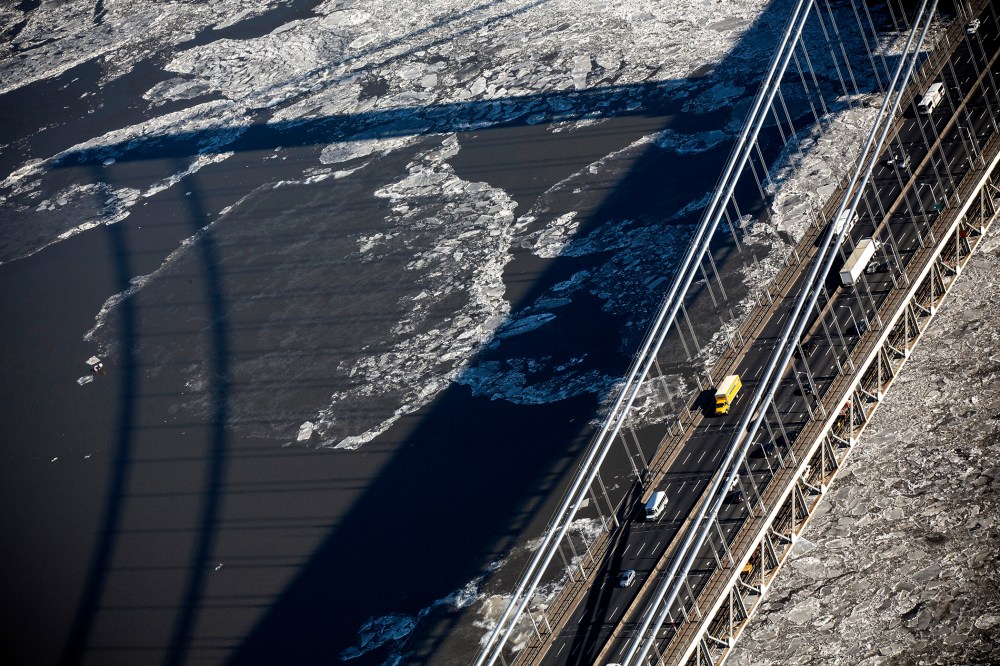
Reporting and research from our UP team has found that it was more than the everyday lives of commuters and residents of Fort Lee, New Jersey that were altered and in some cases jeopardized by the closure of access lanes to the George Washington Bridge carried out by appointees of Governor Chris Christie last September.
The closures also affected and possibly jeopardized a project of enormous economic and political significance. What we’ve learned potentially raises the stakes of what was on the line when the lane closures occurred.
The common understanding of the story thus far has been that the town’s Democratic mayor, Mark Sokolich, was apparently targeted by members of Christie’s team for retribution, and that that retribution took the form of snarled traffic and all of the administrative headaches that came with it. But as the status of the those access lanes was up in the air, there was something else for Sokolich to worry about: the fate of a $1 billion redevelopment project at the foot of the bridge – the largest redevelopment project in the history of Fort Lee and a project that, for better or worse, figure’s to serve as Sokolich’s mayoral legacy.
The project in question sits on what is known in Fort Lee as Redevelopment Area 5 – a 16-acre parcel of land that had sat vacant for four decades before Sokolich began leading plans to develop it. It is some of the most valuable real estate in New Jersey, thanks to its proximity to the George Washington Bridge, which serves as a gateway to New York City – and especially because it abuts the very local access lanes that were closed by members of Christie’s team.
As those closures played out in September – and as his calls were ignored by Christie officials – Sokolich wrote an email to Christie’s point man at the Port Authority, Bill Baroni, asking him to reopen them and asking this question: “What do I do when our billion dollar redevelopment is put on line at the end of next year?”
There was good reason for the project to be on Sokolich’s mind. The redevelopment of the land has been laying out in several phases. Twin 47-floor towers are currently under construction on half of it, with residents expected to begin moving in late this year. But back in September, when the lanes were closed, financing had not yet been finalized for the redevelopment of the second half of land – a plan to build a mix of commercial, residential and parking facilities. Speedy access to the George Washington Bridge – and to those access lanes in particular – is what made the land particularly valuable, both to developers and potential tenants. A study commissioned by Fort Lee a year earlier had stressed that, once the site was redeveloped, anyone living or working at it would be able to drive to the bridge expeditiously even during rush hour. And in a brochure, the lead developer of the second half of the project – a development called Hudson Lights – played up its proximity to the bridge.
Notably, a Bergen Record report from last September 16 announced that financing had – after an unexpected delay – been finalized for the Hudson Lights portion of the redevelopment. That date – September 16 – came three days after New York officials at the Port Authority intervened to put an end to the lane closures.
Adding further intrigue are public statements made subsequently by both Christie and Baroni. The governor, in the now infamous December press conference where he jokingly claimed that he’d been putting up cones at the bridge, expressed dismay for the access lanes, claiming they were some kind of sweetheart deal for Fort Lee.
“The fact is I didn’t even know Fort Lee got three dedicated lanes until all of this stuff happened,” he said. “And I think we should review that entire policy, because I don’t know why Fort Lee needs three dedicated lanes, to tell you the truth, and I’ve told Chairman [David] Samson this, that we should look at this policy. Because I don’t know why one town gets three lanes. One lane, maybe. Three lanes, for one town? I don’t quite get it.” This past week it was learned that David Samson, a former New Jersey attorney general who was appointed by Christie to serve as chairman of the Port Authority, apparently met with Christie in early August – information that came to light in the email and text records of David Wildstein, another Christie Port Authority appointee, which were subpoenaed and released to the public. That apparent Christie-Samson meeting would have come before Christie’s now former deputy chief of staff, Bridget Kelly, wrote an August 13 email to Wildstein saying, “Time for some traffic in Fort Lee.” Baroni, in an appearance before the state Assembly committee investigating the matter in late November, also argued that Fort Lee was getting special treatment with the access lanes. Taken together, his comment and Christie’s suggest the administration may have been looking at permanently closing or reducing the access lanes back in September. And that September closure, we can now say, didn’t simply complicate the everyday lives of Fort Lee residents. It potentially jeopardized the value and the future of a $1 billion redevelopment plan that has been the centerpiece of Sokolich’s mayoral agenda for years.
Steve Kornacki
Steve Kornacki, author of "The Red and the Blue: 1990s and the Birth of Political Tribalism," is a national political correspondent for NBC News and MSNBC. Recommended


