








Tea Party activists in Kentucky have been privately talking about a conservative challenge to Mitch McConnell since last Election Day. McConnell’s aides knew about these machinations and tried to head off a primary. They failed.
Even before November, McConnell tapped Jesse Benton, a longtime adviser to the Paul family, as his campaign manager. He held one-on-one meetings with key Tea Party leaders around the state, some of whom had never spent such extended time with the Senate Republican Leader. After supporting Rand Paul’s opponent in the 2010 GOP primary, McConnell actively courted the junior senator. When McConnell, along with Vice President Biden, reached the compromise that averted the fiscal cliff but also raised taxed on the wealthy earlier this year, McConnell aides immediately reached out to conservative activists in the state to explain the agreement, emphasizing that the senator had stopped what could have been an increase in taxes for most working Americans.
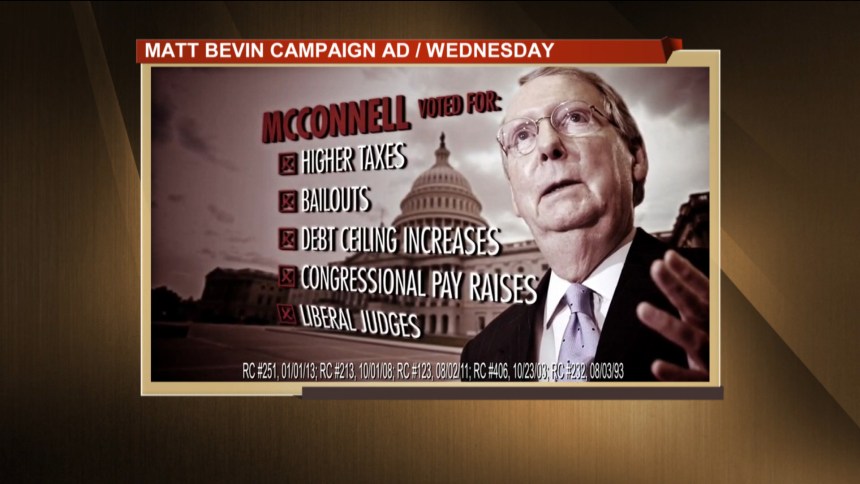
It didn’t work. On Wednesday, Matthew Bevin, a millionaire Louisville businessman and investor, announced his primary challenge to McConnell, blasting the incumbent as insufficiently conservative on a range of issues from immigration to earmarks to the 2008 Wall Street bailout. One of Bevin’s aides for his campaign will be Sarah Durand, who stepped down as the head of the Louisville Tea Party to help Bevin defeat McConnell. The United Kentucky Tea Party, a coalition of Tea Party groups around the state, announced their endorsement of Bevin.
“Over his 30 years in Washington, Mitch McConnell has supported a lot of bad policies,” Bevin said in his announcement speech in Frankfort, Kentucky’s capital.
At the same time, Bevin was realistic about his chances, saying, “never in the history of American politics has a party leader in the United States Senate been defeated in a primary.”
McConnell, long prepared for Bevin’s entrance into the race, quickly released an ad attacking the challenger for tax liens accessed against a company Bevin’s family owns and the candidate has helped run.
This race will not be like the several of the GOP primaries of 2010 and 2012, when an upstart Tea Party challenger defeated an incumbent caught blindsided, like Indiana’s Richard Lugar last year. Bevin’s candidacy was rumored for months in Kentucky, and McConnell aides were intensely aware of it and ready to attack him the moment he formally entered the May 20 primary.
McConnell doesn’t want to worry about a Tea Party challenge forcing him too far to the right to win a general election. Kentucky is quite conservative; Barack Obama lost by 23 points there in November. McConnell’s anti-Obama credentials will help both against Bevin and his general election race against the likely Democratic candidate, Secretary of State Alison Lundergan Grimes.
“He [McConnell] saw what happened to me, he saw what happened to Lugar, he saw what happened to Lisa Murkowski,” said Trey Grayson, the one-time Kentucky Secretary of State who lost the 2010 U.S. Senate primary there to Paul. “ I think he’s put himself in a strong position.”
At the same time, the Tea Party groups in Kentucky were wary of tapping a candidate like Indiana’s Richard E. Mourdock, who defeated Lugar in the 2012 GOP primary and then made controversial statements about rape and lost a Senate seat in a red state that a Republican should have won. Kentucky Tea Republicans spent months looking for the right kind of candidate, a conservative but one unlikely to make crippling gaffes in either the primary or general election. And they wanted someone to match McConnell’s prodigious fundraising abilities.
In Bevin, they found a millionaire, who is expected to put some of his own money in the race, as well as a candidate with a strong personal story, a captain in U.S. Army before entering business and the father of nine children, four of whom he and his wife adopted from Ethiopia. Bevin, according to advisers, will attempt to cast McConnell as insufficiently conservative, blasting him for voting to increase the debt ceiling repeatedly as a senator, supporting the 2008 Wall Street bailout and initially opposing the candidacy of Paul. He will also argue that the senator’s approval ratings are so low that Kentucky Republicans are risking control of the seat by nominating McConnell. In a state President Obama lost by 23 points, a traditional Republican will defeat a traditional Democrat, according to Bevin aides, but voters in Kentucky are tired of McConnell and might opt for Grimes in a general election just to get rid of the man who has represented the state in the Senate since 1985. And they will question one of the core arguments McConnell is making on the campaign trail against Grimes, namely that Kentucky does not want to replace a member with huge clout in the chamber with a freshman. “He was the minority leader when the $700 billion stimulus bill passed. Where was all this clout then?” Durand said in an interview. The race will test the power of the Tea Party in Kentucky. Rand Paul won here in 2010, defeating the favored Grayson, but he also had a famous last name and a national fundraising network from his father. Other Tea Party candidates have struggled to defeat establishment Republicans in the state, and Paul himself won’t be aiding Bevin, having already endorsed McConnell with an eye toward his likely 2016 presidential run. But Bevin’s aides polled Kentucky Republicans before the race. And while they would not release details, they argue McConnell is weak even among Republicans, particularly once they are informed of some of the less conservative elements of his voting record. Bevin’s Team says they can win this race because it is not simply Tea Party vs. establishment, but the Tea Party against a politician people in Kentucky simply are tired of.
Perry Bacon Recommended


