








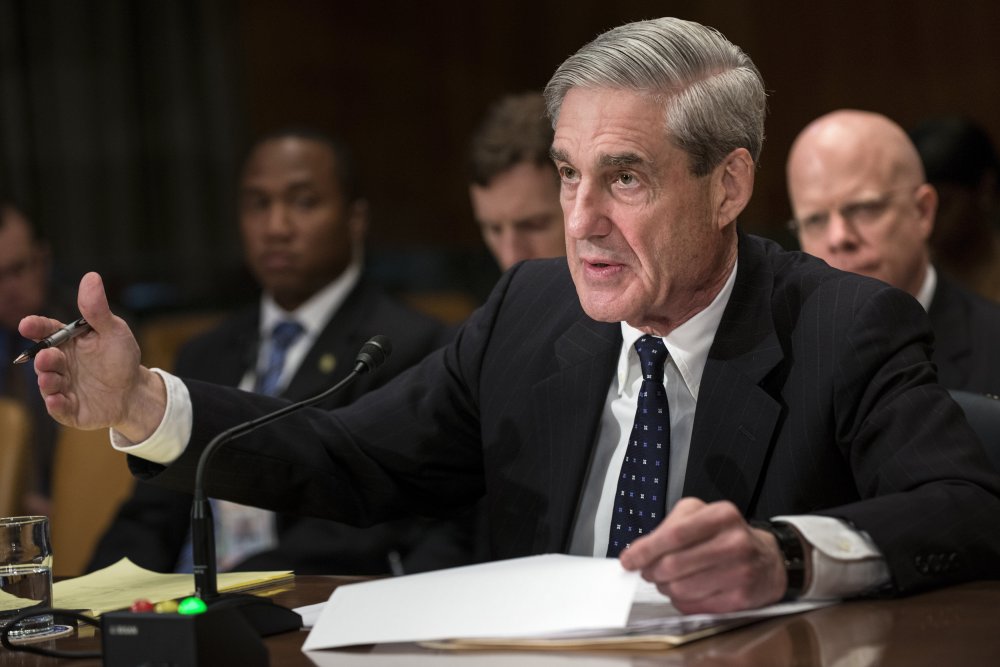
As recently as Friday afternoon, a reporter asked Donald Trump whether Special Counsel Robert Mueller should testify before Congress. “I don’t know,” the president replied. “That’s up to our attorney general.”
Two days later, Trump’s position changed in dramatic fashion.
President Donald Trump said Sunday that special counsel Robert Mueller should not testify to Congress on his report on Trump and Russia, claiming Democrats only want him to appear because his probe didn’t reach the conclusions they wanted.
“Are they looking for a redo because they hated seeing the strong NO COLLUSION conclusion?” Trump tweeted. “There was no crime, except on the other side (incredibly not covered in the Report), and NO OBSTRUCTION. Bob Mueller should not testify. No redos for the Dems!”
I don’t know what Trump thinks “redo” means, but much of his missive was gibberish. The president’s assertions about the Mueller report’s conclusions bear no real resemblance to the special counsel’s actual findings.
Indeed, the contradiction at the heart of the Republican’s argument was apparently lost on him: if Mueller arrived at a “strong no collusion conclusion,” and the special counsel determined that there was “no obstruction,” shouldn’t Trump be eager to have Mueller say so in sworn testimony for all the world to see?
It apparently never occurred to the president that it might look foolish for him to effectively say, “The person who totally exonerated me should remain silent, indefinitely.”
Indeed, while Trump’s dramatic shift sparked headlines over the weekend, it’s worth emphasizing that this was less of a reversal and more of a realization. His newfound opposition to Mueller’s testimony is a reflection of the fact that the president now understands, at least on some level, that the investigation’s findings are badly at odds with his recent claims.
Trump chose to believe what he wanted to believe, and he substituted a self-satisfying fiction for reality. What’s less clear is what happens now.
As of yesterday, Democrats on the House Judiciary Committee were still working on trying to get the special counsel to testify on May 15, which is a week from Wednesday. This need not be seen as a strictly partisan matter: Republicans on the House Judiciary Committee also want to hear from Mueller. Even Attorney General Bill Barr, during his controversial press conference the morning of April 18, told reporters, “I have no objection to Bob Mueller testifying.” All of which leaves Trump rather isolated on this point. But will he have the final say anyway? I can’t speak with any authority on Justice Department procedures, but I’ll be curious to see whether Trump’s weekend tweet was a presidential directive or a random thought about his personal preference. If it was the former, can Trump block a Justice Department employee from testifying? What about when Mueller is no longer part of the department?
Steve Benen is a producer for "The Rachel Maddow Show," the editor of MaddowBlog and an MS NOW political contributor. He's also the bestselling author of "Ministry of Truth: Democracy, Reality, and the Republicans' War on the Recent Past." Recommended


