








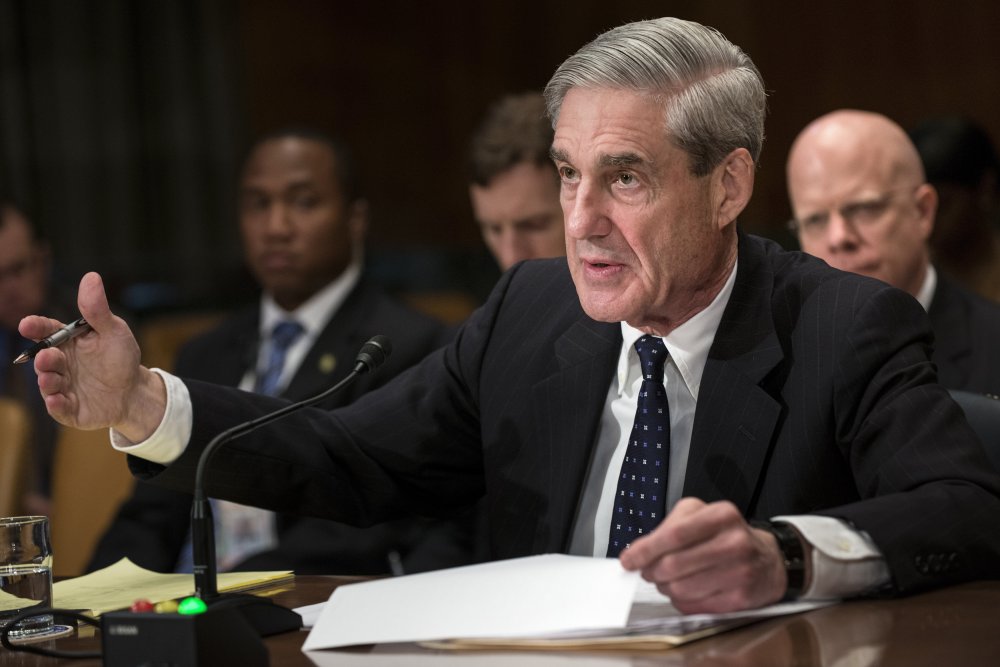

For those who’ve followed the investigation into the Russia scandal closely, it started to seem as if we’d never hear another word from former Special Counsel Robert Mueller. He’d issued a report; he’d delivered brief remarks; and Mueller made clear he had no interest in further addressing the probe or its findings — in any forum, at any time, for any reason.
As you may have seen on last night’s show, some in Congress are aware of the former special counsel’s reticence, but they nevertheless have questions that need answers.
Former special counsel Robert Mueller has agreed to testify in public about his two-year Russia investigation at a hearing before the House Intelligence Committee and Judiciary Committee on July 17. The announcement came from the chairmen of the two panels, who issued a subpoena compelling his testimony.
In a news release issued late Tuesday, Judiciary Committee Chairmen Jerrold Nadler, D-N.Y., and Intelligence Committee Chairman Adam Schiff, D-Calif., said that Mueller had agreed to testify next month.
House Intelligence Committee Chairman Adam Schiff (D-Calif.) conceded during an on-air interview with Rachel that the subpoena probably shouldn’t be seen as a “friendly” one: Mueller doesn’t want to do this.
But he’ll honor the congressional subpoena anyway. Some of the logistical and procedural issues haven’t yet been resolved, though it appears Mueller will testify — on camera and in open session — for both the House Judiciary Committee and the House Intelligence Committee, in back-to-back sessions on the same day. Schiff indicated last night that there will also be a closed-session hearing with members of the special counsel’s team.
While those plans for the July 17 hearing come into sharper focus, the larger questions are also taking shape: what, exactly, can we expect to learn from Mueller? What will members ask?
When Rachel asked former U.S. Attorney Barbara McQuade about this last night, she quickly pointed to some key lines of inquiry: did Mueller really intend for Attorney General Bill Barr to make the final call after the special counsel’s office declined to make a prosecutorial decision, why did Mueller handle the obstruction-of-justice issue differently than the criminal-conspiracy question, and what was the special counsel’s office unable to determine as a result of Team Trump’s obstructive behavior? That’s an excellent start, though there are certainly other areas ripe for congressional scrutiny. But I also want to circle back to a point that we kicked around a month ago. As disappointing as this is, the fact remains that most Americans didn’t read the Mueller report. Some have heard the truth about it, others haven’t, but most of the public doesn’t have a meaningful understanding of its contents. All of which reinforces the importance of the former special counsel’s testimony. Mueller said in May that if he appeared before Congress, he wouldn’t go further than what appeared in his report. I’m not at all convinced that’s true — there are many areas he can bring fresh clarity to — but even if he answered every question by literally reading from his own document, that too would have some utility, since for many of those watching, it would be their first introduction to the report’s findings.
Steve Benen is a producer for "The Rachel Maddow Show," the editor of MaddowBlog and an MS NOW political contributor. He's also the bestselling author of "Ministry of Truth: Democracy, Reality, and the Republicans' War on the Recent Past." Recommended


