








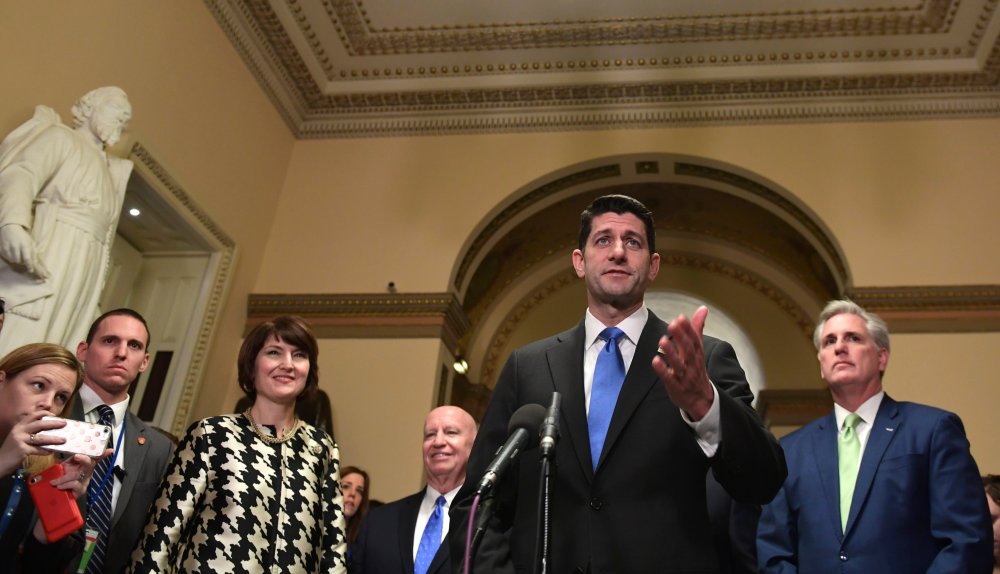
House Republicans have wrapped up the legislative work on the party’s regressive tax plan and have sent the GOP bill to Donald Trump for his signature. It’s going to take some time to fully digest the real-world consequences of the biggest tax bill Americans have seen in a generation.
But beyond the substantive and policy implications, there’s also the political fallout to consider. Politico had a notable piece this past weekend, before the voting began on Capitol Hill, asking why the efforts from opponents of the bill fell short.
The tax fight has all the ingredients that helped Democrats kill Obamacare repeal: party unity on Capitol Hill, energized liberal activists and legislation that polls in the toilet. But this time it doesn’t appear to be enough. […]
[T]he reasons for their likely failure are becoming clear. While stripping people of health insurance strikes at a visceral human need, a debate over taxes tends to bog down voters in wonky details. Meanwhile, Democrats struggled to break through a media environment crowded with an intensifying Russia investigation, a wave of sexual harassment scandals and a fight over young undocumented immigrants. And while liberal grass-roots activists sought to bring pressure to bear on GOP swing votes, the Republican Party held together this time, desperate for a major legislative victory after a year in total control of Washington.
The comparison between the health care fight and the tax fight are probably inevitable, and may help explain the different outcomes. Far more Americans were poised to suffer under the GOP’s proposed health care changes — and suffer more severely — which was reflected in the intensity of the public backlash.
That said, I’m at a loss to think of something critics of the Republican tax plan could’ve done to derail the bill that they didn’t do.
When there’s one party that controls all the levers of federal power, and that party can pass their top goal by majority rule, the opposition has limited options. Its principal objective is obvious: make the majority party’s goal as unpopular as possible in order to pressure the majority party’s members to break ranks. In this case, the GOP’s progressive opponents did that: the Republican tax plan is the least popular major piece of legislation in three decades. At the same time, Democrats collected a mountain of evidence — from economists, from official score-keepers, from stakeholders across multiple industries — effectively making a bullet-proof case that this legislation is dangerously misguided. But it didn’t matter, not because the progressive case was weak, and not because activists didn’t show up to be heard, but because the case was ultimately irrelevant. Republicans were going to pass this bill no matter what. Polls and protests weren’t going to dissuade them, and for GOP lawmakers, economic data was even less important to the party. With that in mind, those looking for someone to blame for what transpired over the last seven weeks should probably focus on those who actually voted for this thing.
Steve Benen is a producer for "The Rachel Maddow Show," the editor of MaddowBlog and an MS NOW political contributor. He's also the bestselling author of "Ministry of Truth: Democracy, Reality, and the Republicans' War on the Recent Past." Recommended


