








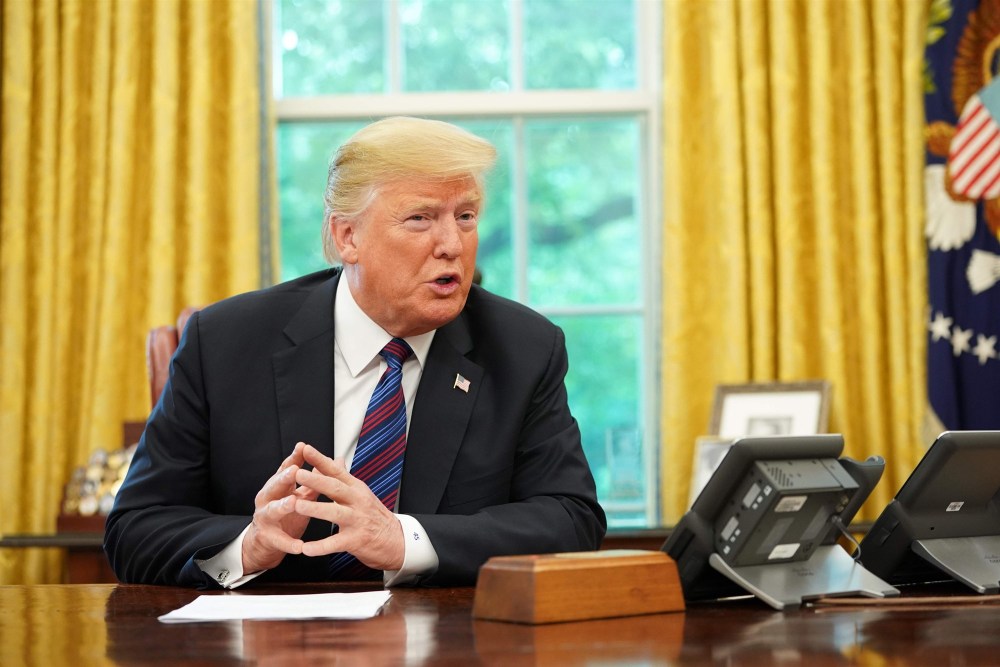
In the modern era, it hasn’t been especially easy for foreign officials to get an American president on the phone. A diplomatic process is supposed to be in place to add layers of security and official accountability to these interactions.
As the Wall Street Journal reported the other day, Donald Trump isn’t overly fond of that process.
World leaders have found a new route to get a read on official U.S. thinking: straight to the top.
Increasingly, savvy leaders are bypassing the standard protocols and government processes of American diplomacy to go directly to President Trump himself, according to current and former officials, allies and foreign-policy experts.
North Korea’s Kim Jong Un, Turkey’s Recep Tayyip Erdogan and Russia’s Vladimir Putin are among the heads of state who have cut out the middle layers of aides and agency officials to talk to Mr. Trump.
It’s an amazing foreign policy dynamic — which the American president has reportedly “encouraged” — with no modern precedent. It’s also a recipe for trouble.
Part of the problem, not surprisingly, is that U.S. officials who work in international affairs sometimes have no idea what their boss has discussed with foreign heads of state. Did Trump, who likes to give his foreign counterparts his personal cell-phone number, endorse proposals his administration opposes? Did he agree to terms that advance our rivals’ interests? Did he agree to diplomatic negotiations? Did he make any promises?
When the people responsible for executing American foreign policy are out of the loop, they can’t do their jobs.
As the WSJ added, “Some aides fret that the personal talks can sow confusion within the administration. At times, senior officials have been left in the dark or had to backtrack on some of Mr. Trump’s remarks.”
But I’m especially interested in why some foreign leaders prefer this approach.
Part of the problem is that officials have come to realize what many American policymakers already know: no one other than Trump can actually speak for Trump. If you’re a foreign head of state who wants a definite answer about the White House’s position, you could talk to an ambassador or another State Department diplomat, and for the last several decades, that would’ve been fine.
But in the Trump era, everyone has seen far too many examples of administration officials articulating the White House’s policy, only to have the amateur president replace that policy with another soon after. A former U.S. official who served under the Trump administration told the Journal that foreign officials have questioned whether conversations they have held with the president’s cabinet were “representative of reality.” The former official added, “They used to tell me, ‘We don’t know what to believe, what is on TV or tweeted,’ ” or what the president’s top advisers say. This is, of course, exactly the opposite of how the preeminent global superpower is supposed conduct a modern foreign policy. But towards the bottom of the article, there was one other sentence of note: “In some cases, leaders think they might be able to get a better deal by going directly to Mr. Trump, according to several administration and foreign officials.” Exactly. It’s not exactly a secret that the first-ever American amateur president is — let’s phrase this in the most charitable way possible — limited in his understanding of current events and substantive policy disputes. Foreign leaders looking for the best possible outcome for their countries often have a choice between speaking to experienced U.S. diplomats — who know what they’re talking about — or calling the reality-television personality who lives in the White House — who can be flattered, cajoled, and manipulated. Who would you call?
Steve Benen is a producer for "The Rachel Maddow Show," the editor of MaddowBlog and an MS NOW political contributor. He's also the bestselling author of "Ministry of Truth: Democracy, Reality, and the Republicans' War on the Recent Past." Recommended


