









President Joe Biden held his latest bipartisan meeting with members of Congress yesterday, and once again stressed his eagerness to work out a deal.
“I am prepared to compromise, prepared to see what we can do and what we can get together on,” the president said at the outset of the discussion. Biden added, “I’ve noticed everybody is for infrastructure. The question is, who’s going to pay for it?”
Republicans appear to have an answer to that question: not their corporate allies. Axios reported overnight:
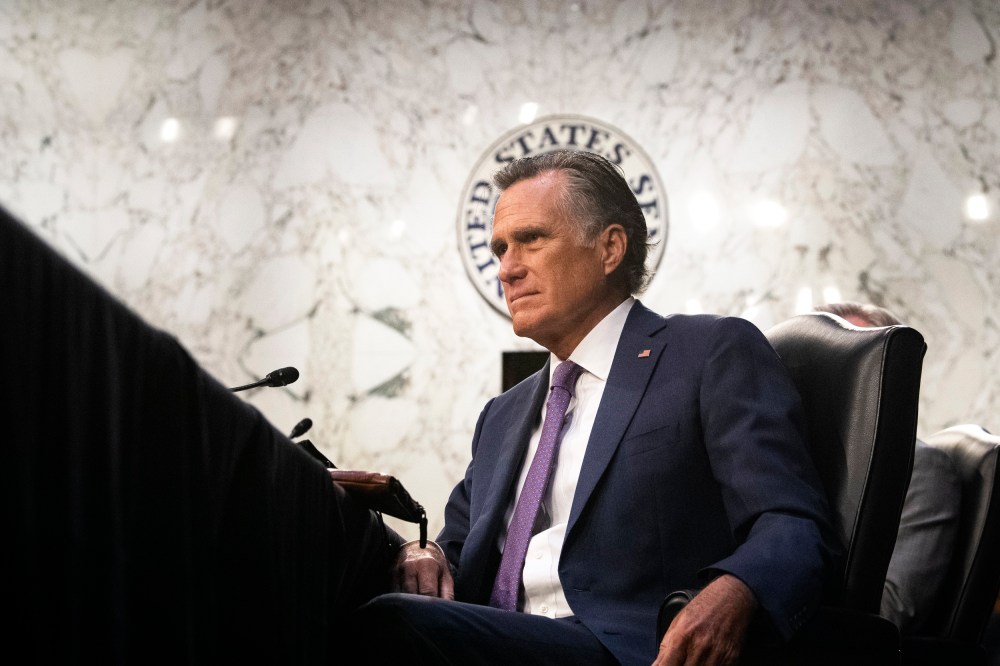
Sens. Mitt Romney (R-Utah) and John Hoeven (R-N.D.) told President Biden Monday they are opposed to increasing the corporate tax rate to pay for his proposed $2.25 trillion infrastructure package, according to people familiar with the matter…. The opposition from Romney and Hoeven, the only two Republican senators in Monday’s bipartisan Oval Office meeting, suggests Biden is going to have a difficult time finding any Republican support to pay for his road, bridge and health care spending proposals by increasing corporate rates.
This comes on the heels of Sen. Shelly Moore Capito (R-W.Va.) describing corporate tax rates as a “non-negotiable red line” for her party. Which came on the heels of Sen. Roger Wicker (R-Miss.) characterizing a corporate tax hike as a deal breaker for GOP senators. Which came on the heels of Sen. Susan Collins (R-Maine) literally laughing out loud at Biden’s tax proposal.
As we’ve discussed, the underlying idea has a lot going for it. Raising the corporate tax rate from 21% to 28% to pay for infrastructure investments is, for example, quite popular with the American mainstream. The idea has also drawn support from Gary Cohn — who helped negotiate the Republican tax plan as the then-director of Donald Trump’s National Economic Council.
Perhaps most importantly, the GOP’s corporate tax cut — the one Democrats intend to scale back in part — set out to achieve certain policy goals, and failed spectacularly.
And yet, as the debate over infrastructure investments begins in earnest, and Republicans explore the possibility of presenting an alternative blueprint that could be used in negotiations, the GOP has apparently decided the obvious financing solution is the one thing the party will not even consider.
As a practical matter, this may prove to be a far bigger problem for Republicans than Democrats. As things stand, Biden wrapped up yesterday’s White House discussion by asking GOP lawmakers to craft a counterproposal to the American Jobs Plan by mid-May. The point, obviously, is to create some kind of framework for negotiations: there can be no search for compromise between one party’s blueprint and another party’s blank sheet of paper. But the presidential request also puts Republicans on the spot, creating a put-up-or-shut-up challenge. If GOP lawmakers want an infrastructure bill — they continue to claim that they do — they should be able to write up some kind of plan, including a realistic price tag and a clear funding mechanism. It’s possible that Biden is entirely sincere, and intends to take seriously whatever Republicans come up with. It’s also possible that Biden realizes that GOP lawmakers will struggle mightily to craft a credible blueprint — it’s not a governing party — and their failure will make it easier for Democrats to advance the White House’s plan through the budget reconciliation process. Either way, the prospects for a meaningful compromise are poor, and the odds of Dems once again concluding that they have no choice but to go their own way are high.
Steve Benen is a producer for "The Rachel Maddow Show," the editor of MaddowBlog and an MS NOW political contributor. He's also the bestselling author of "Ministry of Truth: Democracy, Reality, and the Republicans' War on the Recent Past."
Latest Post
Recommended


