









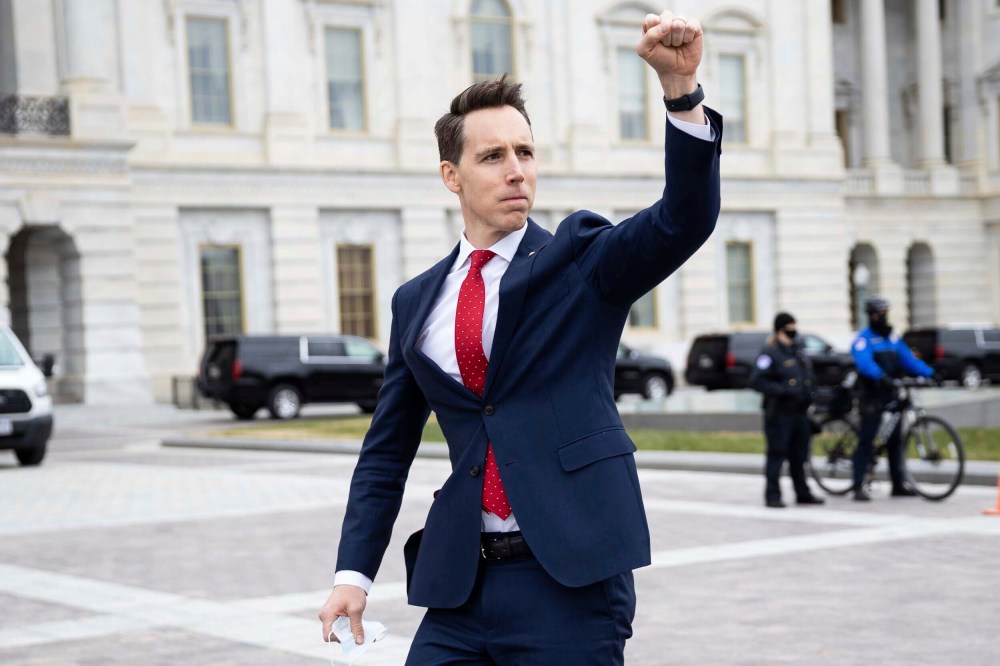

As 2021 got underway, Senate Republican leaders urged their members to be responsible and not try to block Joe Biden’s election victory. Recognizing a partisan opportunity, Sen. Josh Hawley (R-Mo.) ignored the advice in the most performative way possible.
The Missouri Republican got the ball rolling on Dec. 30, announcing his plan to contest election results he didn’t like. Michael Gerson, a former George W. Bush speechwriter, concluded, “The ambitions of this knowledgeable, talented young man are now a threat to the republic.” Sen. Ben Sasse (R-Neb.) added, in reference to Hawley, “Adults don’t point a loaded gun at the heart of legitimate self-government.”
The reactions only seemed to encourage Hawley to go further, and he continued to escalate his anti-election campaign. On Jan. 4, Fox News asked the GOP senator whether he believed Donald Trump would remain president, despite having lost. Hawley replied that “it depends” on what transpired on Jan. 6 — suggesting the outcome of the election was still in doubt. Two days later, the Missourian was also photographed giving an insurrectionist mob a thumbs up and a raised fist in apparent solidarity, shortly before the deadly riot.
Later that day, after the rioters had retreated, Hawley voted not to accept his own country’s election results.
As the Washington Post noted, it was against this backdrop that Hawley spoke at the Conservative Political Action Conference (CPAC), where he elaborated on his perspective.
“We can have a republic where the people rule or we can have an oligarchy where Big Tech and the liberals rule,” Hawley began, suggesting there’s a distinction to be made between “the people” and “the liberals.” But soon after, the Republican made an even more striking argument:
“That’s the fight of our time: to make the rule of the people an actual thing again, to restore the sovereignty of the American people,” he said a bit later.
Pointing to his votes to overturn the election results, Hawley defended his antics by saying “it is the right of the people to be heard.” He added, “What are we fighting for? It’s the same thing our Founding Fathers fought for. We’re fighting for the rule of the people.”
Note the repetition of a specific two-word phrase: “the people” must rule, “the people” must be heard, the sovereignty of “the people” must be protected, etc.
At first blush, the message seems ridiculous given the messenger: Hawley balked at his own country’s election results because “the people” had the temerity to vote for a candidate he didn’t like.
But from his perspective, there is no contradiction because when he refers to “the people,” Hawley almost certainly means his people. The GOP senator argued a few weeks ago, for example, that he sees himself as “accountable” specifically to Republican voters. MSNBC’s Chris Hayes added soon after, “[Hawley’s] speaking here not about being a U.S. Senator who is accountable to the voters — all of them — of his state of Missouri. No, he’s saying the Party is what matters here, and the Party is run by its voters and so that is who he is accountable to…. Hawley is making it explicit here that he sees himself fundamentally as a party functionary, not a member of the representative government.” In this light, the logic behind Hawley’s absurd rhetoric starts to come into focus: protecting “the rule of the people” means protecting election results in which Hawley is satisfied with the outcome. As far as democracy is concerned, however, there’s no need to “restore” the rule of the people because the election results already reflect the people’s will. This happened despite Hawley, not because of him.
Steve Benen is a producer for "The Rachel Maddow Show," the editor of MaddowBlog and an MS NOW political contributor. He's also the bestselling author of "Ministry of Truth: Democracy, Reality, and the Republicans' War on the Recent Past."
Latest Post
Recommended


