We’ve been having a long-running discussion in the office lately about whether NASA’s Voyager 1 spacecraft has left the solar system — or not.
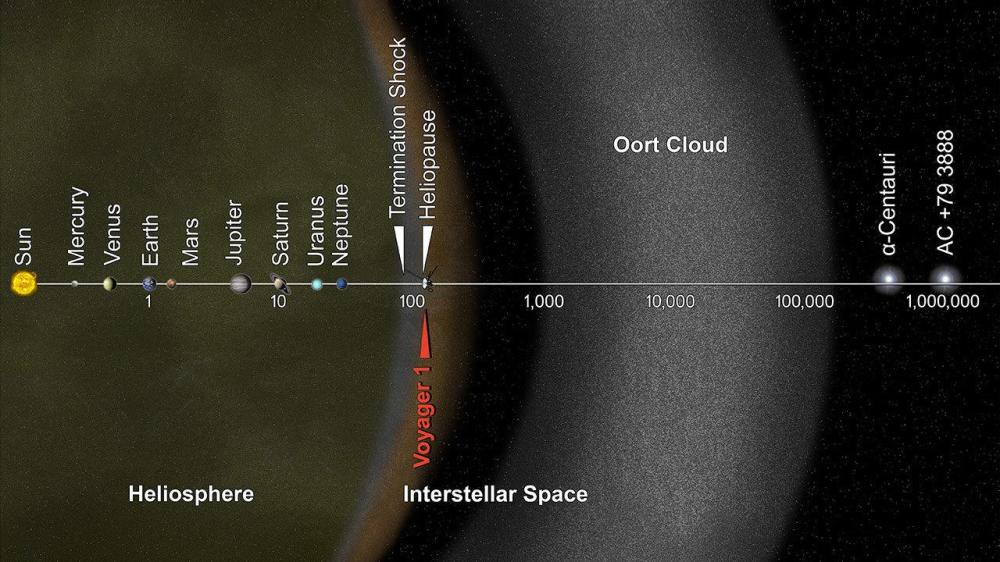
Luckily for us, our in-house astrophysicist stopped by Bill’s office to explain. As you can see from Summer Ash in the video below, the short answer is no, Voyager 1 has not left the solar system. It has left the familiar planets behind, but, despite what your science teacher might have told you, Neptune and Pluto are not the end of our solar neighborhood.
Summer sketched that out for us on the whiteboard, and then she sent along a deeper explanation (and charts!). Summer writes:
“While Voyager hasn’t yet left the Solar System, it still passed an important milestone — entering INTERSTELLAR space. This means that the spacecraft, launched in 1977, has left the bubble made by the Sun’s magnetic field as moves among the other stars in our galaxy. This sphere of influence is called the heliosphere (we astronomers call ’em like we see ’em). Inside the heliosphere, charged particles from the Sun stream out in all directions as the solar wind at speeds up to millions of miles per hour. Outside the heliosphere, the density of these particles drops sharply as they mix with the clouds of hydrogen and helium atoms that fill the space between the stars.
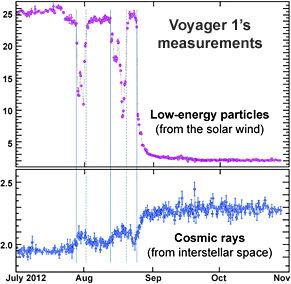
“Last August, Voyager began to send back data that indicated the spacecraft was approaching and subsequently passing through this transition. For the data geeks among you, this graph plots solar wind particle per second versus time (top) and cosmic ray particles per second versus time (bottom).
“Both show a transition period from August to September of 2012. NASA scientists perused this data over the past year (along with some new data this past spring), and they now believe it’s evidence that Voyager 1 has indeed left the heliosphere. “As you can see from the graph, the transition isn’t smooth; it’s theorized that particles and magnetic fields from interstellar space can infiltrate the heliosphere and pockets of particles and magnetic fields from the solar neighborhood can leak out, but at some point on either side of the heliosphere the former or the latter dominates. “Voyager 1 is currently traveling at approximately 38,000 mph. So will just shy of 100,000 AU (or just under a quadrillion miles) to go, it will indeed leave the Solar System one day — about 10 million of them from today. So check back here in 30,000 years for the latest.” Thanks, Summer. We’ll be back for that update in 32,013.
The place for in-depth analysis, commentary and informed perspectives. Recommended