








Every Democratic presidential candidate faces a challenge for which there is no obvious solution: many voters are going to ask how, exactly, they intend to advance their policy agenda in a political environment in which progressive legislating is effectively impossible.
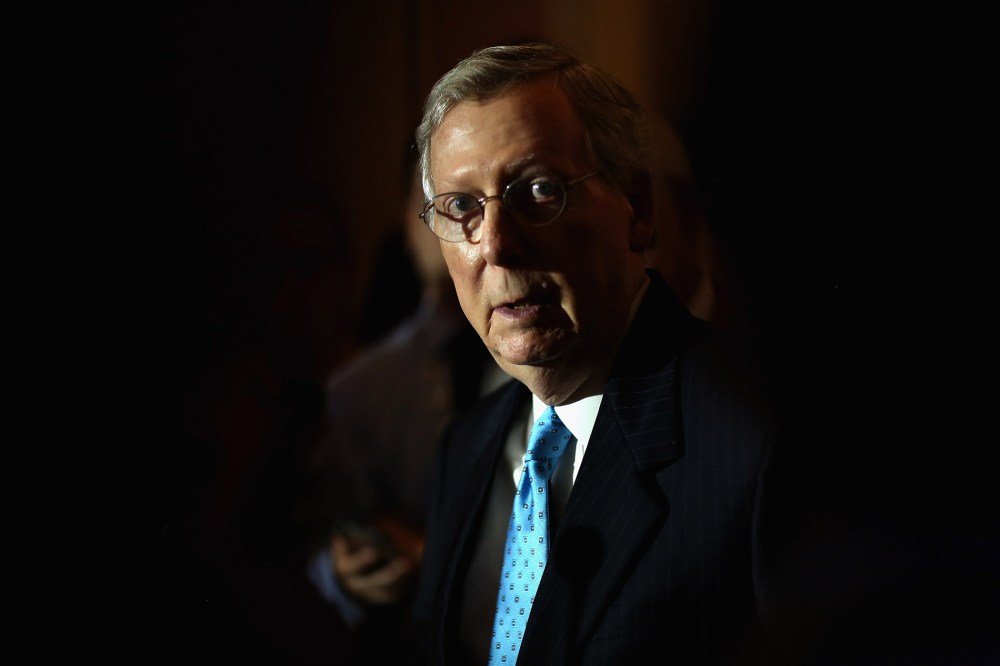
Presidential hopefuls can’t simply say, “You’re right, Mitch McConnell will veto my agenda even if there’s a Democratic Congress, but I hope you’ll vote for me anyway.” But avoiding that kind of candor leaves 2020 candidates with a narrower set of options.
Former Colorado Gov. John Hickenlooper, the newest Democratic presidential hopeful, believes he knows what will work.
“When I come into office, I would go to Mitch McConnell to his office and I would sit down with him and say, ‘Now what is the issue again?’ and we would talk and I would continue to speak back to him — it sounds silly, right? But this works….”
I wish that were true. It’s not.
To be sure, the former governor’s approach sounds compelling, and it’s based on an assumption that Senate Republicans and their leaders have consistent policy goals. GOP policymakers, the argument goes, want to govern responsibly, which necessarily means a determined Democratic president, committed to bipartisan cooperation, can succeed by engaging in good-faith negotiations.
That may be a description of how the process should work, but to understand contemporary politics at the federal level is to realize that the fantasy isn’t real.
Indeed, Mitch McConnell, to his credit, has been candid about his tactics to a degree that is often overlooked. The Kentucky Republican acknowledged in 2010, for example, that he and his party made a conscious choice to reject any and all attempts at bipartisanship during the Obama era.
It was the same year in which McConnell identified his party’s principal focus. Solving problems? Helping the public? Not even close: “The single most important thing we want to achieve is for President Obama to be a one-term president.”
The comments made clear that the GOP Senate leader didn’t want Barack Obama to succeed; he wanted Barack Obama to lose. In practical terms, that meant rejecting the Democratic president’s agenda, denying him any bipartisan victories, slapping away Obama’s outstretched hand, and creating as much partisan gridlock as humanly possible. My point is not to single out John Hickenlooper for criticism. He is, after all, not only the only one who’s made this mistake. Rather, I emphasize this because everyone involved in the process — Democratic candidates, voters, media professionals covering the 2020 race, et al — need to better understand the driving motivations in contemporary Republican politics. The GOP of the 21st century is not a governing party; it is a post-policy party, indifferent to substance, and overtly hostile toward compromise. If a presidential hopeful’s plan for success is predicated on constructive chats with Mitch McConnell, persuading him to see the merits in Democratic proposals, that candidate needs a different plan. Those who see this as needlessly cynical, and who believe McConnell and his cohorts can be moved by way of friendly conversations, should give Barack Obama a call.
Steve Benen is a producer for "The Rachel Maddow Show," the editor of MaddowBlog and an MS NOW political contributor. He's also the bestselling author of "Ministry of Truth: Democracy, Reality, and the Republicans' War on the Recent Past." Recommended


