








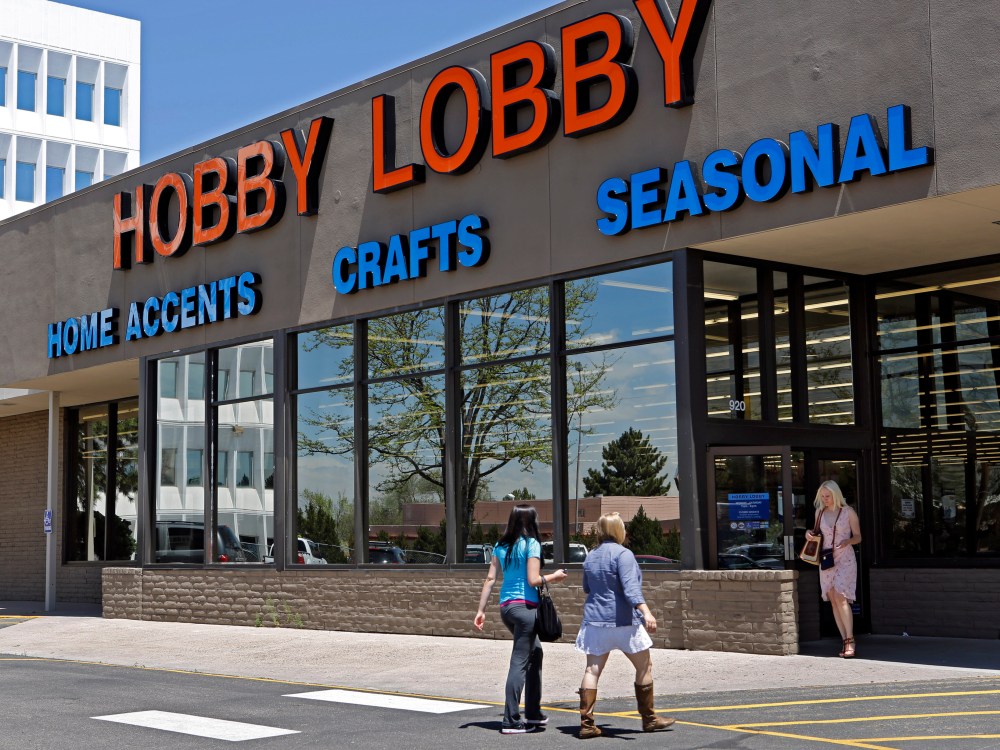
First up from the God Machine this week is a major national retailer with a religious agenda, which is becoming famous for all the wrong reasons.
Hobby Lobby, an arts-and-crafts chain owned by conservative billionaire Steve Green, generated headlines recently when it filed an anti-contraception lawsuit, arguing that since the company’s leaders opposed birth control, it should be able to restrict contraception access among Hobby Lobby employees. The business’ lawyers have said corporations are people with religious liberty, and contraception access under the Affordable Care Act conflicts with Hobby Lobby’s spiritual beliefs.
This week, however, Hobby Lobby was at the center of a different controversy when Jewish customers claimed the chain will not carry merchandise related to Hanukkah. One New Jersey customer, Ken Berwitz, claims he asked a store clerk about bar mitzvah cards, and a Hobby Lobby salesperson replied, “We don’t cater to you people.”
It sparked a larger controversy, which Hobby Lobby tried to resolve yesterday (thanks to reader R.P. for the tip).
Steve Green told The Associated Press that the Oklahoma City-based chain is looking at carrying items this holiday season in stores near areas with large Jewish populations. He could not yet say what the items will be, but he said they should be in stores by November. The company said the items will be sold in stores in New York and New Jersey.
“We do not have any problems selling items that celebrate Jewish holidays,” Green said. “We have in the past and have decided we would try it again in some of the markets where we have Jewish population.”
Though the issue now appears to be nearing a resolution, when it comes to the culture war, it looks like Hobby Lobby is quickly joining outlets like Chick Fil A as private chains making a larger religio-political footprint.
Also from the God Machine this week:
* A public middle school in Ohio finally agreed this week to remove a portrait of Jesus from school property. It will, however, have to pay nearly $100,000 in local taxpayer dollars in legal fees after initially resisting church-state separation.
* Speaking of church-state trouble, an Alabama town suffering through a terrible crime wave has launched “Operation Good Shepherd,” in which the town of Montgomery will spend taxpayer money to bring Christian pastors to crime scenes to counsel and pray with victims and witnesses. Local officials hope government-sponsored evangelism may reduce crime rates. * And speaking of Alabama, a public high school near Mobile asked a former University of South Alabama professor to teach Arabic as an elective, alongside Spanish, Mandarin Chinese, and Japanese. This has not gone over well with local Christian culture warriors. * The Family Research Council, a powerhouse in the religious right movement, has begun promoting its upcoming “Values Voter Summit,” and its materials are relying on a James Madison quote that was debunked nearly 20 years ago. * And radical TV preacher Pat Robertson told an elderly woman this week that she would have fewer financial and health problems if she gave more money to her church in the form of tithing.
Steve Benen is a producer for "The Rachel Maddow Show," the editor of MaddowBlog and an MS NOW political contributor. He's also the bestselling author of "Ministry of Truth: Democracy, Reality, and the Republicans' War on the Recent Past." Recommended


